Foundation History
One of the oldest American foundations, the Russell Sage Foundation was established in 1907 for “the improvement of social and living conditions in the United States” by a gift of $10 million from Margaret Olivia Slocum Sage (1828–1918), widow of railroad magnate and financier Russell Sage. Mrs. Sage directed the foundation to pursue its mission through a broad set of activities, including “research, publication, education, the establishment and maintenance of charitable or benevolent activities, agencies and institutions, and the aid of any such activities, agencies, or institutions already in existence.”

Margaret Olivia Sage
Also known as Olivia Sage (September 8, 1828 – November 4, 1918), was an American philanthropist known for her contributions to education and progressive causes. In 1869 she became the second wife of industrialist Russell Sage. At his death in 1906, she inherited a fortune estimated at more than $63,000,000, to be used at her discretion.
A former teacher, Sage strongly supported education, both with program and building grants to Syracuse and other universities. She established the Russell Sage Foundation in 1907 and founded Russell Sage College in 1916, as well as endowing programs for women.
Letter of Gift
To the Trustees of Russell Sage Foundation:
I have transferred to Russell Sage Foundation…a fund, the principal of which…shall be held, and the income thereof applied to the improvement of social and living conditions in the United States of America...
The scope of the Foundation is not only national but is broad. It should, however, preferably not undertake to do that which is now being done or is likely to be effectively done by other individuals or by other agencies. It should be its aim to take up the larger and more difficult problems, and to take them up so far as possible in such a manner as to secure co-operation and aid in their solution...
Yours sincerely,
Margaret Olivia Sage
New York, April 19, 1907
Historical Timeline
April 19, 1907
Margaret Olivia Sage (1828-1918) establishes the Russell Sage Foundation as the nation’s first general purpose foundation with an initial gift of $10 million, part of the fortune she inherited upon the death of her husband, Russell Sage, in 1906. Mrs. Sage directs the new foundation to pursue research and programs for the improvement of social and living conditions in the United States of America.
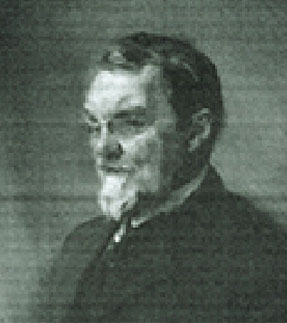
Robert W. De Forest played a large role in shaping the Foundation’s early undertaking as Mrs. Sage’s attorney, her most trusted advisor, and as an influential member of the board of trustees. A leader of the New York Charity Organization Society, de Forest guided the Foundation towards efforts to understand and alleviate the conditions that cause poverty, rather than providing direct assistance to the poor.
May 1907
The Foundation funds the Pittsburgh Survey, the first systematic effort to survey the employment and living conditions among the working class in a large U.S. city. The findings inspire reforms regulating working conditions and the employers’ liability system, and help end twelve-hour days and seven-day weeks for steel workers.
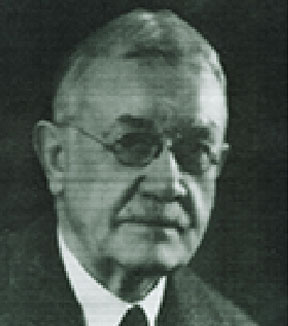
John Glenn, RSF’s first general director, 1907-1931.
1907-1914
The Foundation sponsors early research on programs in housing, public health, working conditions, education, consumer credit, industrial relations, social surveys, and social statistics. These programs lead to legal reforms in building codes, workplace health and safety regulations, workmen’s compensation and anti-usury laws.
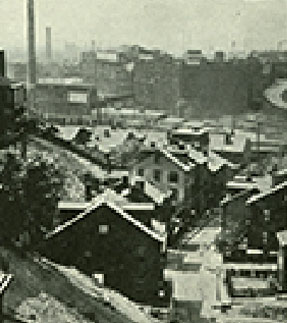
“Homes of the Tax Burden Bearers,” by Lewis W. Hine, from the series of photos commissioned by the foundation to illustrate the findings of the Pittsburgh Survey.
1910
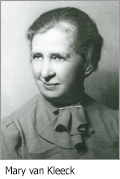
Mary van Kleeck joins RSF's Department of Industrial Studies to study the working conditions of women. Her book Women in the Bookbinding Trade leads to legislation banning the employment of women in factories between 10 p.m. and 6 a.m. Over the next 45 years, Van Kleeck builds a remarkable record of industrial relations research at Russell Sage, conducting studies of working conditions, unemployment, collective bargaining and economic planning.
1912
At Mrs. Sage’s direction, the Foundation erects its headquarters building just north of Gramercy Park to house its expanding research operations. Designed by Grosvenor Atterbury in Italian Renaissance style, the nine-story building is decorated with carved panels symbolizing Service flanked by Study and Counsel, Religion, Education, Civics, Justice, Health, Work, Play and Housing.
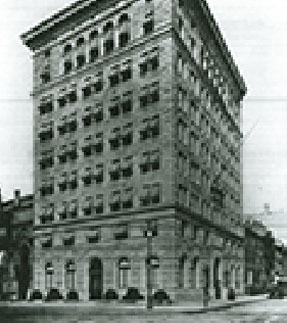
The Foundation’s headquarters, built in 1912.
1909-1922
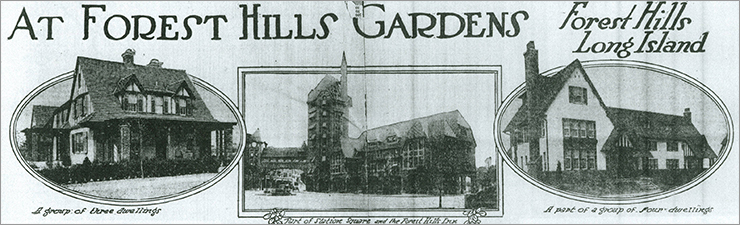
RSF expends nearly a sixth of its capital to build Forest Hills Gardens, a model suburban community for working families designed by architect Fredrick Law Olmstead. The grand aim was to demonstrate the possibilities of intelligent town planning for moderate cost housing close to a major urban center. The architecture was a great success, but the housing prices soon soared beyond the range of the families they were intended for, and the Foundation lost a significant part of its investment.
1917
RSF publishes Social Diagnosis, Mary Richmond's classic text on social work. Head of the Foundation's Charity Organization Department since 1909, Richmond orchestrates RSF's long-standing efforts to support private social service agencies, rationalize their operations and improve case work methods. These efforts culminate in the 1930s, when the Foundation provides space in its own building for the New York School of Social Work and gives key support for other fledgling schools of social work around the country.
1921-1931
RSF supports the New York Regional Urban Planning Project, "to visualize the commercial, the industrial, the social and the artistic values and possibilities of our glorious harbor and of all [its] broad and varied environs." The project becomes the Regional Plan Association of New York, responsible for coordinating policies for urban planning in the New York City area.
1931-1948
In charge of the statistical work for the Pittsburgh Survey in the early days of the Foundation, and later head of the Department of Exhibits and Surveys, Shelby Harrison takes over as second general director of the Foundation.
1935
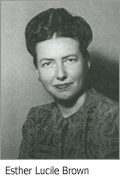
Esther Lucile Brown, a member of the Foundation's Department of Statistics, produces a study on Social Work as a Profession. Over the next three years, she releases reports on the professions of engineering, nursing, medicine, and law. In 1944, the Department of Studies in the Professions is established, headed by Brown.
1945-1948
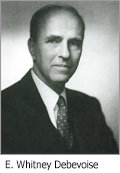
Trustee E. Whitney Debevoise spearheads a major overhaul of the Foundation's mission and institutional identity. Using a military metaphor in the wake of World War II, RSF declares a redeployment of its intellectual and capital resources to the second trench. Henceforth, the Foundation will work to strengthen the basic capacities of social science in order to provide intellectual and scientific support for efforts to design and implement social policy on the Afront lines. The Foundation phases out all existing grants and direct financial support for charitable organizations, the original building is sold, and staffing is reduced.
1948-1963
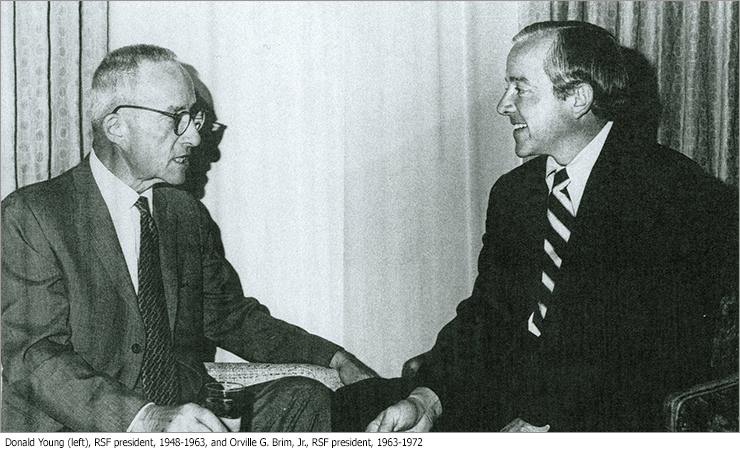
Donald Young, formerly a professor of sociology at the University of Pennsylvania and Director of the Social Science Research Council assumes the presidency of RSF and develops its new research agenda. The Foundation focuses on applying social science to the professions of medicine, law, social work, and to the arts of social practice more generally. Under Young, and later Orville Brim, RSF begins to develop a new role as a linking institution, connecting the growing enterprise of university-based social science to the social issues of long-standing concern to the Foundation.
1950
In collaboration with the Social Science Research Council, the Foundation publishes a series of 17 monographs analyzing social and demographic data from the 1950 census. The decennial Acensus series becomes a tradition at Russell Sage; for every census thereafter, except 1970, the Foundation publishes reports on the economic and social condition of the country based on the statistics available in the census.
1950s
Under the direction of F. Emerson Andrews, the Foundation begins a series of studies of philanthropy: Philanthropic Giving (1950), Corporation Giving (1952), Attitudes Toward Giving (1953), Legal Instruments of Foundations (1958). This work on philanthropy leads eventually to RSF's support for the publication of the Foundation Directory and the establishment of the Foundation Center, both key resources in making the world of American foundations more intelligible and accessible.
1962
Donald Young inaugurates a program on social science and the mass media in the hopes of fostering more informed and accurate reporting on the social sciences by professional journalists.
1963-1972
Orville Brim serves as president of RSF. Brim extends research on the professions to include journalism and the military, and inaugurates diverse new areas of research, including life-span development and aging, mental testing and human resource management, techniques for evaluating social programs, the development of social indicators, and even behavioral biology.
1963
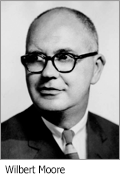
Brim's first staff appointment, Princeton sociologist Wilbert Moore, helps solidify the Foundation's reputation as a research institute. Moore works with staff member Eleanor Bernert Sheldon to explore the possibility of developing a national battery of social indicators. Their pioneering work is published in Indicators of Social Change in 1968 and leads eventually to the development of the General Social Survey.

1963-1969
The Foundation initiates a series of studies of the social and educational effects of standardized testing under the direction of staff member David Goslin. The resulting RSF volumes include Goslin's Search for Ability, Brim et. al.'s American Beliefs and Attitudes about Intelligence, and David Armor's American School Counselor.
1964
Under staff member Leonard Cottrell, and later Stanton Wheeler, the Foundation's effort to extend social science to the study of legal institutions become RSF's largest program and succeeds in creating a new interdisciplinary field. With seed money from Russell Sage, the Law and Society Association—and its affiliated journal, the Law & Society Review—is launched.

1966
The Foundation’s prior focus on social science and medicine evolves toward more basic support for the developing field of behavior genetics. Russell Sage partners with Rockefeller University to select candidates for joint training in biology and the social sciences. A prominent result of this initiative is the three-volume Biology and Behavior Series published jointly by Russell Sage and the Rockefeller University.
1967
The Foundation's Visiting Scholars program is inaugurated with the appointment of Alex Inkeles (Stanford) and Robert K. Merton (Columbia). Other visitors in the early years of the program include futurist Alvin Toffler, sociologist Daniel Bell and Public Interest editor, Irving Kristol.
1970
Capping the studies of the professions inaugurated by Young and carried out under Brim, Wilbert Moore's The Professions is published.
1970-1971
As part of an evaluation of the quality of RSF's programs, Brim opens RSF files to a group of radical New Left sociologists. They criticize the Foundation for focusing on applied research rather than supporting direct action programs, and for the lack of attention to powerless groups in American society. Brim's own approach to evaluating foundation programs appears in his classic essay archly titled Do We Know What We Are Doing?
1972-1976
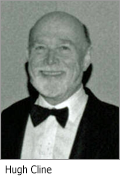
Hugh Cline serves as RSF president. During his tenure RSF focuses on improving measurements and methods of analyzing social change. The Foundation also sponsors research on the evaluation of governmental and non-governmental social programs. Cline extends the effort carried out by Young and Brim to explore more effective ways of communicating the findings of social science to policymakers and others outside academia.
1974
RSF launches new research programs on civil liberties and social control to study the attitudes and behavior of the general publicY toward general and specific topics of freedom and control, and on the changing social roles ascribed to individuals on the basis of gender, race, and ethnicity.
1979
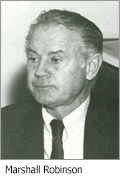
After a period of administrative upheaval at Russell Sage in the late 1970s, Ford Foundation economist Marshall Robinson assumes the presidency of RSF and establishes new research programs on the social impact of changing gender roles, the growth of procedural complexity in the organization of economic and social activity, and the assessment, management, and public perception of risk.
1982
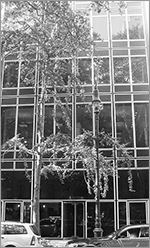
The Foundation establishes its new headquarters on East 64th Street in the former home of the Asia Society, designed by distinguished American architect, Philip Johnson.
1982
The Foundation's research program on the impact of gender role change focuses on institutional responses to efforts to expand opportunities for women. With support from the Carnegie Corporation, the Ford Foundation and Russell Sage, a task force under the direction of resident scholar Mariam Chamberlin is formed to chart the progress of women in higher education and examine the impact of changing gender roles on institutions of higher learning.
1983-1993
After skipping the 1970 Census, RSF again collaborates with SSRC to study the results of the 1980 Census. The Foundation publishes an authoritative 17-volume series on social, cultural, and economic trends in the U.S. revealed by the Census.
1986
Eric Wanner, a social psychologist and vice president at the Sloan Foundation, is appointed president of RSF. The Foundation launches several new research initiatives, redesigns the Visiting Scholar program to permit open application and to foster collaborative groups, and overhauls the book publishing program to give the Foundation's research wider distribution and greater public impact.

1987
Continuing its tradition of support for promising inter-disciplinary research, the Foundation announces a joint program of research with the Sloan Foundation in behavioral economics, examining the consequences of incorporating more realistic accounts of human decision making into economic models of market behavior. A second new program returns the Foundation to its earliest concerns with the plight of the poor, supporting research on the causes of the persistence of poverty and the rise of economic inequality in the U.S. despite robust economic growth.
1988
Maintaining the Foundation's long-standing interest in strengthening the methodological equipment of social science, RSF provides support to encourage the use of state-of-the-art methods in quantitative research synthesis, which allow reliable conclusions to be drawn from multiple studies of a given social intervention or program.

1990
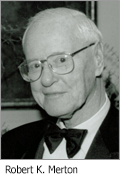
Robert K. Merton becomes the first Foundation Scholar at Russell Sage, recognizing his long and invaluable service as an advisor to the administration and a mentor to so many visiting scholars. In 2000, Robert M. Solow becomes the second Foundation Scholar, following Merton’s retirement. In 2003, the position is renamed the Merton Scholar, in memory of the Foundation’s invaluable friend.
1991
RSF inaugurates a new program of research on immigration to investigate how well immigrants and their children are adapting socially and economically to life in the U.S. The program is designed to examine speculation that non-European families in the current immigrant cohort might not duplicate the inter-generational progress of European immigrants in the great wave of immigration at the beginning of the twentieth century.
1992
A program is formed to study contact among cultures within the increasingly diverse American population. In its initial stage the program examines problems of racial and ethnic discrimination; subsequently, the program evolves to study the frictions that arise as American institutions like schools, health care facilities, and the legal system adapt to a more diverse clientele.
1992-2000
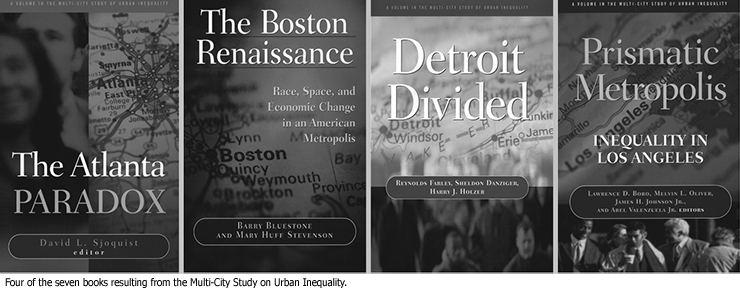
Working jointly with the Ford Foundation, RSF conducts the Multi-City Study of Urban Inequality, which examines the economic problems of the poor in four of America's largest cities. Echoing the Pittsburgh Survey, the Multi-City Study attempts to determine whether high rates of unemployment in the inner city are due to residential segregation, labor market discrimination, the flight of employers to the suburbs, or poor educational preparation. The results are published in seven RSF books and over a dozen doctoral dissertations.
1993
The Foundation establishes the Behavioral Economics Roundtable, a group of leading behavioral economists elected by grantees in the program and charged to design initiatives to advance the this new interdisciplinary field. The most successful of the Roundtable's several initiatives is its summer institute, run in alternate years since 1994 to provide an introduction to the field for young investigators.
1994
The Foundation's program of research on poverty is refocused specifically on an examination of the causes and consequences of the long-term decline in availability and quality of jobs for workers with limited education. Renamed the Future of Work and undertaken jointly with the Rockefeller Foundation, the program supports extensive case studies of nearly 500 establishments in 25 industries to assess the changing competitive pressures on American firms, the ways in which firms responded by restructuring work, and the consequences for the quality of low-wage jobs. More recently, the Foundation has undertaken a comparative study of low-wage jobs in five European countries to compare the restructuring of work and the quality of low-wage jobs in different national institutional environments.
1999
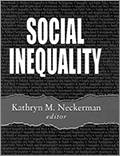
In partnership with the Carnegie Corporation, RSF launches a special project on Social Inequality to explore the social repercussions of rising economic inequality in such areas as family formation and functioning, the resources available to children, education from pre-school to college, health care and insurance coverage, political participation and representation, and involvement with the criminal justice system. The project is designed to determine whether families who are falling behind economically are also falling behind in other ways that will make it difficult for them to keep pace in the future.
2000
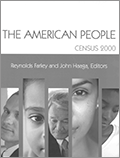
Extending the trend toward lighter, faster reports on the decennial census, the 2000 project focuses on promoting public awareness of the census results and their societal implications. With the Population Reference Bureau, RSF produces a series of 14 reports on what the census reveals about issues such as work, gender, immigration, and racial inequality. Two major volumes are commissioned framing the results of the 2000 census within a long, historical view of the statistical trends in American society over the course of the 20th century. RSF also funds an online guide to the census for journalists, a web-based survey of public participation in the census, and a study of the impact of the Census Bureau's decision to allow respondents to identify as multiracial.
2002
Prompted by the terrorist attacks of September 11, 2001, RSF develops several lines of research to examine the nature of social and political life after September 11. The initiatives include studies of New York City’s recovery from the attack on the World Trade Center, field studies of Muslim- and Arab-American communities in the U.S., and a standing committee to monitor the effects of the war on terror on the relationship between national security concerns and the protection of civil liberties.
2007
The Foundation celebrates its centennial with a day-long symposium focused on some of the principal issues which have concerned the Foundation over its long history, including the plight of low-wage workers, the stratification of American society, immigration and diversity in the United States, and the role of social science in addressing these issues.

2013
Sheldon Danziger, the Henry J. Meyer Distinguished University Professor of Public Policy at the Gerald R. Ford School of Public Policy and director of the National Poverty Center at the University of Michigan, is appointed president of RSF.

2014
In 2014, the Russell Sage Foundation launched research collaborations with the W.K. Kellogg Foundation and the John D. and Catherine T. MacArthur Foundation. Over the last two years, 7 projects have been co-funded with the Kellogg Foundation and 9 projects have been co-funded with the MacArthur Foundation.
Also in 2014, the Russell Sage Foundation launched a study with the Washington Center for Equitable Growth that examined how differences in home environments may play a role in explaining the skills gaps, and whether home environments, especially for disadvantaged children, are deteriorating relative to those of affluent children over time.


2014-2016
The Foundation enters into research collaborations with a number of other foundations on a variety of topics related to its core interests. Co-funders include the Carnegie Corporation; the William T. Grant Foundation; the W.K. Kellogg Foundation; the MacArthur Foundation; the Robert Wood Johnson Foundation; The Spencer Foundation; and the Washington Center for Equitable Growth.
2015
In 2015 the Russell Sage Foundation partnered with the Robert Wood Johnson Foundation on an initiative exploring the social, economic and political effects of the Affordable Care Act (ACA). Research funded through this collaboration addresses important questions about the consequences of health care reform in the U.S.—from financial security and family economic well-being, to labor supply and demand, participation in other public programs, family and children’s outcomes, differential effects by race/ethnicity/nativity or disability status, and politics and views of government.

2016
In 2016, the Russell Sage Foundation partnered with the William T. Grant Foundation to build the Stanford Education Data Archive, a data archive developed by Sean Reardon and colleagues that covers every public school and school district in the United States, and to co-fund two rounds of small grants for research projects that analyze these data to deepen our understanding of educational opportunity and success.

2017
In 2017, the foundation partnered with the Carnegie Corporation to launch a special initiative on Immigration and Immigrant Integration and with the Ford Foundation to launch a special initiative on Integrating Biology and Social Science Knowledge. RSF also partnered with the Robin Hood Foundation for a forthcoming RSF journal issue on anti-poverty initiatives in the U.S. and with the Bill & Melinda Gates Foundation for a RSF journal issue on using administrative data for science and policy.

2018
In 2018, the foundation partnered with the JPB Foundation in the special initiative on Integrating Biology and Social Science Knowledge (BioSS). This joint initiative supported new research and training on how individual biological processes interact with the social environment and influence the ways that social inequalities are initiated, maintained, and transmitted from one generation to the next.
In 2018, the foundation extended its partnership with the William T. Grant Foundation to co-fund two additional rounds of Educational Opportunity Monitoring Grants.
2019
In 2019, the foundation partnered with the Economic Mobility and Opportunity program at the Bill & Melinda Gates Foundation to launch the Pipeline Grants Competition. This program funds projects by early-career researchers in an effort to promote diversity in the social sciences broadly, including racial, ethnic, gender, disciplinary, institutional, and geographic diversity. The foundation also partnered with the Sloan Foundation for an RSF journal issue on U.S. labor market trends in the twenty-first century and the growing disparities among American workers.
2020
In 2020, the foundation partnered with the Carnegie Corporation of New York for an RSF journal issue on the historical and contemporary landscape of legal immigration to the United States.
2021
In 2021, the foundation partnered with the JPB Foundation for a second time to co-fund projects that focused on the social, political, economic, and psychological consequences of the COVID-19 pandemic, as well as research projects on systemic inequality and the mass anti-racism protests in 2020. The foundation also partnered with the Rockefeller Brothers Fund for an RSF journal issue on the legacy of the Plessy v. Ferguson Supreme Court ruling.
2022
In 2022, the foundation partnered with the W.E. Upjohn Institute for Employment Research to fund additional Dissertation Research Grants focused on employment-related topics. Additionally, the foundation partnered with the Doris Duke Charitable Foundation for an RSF journal issue on the changing natures of work and family in the United States.
Archives
The Russell Sage Foundation archives reside at the Rockefeller Archive Center. Prospective researchers should contact the Center for further information.
More About Our History
The Russell Sage Foundation Centennial, 1907-2007
On Thursday, April 19, 2007, the Russell Sage Foundation celebrated the 100th anniversary of its founding by Mrs. Margaret Olivia Sage in 1907. To mark the occasion, the Foundation held a day-long symposium focused on some of the principal issues that have concerned the Foundation over its long history—and which continue to engage RSF as it moves into its second century.
Historical Leadership at the RSF
View all of our former and current Presidents, Chief Operating Officers, and Trustees.