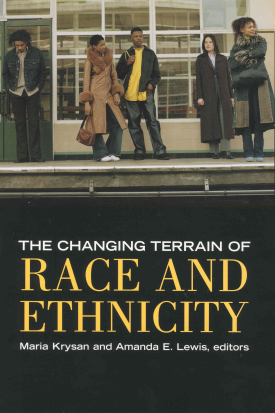
The Changing Terrain of Race and Ethnicity
About This Book
"Anyone who wants to gain an authoritative understanding of what race and ethnicity mean in the contemporary United States should read this book. The facts are here, along with some theoretical perspectives that will help us to interpret them. A recurrent theme of the essays is that racism has not died and been replaced by genuine color-blindness, as some recently have claimed, but has taken on insidious new forms. The authors demonstrate statistically and in other ways that 'structural' or 'systemic' inequality based on race or color has not only persisted but in some respects gotten worse in the last two or three decades. The issues raised by the distinguished sociologists and other scholars who have contributed to this volume require the urgent attention of all Americans who aspire to create a more just and equal society."
-GEORGE M. FREDRICKSON, Edgar E. Robinson Professor of History Emeritus, Stanford University
"A collection of remarkably well-integrated research articles and theoretical essays on how the meanings, uses, and practices of race are constantly evolving. Highly recommended."
-TROY DUSTER, professor of sociology, New York University, and president, American Sociological Association
The legal institutions of overt racism in the United States have been eliminated, but social surveys and investigations of social institutions confirm the continuing significance of race and the enduring presence of negative racial attitudes. This shift from codified and explicit racism to more subtle forms comes at a time when the very boundaries of race and ethnicity are being reshaped by immigration and a rising recognition that old systems of racial classification inadequately capture a diverse America. In The Changing Terrain of Race and Ethnicity, editors Maria Krysan and Amanda Lewis bring together leading scholars of racial dynamics to study the evolution of America’s racial problem and its consequences for race relations in the future.
The Changing Terrain of Race and Ethnicity opens by attempting to answer a puzzling question: how is it that so many whites think racism is no longer a problem but so many nonwhites disagree? Sociologist Lawrence Bobo contends that whites exhibit what he calls “laissez faire racism,” which ignores historical and structural contributions to racial inequality and does nothing to remedy the injustices of the status quo. Tyrone Forman makes a similar case in his chapter, contending that an emphasis on “color blindness” allows whites to be comforted by the idea that all races are on a level playing field, while not recognizing the advantages they themselves have reaped from years of inequality. The book then moves to a discussion of the new ways that Americans view race. Eduardo Bonilla-Silva and Karen Glover argue that the United States is moving from a black-white divide to a tripartite system, where certain light-skinned, non-threatening minority groups are considered “honorary whites.” The book’s final section reexamines the theoretical underpinnings of scholarship on race and ethnicity. Joe Feagin argues that research on racism focuses too heavily on how racial boundaries are formed and needs to concentrate more on how those boundaries are used to maintain privileges for certain groups at the expense of others. Manning Marable contends that racism should be addressed at an institutional level to see the prevalence of “structural racism”—deeply entrenched patterns of inequality that are coded by race and justified by stereotypes.
The Changing Terrain of Race and Ethnicity provides an in-depth view of racism in modern America, which may be less conspicuous but not necessarily less destructive than its predecessor, Jim Crow. The book’s rich analysis and theoretical insight shed light on how, despite many efforts to end America’s historic racial problem, it has evolved and persisted into the 21st century.
MARIA KRYSAN is associate professor of sociology in the Department of Sociology. She is a fellow at the Institute for Research on Race and Public Policy, University of Illinois, Chicago.
AMANDA E. LEWIS is assistant professor in the Departments of Sociology and African American Studies at the University of Illinois, Chicago. She is a fellow at the Institute for Research on Race and Public Policy, University of Illinois, Chicago.
CONTRIBUTORS: Lawrence D. Bobo, Eduardo Bonilla-Silva, Sharon M. Collins, Korie Edwards, Reynolds Farley, Joe R. Feagin, Tyrone A. Forman, Evelyn Nakano Glenn, Karen S. Glover, Nakisha Harris, Maria Krysan, Amanda E. Lewis, Manning Marable, Charles W. Mills, and Geoff Ward.