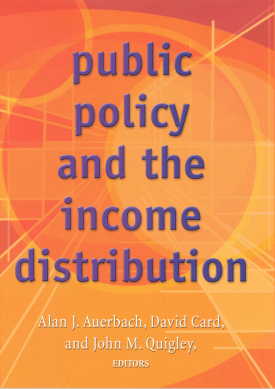
Over the last forty years, rising national income has helped reduce poverty rates, but this has been accompanied by an increase in economic inequality. While these trends are largely attributed to technological change and demographic shifts, such as changing birth rates, labor force patterns, and immigration, public policies have also exerted a profound affect on the welfare of Americans. In Public Policy and the Income Distribution, editors Alan Auerbach, David Card, and John Quigley assemble a distinguished roster of policy analysts to confront the key questions about the role of government policy in altering the level and distribution of economic well being.
Public Policy and the Income Distribution tackles many of the most difficult and intriguing questions about how government intervention—or lack thereof—has affected the incomes of everyday Americans. Rebecca Blank analyzes welfare reform, and presents systematic research on income, poverty rates, and welfare and labor force participation of single mothers. She finds that single mothers worked more and were less dependent on public assistance following welfare reform, and that low-skilled single mothers had no greater difficulty finding work than others. Timothy Smeeding compares poverty reduction programs in the United States with policies in other developed countries. Poverty and inequality are higher in the United States than in other advanced economies, but Smeeding argues that this is largely a result of policy choices. Poverty rates based on market incomes alone are actually lower in the United States than elsewhere, but government interventions in the United States were less than half as effective at reducing poverty as were programs in the other countries. The most dramatic poverty reduction story of twentieth century America was seen among the elderly, who went from being the age group most likely to live in poverty in the 1960s to the group least likely to be poor at the end of the century. Gary Englehardt and Jonathan Gruber examine the role of policy in alleviating old-age poverty by estimating the impact of Social Security benefits on the income of the elderly poor. They find that the growth in Social Security almost completely explains the large decline in elderly poverty in the United States.
The twentieth century was remarkable in the extent to which advances in public policy helped improve the economic well being of Americans. Synthesizing existing knowledge on the effectiveness of public policy and contributing valuable new research,Public Policy and the Income Distribution examines public policy's successes, and points out the areas in which progress remains to be made.
ALAN J. AUERBACH is Robert D. Burch Professor of Economics and Law at the University of California, Berkeley.
DAVID CARD is Class of 1950 Professor of Economics at the University of California, Berkeley.
JOHN M. QUIGLEY is I. Donald Terner Distinguished Professor and professor of economics at the University of California, Berkeley.
CONTRIBUTORS: Rebecca M. Blank, Dora L. Costa, Janet Currie, Gary V. Engelhardt, Jonathan Gruber, Matthew E. Kahn, Steven Raphael, Emmanuel Saez, Jonathan Skinner, Timothy M. Smeeding, Weiping Zhou.