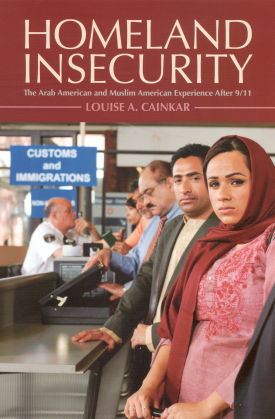
Cover image of the book Homeland Insecurity
Books

Homeland Insecurity

The Arab American and Muslim American Experience After 9/11
Author
Louise A. Cainkar
Paperback
$33.95
Add to Cart
Publication Date
6 in. × 9 in. 340 pages
ISBN
978-0-87154-053-9
Also Available From

About This Book

"Homeland Insecurity is rare in its ability to connect governmental policies at the national level with events on the ground in Chicago. Cainkar documents the War on Terror with a strong critical eye, showing how it was animated by a combination of local and global forces, by an American media culture that was prone to depict Muslims and Islam negatively, and by deep historical patterns of anti-Arab racism. Intimate ethnography, based on years of acquaintance with Chicago's Arab communities, and savvy political commentary, backed up by painstaking research, come together in this forceful study, which will double as a guidebook to those who want to understand, and undermine, the mechanics of anti-Arab and anti-Muslim politics in the U.S. today."
-ANDREW SHRYOCK, Arthur F. Thurnau Professor of Anthropology, University of Michigan

"This book turns the Bush Administration's concept of homeland security on its head. Where the government treated Arab Americans and Muslim Americans as potential threats to the security of the United States, Louise Cainkar documents the U.S. government's threats to the security of these minority populations, almost none of whom were ever shown to be dangerous. In the words of one of Cainkar's interviewees, 'After September 11, I don't think anybody felt safe ... but Muslims definitely did not feel safe.'"
-CHARLES KURZMAN, professor of sociology, University of North Carolina

In the aftermath of 9/11, many Arab and Muslim Americans came under intense scrutiny by federal and local authorities, as well as their own neighbors, on the chance that they might know, support, or actually be terrorists. As Louise Cainkar observes, even U.S.-born Arabs and Muslims were portrayed as outsiders, an image that was amplified in the months after the attacks. She argues that 9/11 did not create anti-Arab and anti-Muslim suspicion; rather, their socially constructed images and social and political exclusion long before these attacks created an environment in which misunderstanding and hostility could thrive and the government could defend its use of profiling. Combining analysis and ethnography, Homeland Insecurity provides an intimate view of what it means to be an Arab or a Muslim in a country set on edge by the worst terrorist attack in its history.

Focusing on the metropolitan Chicago area, Cainkar conducted more than a hundred research interviews and five in-depth oral histories. In this, the most comprehensive ethnographic study of the post-9/11 period for American Arabs and Muslims, native-born and immigrant Palestinians, Egyptians, Lebanese, Iraqis, Yemenis, Sudanese, Jordanians, and others speak candidly about their lives as well as their experiences with government, public mistrust, discrimination, and harassment after 9/11. The book reveals that Arab Muslims were more likely to be attacked in certain spatial contexts than others and that Muslim women wearing the hijab were more vulnerable to assault than men, as their head scarves were interpreted by some as a rejection of American culture. Even as the 9/11 Commission never found any evidence that members of Arab- or Muslim-American communities were involved in the attacks, respondents discuss their feelings of insecurity—a heightened sense of physical vulnerability and exclusion from the guarantees of citizenship afforded other Americans.

Yet the vast majority of those interviewed for Homeland Insecurity report feeling optimistic about the future of Arab and Muslim life in the United States. Most of the respondents talked about their increased interest in the teachings of Islam, whether to counter anti-Muslim slurs or to better educate themselves. Governmental and popular hostility proved to be a springboard for heightened social and civic engagement. Immigrant organizations, religious leaders, civil rights advocates, community organizers, and others defended Arabs and Muslims and built networks with their organizations. Local roundtables between Arab and Muslim leaders, law enforcement, and homeland security agencies developed better understanding of Arab and Muslim communities. These post-9/11 changes have given way to stronger ties and greater inclusion in American social and political life.

Will the United States extend its values of freedom and inclusion beyond the politics of “us” and “them” stirred up after 9/11? The answer is still not clear. Homeland Insecurity is keenly observed and adds Arab and Muslim American voices to this still-unfolding period in American history.

LOUISE A. CAINKAR is assistant professor of sociology and social justice at Marquette University.

RSF Journal
View Book Series
Sign Up For Our Mailing List
Apply For Funding
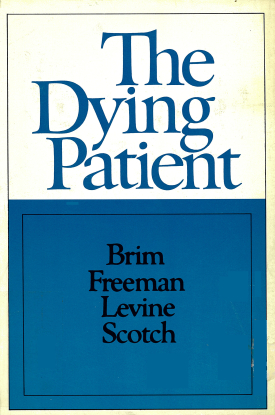
Cover image of the book The Dying Patient
Books

The Dying Patient

Editors
Orville G. Brim, Jr.
Howard E. Freeman
Sol Levine
Norman A. Scotch
Hardcover
Add to Cart
Publication Date
6 in. × 9 in. 416 pages
ISBN
978-0-87154-155-0
Also Available From

About This Book

There has hitherto been limited systematic social research on the prolongation and termination of life, and minimal agreement of the resolution of the moral and social dilemmas that dying provokes. Among the topics discussed by the contributors are: the social context of dying—when, where, and why people die; what they think about death; the cultural background of the patients' attitudes; and how medical practitioners cope with terminal illness. The social, ethical, legal, and economic problems arising from the prolongation and termination of life are also set forth.

ORVILLE G. BRIM, JR. is president of the Foundation for Child Development and former president of the Russell Sage Foundation.

HOWARD E. FREEMAN is director of the Institute for Social Science Research and professor of sociology at University of California, Los Angeles.

SOL LEVINE is university professor of sociology and community medicine at Boston University.

NORMAN SCOTCH is professor and chairman of the Department of Socio-Medical Services and Community Medicine at Boston University School of Medicine.

CONTRIBUTORS: Richard M. Bailey, Orville G. Brim, Jr., Diana Crane, Howard E. Freeman, Barney G. Glaser, Robert J. Glaser, Richard A. Kalish, Andie L. Knutson, Louis Lasagna, Monroe Lerner, Sol Levine, Bayless Manning, Robert S. Morison, Osler L. Peterson, David L. Rabin, Laurel H. Rabin, John W. Riley, Jr., Elisabeth K. Ross, Norman A. Scotch, Anselm L. Strauss, David Sudnow, Greer Williams
 

RSF Journal
View Book Series
Sign Up For Our Mailing List
Apply For Funding
Cover image of the book Research Directions of Black Psychologists
Books

Research Directions of Black Psychologists

Editors
Wade Boykin
Anderson J. Franklin
J. Frank Yates
Hardcover
$65.00
Add to Cart
Publication Date
6 in. × 9 in. 464 pages
ISBN
978-0-87154-254-0
Also Available From

About This Book

Focusing on issues of particular importance to black people, and confronting the rich variety and the complexity of the black experience, the many contributors demonstrate the broad diversity of research interests and strategies among black psychologists, from the traditional to the innovative. Topics covered include studies of motivation, cognitive development, life-span development, and cultural difference versus deficit theories. Many of the studies directly refute previous conceptions of the psychological functioning of blacks and offer alternative models and formulations.

This book is the first to present soundly designed and executed research that is emphatically linked to the perspectives and the psychological concerns of black Americans. In designing these studies, the authors aimed to ameliorate the pressing educational and social problems of blacks through a better understanding of their life conditions.

A. WADE BOYKIN is associate professor of psychology at Cornell University and associate editor of the Journal of Black Psychology.

ANDERSON J. FRANKLIN is associate professor of clinical psychology in the Graduate Center and at City College of the City University of New York.

J. FRANK YATES is associate professor of psychology at the University of Michigan.

CONTRIBUTORS:  John D. Bacon,  W. Curtis Banks,  Oscar Barbarin, A. Wade Boykin,  Michael Cole,  O. Jackson Cole,  William Collins,  William E. Cross Jr.,  Herman W. Dorsett,  Ozzie L. Edwards,  Anderson J. Franklin,  Lenora Fulani, William S. Hall,  Algea . Harrison,  Janet L. Hubbart,  James S. Jackson,  Ronald M. Jennings,  James M. Jones,  Yvonne B. Kelley, Gregory V. McQuater, Lillian Patterson,  John Peterson,  Diane S. Pollard,  Stephen Reder,  James E. Savage,  Sandra A. Sims,  Anita D. Stearns,  Ewart A. C. Thomas,  M. Belinda Tucker, Janet Williams, Carl O. Word,  J. Frank Yates.

RSF Journal
View Book Series
Sign Up For Our Mailing List
Apply For Funding
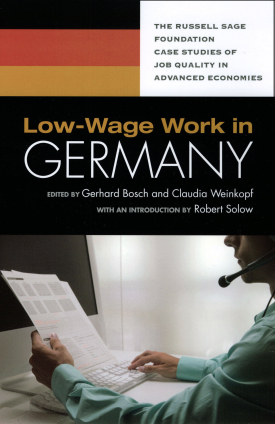
Cover image of the book Low-Wage Work in Germany
Books

Low-Wage Work in Germany

Editors
Gerhard Bosch
Claudia Weinkopf
Paperback
$19.95
Add to Cart
Publication Date
6.63 in. × 9.25 in. 336 pages
ISBN
978-0-87154-062-1
Also Available From

About This Book

"Low-Wage Work in Germany is a valuable addition to knowledge on recent changes in German labor markets. It not only documents the extent and growth of low-wage work, but also offers well researched explanations for these developments in terms of changes in industrial systems and corporate governance, the fragmentation of work, and the weakening of collective agreements. This analysis is of interest in all industrialized countries. It also offers an important scientific contribution to the current debate in Germany on minimum wage policy."
-GERRY RODGERS, International Institute for Labour Studies, Geneva

"The German social model was praised for many decades because of its low level of social exclusion. Now low-wage work nearly reaches the high level of the United States. The brilliant analysis of Gerhard Bosch, Claudia Weinkopf, and their coauthors helps us understand the dramatic changes of the German social model after the unification. What happens in the strongest European economy is decisive for the European Social model. Therefore, Low-Wage Work in Germany is a must-read for policymakers, analysts, and researchers interested in Europe and the future of the welfare state."
-REINER HOFFMANN, European Trade Union Confederation

"This book challenges our understanding of the German social market economy by expertly documenting the incidence and implications of low-wage work in Germany. Combining labor market analysis with industry case studies, the authors provide a detailed and comprehensive treatment of low-wage work across key occupations. The surprising finding that the share of low-wage work in Germany has reached a level nearly as high as the United States and the United Kingdom makes Low-Wage Work in Germany essential reading for those interested in the German economy."
-PETER BERG, Michigan State University

In recent years, the German government has intentionally expanded the low-wage work sector in an effort to reduce exceptionally high levels of unemployment. As a result, the share of the German workforce employed in low-paying jobs now rivals that of the United States. Low Wage Work in Germany examines both the federal policies and changing economic conditions that have driven this increase in low-wage work. The new “mini-job” reflects the federal government’s attempt to make certain low-paying jobs attractive to both employers and employees. Employers pay a low flat rate for benefits, and employees, who work a limited number of hours per week, are exempt from social security and tax contributions. Other factors, including slow economic growth, a declining collective bargaining system, and the influx of foreign workers, also contribute to the growing incidence of low-wage work. Yet while both Germany and the United States have large shares of low-wage workers, German workers receive health insurance, four weeks of paid vacation, and generous old age support—benefits most low-wage workers in the United States can only dream of. The German experience offers an important opportunity to explore difficult trade-offs between unemployment and low-wage work.

GERHARD BOSCH is professor of sociology at the University of Duisburg-Essen.

CLAUDIA WEINKOPF is deputy director of the Institute for Work, Skills, and Training at the University of Duisburg-Essen.

CONTRIBUTORS: Lars Czommer, Karen Jaehrling, Thorsten Kalina, Robert Solow, Achim Vanselow, Dorothea Voss-Dahm.

A Volume in the RSF Case Studies of Job Quality in Advanced Economies

RSF Journal
View Book Series
Sign Up For Our Mailing List
Apply For Funding
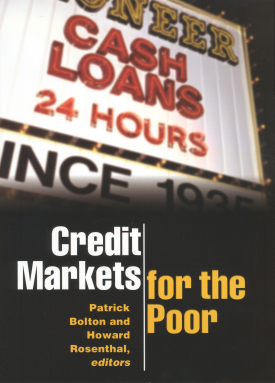
Cover image of the book Credit Markets for the Poor
Books

Credit Markets for the Poor

Editors
Patrick Bolton
Howard Rosenthal
Hardcover
$57.50
Add to Cart
Publication Date
6 in. × 9 in. 320 pages
ISBN
978-0-87154-132-1
Also Available From

About This Book

"Market failures are at the heart of why poor countries cannot get rich, and why poor people in wealthy countries do not become richer. The most crucial sort of market failures are those that plague credit and financial markets. Credit Markets for the Poor provides a rich introduction and overview of both the theory and evidence behind failing credit markets. It shows why credit markets may fail, why they actually do so, how this influences economic outcomes and people's life chances, and what can be done about it. The book will be indispensable reading for economists trying to understand the incidence and persistence of poverty within and between nations."
-JAMES A. ROBINSON, Harvard University

Access to credit is an important means of providing people with the opportunity to make a better life for themselves. Loans are essential for most people who want to purchase a home, start a business, pay for college, or weather a spell of unemployment. Yet many people in poor and minority communities—regardless of their creditworthiness—find credit hard to come by, making the climb out of poverty extremely difficult. How dire are the lending markets in these communities and what can be done to improve access to credit for disadvantaged groups? In Credit Markets for the Poor, editors Patrick Bolton and Howard Rosenthal and an expert team of economists, political scientists, and legal and business scholars tackle these questions with shrewd analysis and a wealth of empirical data.

Credit Markets for the Poor opens by examining what credit options are available to poor households. Economist John Caskey profiles how weak credit options force many working families into a disastrous cycle of short-term, high interest loans in order to sustain themselves between paychecks. Löic Sadoulet explores the reasons that community lending organizations, which have been so successful in developing countries, have failed in more advanced economies. He argues the obstacles that have inhibited community lending groups in industrialized countries—such as a lack of institutional credibility and the high cost of establishing lending networks—can be overcome if banks facilitate the community lending process and establish a system of repayment insurance. Credit Markets for the Poor also examines how legal institutions affect the ability of the poor to borrow. Daniela Fabbri and Mario Padula argue that well-meaning provisions making it more difficult for lenders to collect on defaulted loans are actually doing a disservice to the poor in credit markets. They find that in areas with lax legal enforcement of debt agreements, credit markets for the poor are underdeveloped because lenders are unwilling to take risks on issuing credit or will do so only at exorbitant interest rates. Timothy Bates looks at programs that facilitate small-business development and finds that they have done little to reduce poverty. He argues that subsidized business creation programs may lure inexperienced households into entrepreneurship in areas where little profitable investment is possible, hence setting them up for failure.

With clarity and insightful analysis, Credit Markets for the Poor demonstrates how weak credit markets are impeding the social and economic mobility of the needy. By detailing the many disadvantages that impoverished people face when seeking to borrow, this important new volume highlights a significant national problem and offers solutions for the future.

PATRICK BOLTON is John H. Scully ’66 Professor of Finance and professor of economics in the Bendheim Center for Finance at Princeton University.

HOWARD ROSENTHAL is Roger Williams Straus Professor of Social Sciences and professor of politics at Princeton University and visiting professor in the Department of Economics at Brown University.

CONTRIBUTORS: Raisa Bahchieva, Timothy Bates, Patrick Bolton, John P. Caskey, Daniela Fabbri, Robert Kaestner, Malgosia Madajewicz, Mario Padula, Howard Rosenthal, Loic Sadoulet, Lisa J. Servon, Robert M. Townsend, Susan M. Wachter, Antwuan Wallace, and Elizabeth Warren.

RSF Journal
View Book Series
Sign Up For Our Mailing List
Apply For Funding
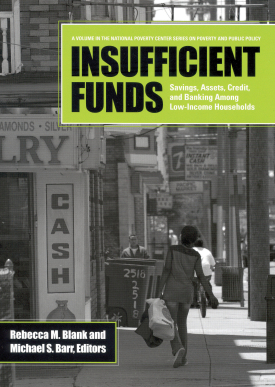
Cover image of the book Insufficient Funds
Books

Insufficient Funds

Savings, Assets, Credit, and Banking among Low-Income Households
Editors
Rebecca M. Blank
Michael S. Barr
Paperback
$34.95
Add to Cart
Publication Date
6.63 in. × 9.25 in. 336 pages
ISBN
978-0-87154-470-4
Also Available From

About This Book

"Insufficient Funds is a comprehensive presentation of what is known about the asset holdings and use of financial services by low-income U.S. households, the factors that might influence their choices in this arena, and the potential for private- and public-sector initiatives to help the poor build wealth and obtain better financial services. All of the authors are top experts in their fields and the volume is well-written, balanced, and cohesive. Insufficient Funds is undoubtedly the best single source for readers seeking a well-informed, thoughtful treatment of the issues."
-JOHN P. CASKEY, Swarthmore College

"This thorough volume from leading scholars provides a textured portrait of the relationships low-income households maintain with formal and informal financial services. Ranging from the latest theory to comparative data analysis to policy innovation, Insufficient Funds is a must read for any scholar, student, or policymaker interested in credit, savings, or asset accumulation in their role as barriers to escaping poverty."
-DALTON CONLEY, New York University

One in four American adults doesn’t have a bank account. Low-income families lack access to many of the basic financial services middle-class families take for granted and are particularly susceptible to financial emergencies, unemployment, loss of a home, and uninsured medical problems. Insufficient Funds explores how institutional constraints and individual decisions combine to produce this striking disparity and recommends policies to help alleviate the problem.

Mainstream financial services are both less available and more expensive for low-income households. High fees, minimum-balance policies, and the relative scarcity of banks in poor neighborhoods are key factors. Michael Barr reports the results of an in-depth study of financial behavior in 1,000 low- and moderate-income families in metropolitan Detroit. He finds that most poor households have bank accounts, but combine use of mainstream services with alternative options such as money orders, pawnshops, and payday lenders. Barr suggests that a tax credit for banks serving primarily disadvantaged customers could facilitate greater equality in the private financial sector.

Drawing on evidence from behavioral economics, Sendhil Mullainathan and Eldar Shafir show that low-income individuals exhibit many of the same patterns and weaknesses in financial decision making as middle-class individuals and could benefit from many of the same financial aids. They argue that savings programs that automatically enroll participants and require them to actively opt out in order to leave the program could drastically increase savings ability. Ronald Mann demonstrates that significant changes in the credit market over the past fifteen years have allowed companies to expand credit to a larger share of low-income families. Mann calls for regulations on credit card companies that would require greater disclosure of actual interest rates and fees. Raphael Bostic and Kwan Lee find that while home ownership has risen dramatically over the past twenty years, elevated risks for low-income families—such as foreclosure—may well outweigh the benefits of owning a home.

The authors ultimately argue that if we want to demand financial responsibility from low-income households, we have an obligation to assure that these families have access to the banking, credit, and savings institutions that are readily available to higher-income families. Insufficient Funds highlights where and how access is blocked and shows how government policy and individual decisions could combine to eliminate many of these barriers in the future.

REBECCA M. BLANK is the Robert S. Kerr Senior Fellow at the Brookings Institution.

MICHAEL S. BARR is professor of law at the University of Michigan Law School.

CONTRIBUTORS: Raphael W. Bostic, Daryl Collins, Kwan Ok Lee, Ronald J. Mann, Jonathan Morduch, Sendhil Mullainathan, Una Okonkwo Osili, Anna L. Paulson, Daniel Schneider, John Karl Scholz, Ananth Seshadri, Eldar Shafir, Michael Sherraden, Peter Tufano.

A Volume in the National Poverty Center Series on Poverty and Public Policy

RSF Journal
View Book Series
Sign Up For Our Mailing List
Apply For Funding
Cover image of the book Academic and Entrepreneurial Research
Books

Academic and Entrepreneurial Research

Consequences of Diversity in Federal Evaluation Studies
Authors
Irene Nagel Bernstein
Howard E. Freeman
Hardcover
Add to Cart
Publication Date
6 in. × 9 in. 224 pages
ISBN
978-0-87154-109-3
Also Available From

About This Book

As social action programs in health, education, and welfare have expanded, interest has grown in evaluating their implementation and effectiveness. Policymakers and social planners--at all levels of government and in the private sector--are currently confronted with the problem of evaluating the large number of human service programs that compete for available resources.

Academic and Entrepreneurial Research presents a systematic study of the expenditure of federal funds for evaluation research. It reviews federally-supported evaluations of programs, including evaluations of social change experiments and research-demonstration programs funded by the various executive departments of the federal government. Evaluation studies of these large-scale programs vary in scope, quality, and potential utility. Bernstein and Freeman examine all projects initiated during fiscal year 1970 in order to understand better the methods employed, the types of persons engaged in such research, and expectations regarding the utilization of findings.

The book provides data about "high" and "low" quality evaluation research and contains recommendations for restructuring the entire evaluation research enterprise in light of the findings.

ILENE NAGEL BERNSTEIN is assistant professor of sociology at Indiana University.

HOWARD E. FREEMAN is director of the Institute for Social Science Research and professor of sociology at the University of California, Los Angeles.

RSF Journal
View Book Series
Sign Up For Our Mailing List
Apply For Funding
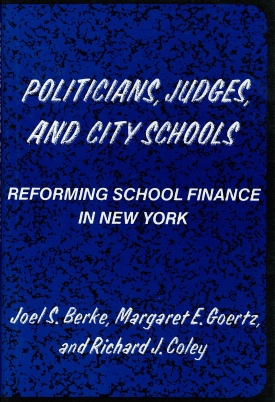
Cover image of the book Politicians, Judges, and City Schools
Books

Politicians, Judges, and City Schools

Authors
Joel S. Berke
Margaret E. Goertz
Richard J. Coley
Hardcover
Add to Cart
Publication Date
6 in. × 9 in. 304 pages
ISBN
978-0-87154-108-6
Also Available From

About This Book

During the 1970s, a nationwide school finance reform movement—fueled by litigation challenging the constitutionality of state education funding laws—brought significant changes to the way many states finance their public elementary and secondary school systems. School finance reform poses difficult philosophical questions: what is the meaning of equality in educational opportunity and of equity in the distribution of tax burdens? But it also involves enormous financial complexity (for example, dividing resources among competing special programs) and political risk (such as balancing local control with the need for statewide parity).

For those states (like New York) that were slow to make changes a new decade has brought new constraints and complications. Sluggish economic growth, taxpayer revolts, reductions in federal aid, all affect education revenues. And the current concern with educational excellence may obscure the needs of the poor and educationally disadvantaged.

This book will provide New York’s policy makers and other concerned specialists with a better understanding of the political, economic, and equity issues underlying the school finance reform debate. It details existing inequities, evaluates current financing formulas, and presents options for change. Most important, for all those concerned with education and public policy in New York and elsewhere, it offers a masterful assessment of the trade-offs involved in developing reform programs that balance the conflicting demands of resource equalization, political feasibility, and fiscal responsibility.

"Synthesizes the political and fiscal research [on school finance reform] and applies it to the New York Context....A blueprint for how to redesign state school finance....A fine book." —Public Administration Review

"This is a book that lucidly discusses the issues in school finance and provides valuable reference material." —American Political Science Review

The late JOEL S. BERKE was director of the Education Policy Research Institute of Educational Testing
Service.

MARGARET E. GOERTZ is policy research scientist at Educational Testing Service.

RICHARD COLEY is research associate at Educational Testing Service.

RSF Journal
View Book Series
Sign Up For Our Mailing List
Apply For Funding
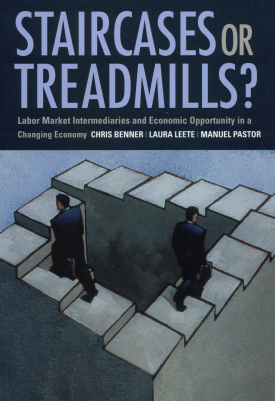
Cover image of the book Staircases or Treadmills?
Books

Staircases or Treadmills?

Labor Market Intermediaries and Economic Opportunity in a Changing Economy
Authors
Chris Benner
Laura Leete
Manuel Pastor
Hardcover
$42.50
Add to Cart
Publication Date
6 in. × 9 in. 312 pages
ISBN
978-0-87154-169-7
Also Available From

About This Book

"The Silicon Valley is seen as the exemplar of the new economy and Milwaukee represents the old. Yet are these labor markets truly different and if so in what ways? Staircases or Treadmills? takes on the challenge of answering this question and does so with a focus on those outside the relatively small elite who have prospered in the past decades. The original fieldwork and survey research reported in this important book adds to our knowledge of the role of institutions and personal networks in shaping outcomes. This is empirical research at its best."
-PAUL OSTERMAN, MIT Sloan School

"Staircases or Treadmills? is a carefully-researched, well-argued, important book. As more and more people turn to a variety of private and public organizations to help them find new or better jobs, the authors' deep understanding of intermediary types, market niches, and outcomes is a significant contribution. Some findings are surprising; all will be useful to researchers, activists, and policymakers concerned about how best to help low-income workers advance."
-RICHARD KAZIS, Jobs for the Future

"Staircases or Treadmills? presents a rich and detailed portrait of the workforce-intermediary landscape in two specific regional labor markets. It offers a useful framework for analyzing the services of workforce intermediaries that covers a wide range of organizational types. The book illuminates the growing influence of a range of organizations that play a role in mediating the hiring process in these two labor markets, and how these organizations have in turn influenced the labor-market prospects and outcomes of low- wage workers. This picture of the tremendous fragmentation, variability of service provision, and uneven quality among workforce-intermediary service providers illustrates the challenge that workers and employers face. Staircases or Treadmills? is essential reading for anyone interested in improving labor-market functioning and facilitating improved outcomes for low-income workers."
-MAUREEN CONWAY, The Aspen Institute

Globalization, technological change, and deregulation have made the American marketplace increasingly competitive in recent decades, but for many workers this “new economy” has entailed heightened job insecurity, lower wages, and scarcer benefits. As the job market has grown more volatile, a variety of labor market intermediaries—organizations that help job seekers find employment—have sprung up, from private temporary agencies to government “One-Stop Career Centers.” In Staircases or Treadmills? Chris Benner, Laura Leete, and Manuel Pastor investigate what approaches are most effective in helping workers to secure jobs with decent wages and benefits, and they provide specific policy recommendations for how job-matching organizations can better serve disadvantaged workers.

Staircases or Treadmills? is the first comprehensive study documenting the prevalence of all types of labor market intermediaries and investigating how these intermediaries affect workers’ employment opportunities. Benner, Leete, and Pastor draw on years of research in two distinct regional labor markets—“old economy” Milwaukee and “new economy” Silicon Valley—including a first-of-its-kind random survey of the prevalence and impacts of intermediaries, and a wide range of interviews with intermediary agencies’ staff and clients. One of the main obstacles that disadvantaged workers face is that social networks of families and friends are less effective in connecting job-seekers to stable, quality employment. Intermediaries often serve as a substitute method for finding a job.  Which substitute is chosen, however, matters: The authors find that the most effective organizations—including many unions, community colleges, and local non-profits—actively foster contacts between workers and employers, tend to make long-term investments in training for career development, and seek to transform as well as satisfy market demands. But without effective social networks to help workers locate the best intermediaries, most rely on private temporary agencies and other organizations that offer fewer services and, statistical analysis shows, often channel their participants into jobs with low wages and few benefits. Staircases or Treadmills? suggests that, to become more effective, intermediary organizations of all types need to focus more on training workers, teaching networking skills, and fostering contact between workers and employers in the same industries.

A generation ago, rising living standards were broadly distributed and coupled with relatively secure employment. Today, many Americans fear that heightened job insecurity is overshadowing the benefits of dynamic economic growth. Staircases or Treadmills? is a stimulating guide to how private and public job-matching institutions can empower disadvantaged workers to share in economic progress.

CHRIS BENNER is assistant professor of urban and economic geography at Pennsylvania State University.

LAURA LEETE is the Fred H. Paulus Director of Public Policy Research and associate professor of economics and public policy at Willamette University.

MANUEL PASTOR is a professor of geography and American Studies and ethnicity at the University of Southern California.

RSF Journal
View Book Series
Sign Up For Our Mailing List
Apply For Funding
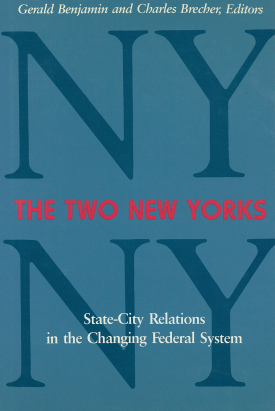
Cover image of the book The Two New Yorks
Books

The Two New Yorks

State-City Relations in the Changing Federal System
Editors
Gerald Benjamin
Charles Brecher
Hardcover
Add to Cart
Publication Date
6 in. × 9 in. 576 pages
ISBN
978-0-87154-107-9
Also Available From

About This Book

Over the past eight years, a marked shift in the national political mood has substantially reduced the federal government's involvement in ameliorating urban problems and enhanced the prominence of state and local governments in the domestic policy arena. Many states and big cities have been forced to reassess their traditionally vexed relationships.

Nowhere has this drama been played out more stormily than in New York. In The Two New Yorks, experts from government, the academy, and the non-profit sector examine aspects of an interaction that has a major impact on the performance of state and city institutions. The analyses presented here explore current state-city strategies for handling such troubling policy areas as education, health care, and housing. Attention is also given to important contextual factors such as economic and demographic trends, and to structural features such as the political framework, relationships with the national government, and the system of public finance.

Despite its uniquely large scope, the drama of the new New Yorks parallels or presages issues faced by virtually all large cities and their states. This unprecedented study makes a vital contribution in an era of declining federal aid and pressing urban need.

GERALD BENJAMIN is at SUNY New Paltz.

CHARLES BRECHER is at New York University.

CONTRIBUTORS: Richard D. Alba, Mary Jo Bane, Gerald Benjamin, Robert Berne, Susan Blamk, Barbara B. Blum, Matthew Drennan, Barbara Gordon Espejo, Ester Fuchs, Cynthia B. Green, James M. Hartman, Raymond D. Horton, Sarah F. Liebschutz, David Lewin, Irene Lurie, Paul D. Moore, James C. Musselwhite Jr., Martin Shefter, Kenneth E. Thorpe, Emanuel Tobier, Katherine Trent, 

RSF Journal
View Book Series
Sign Up For Our Mailing List
Apply For Funding