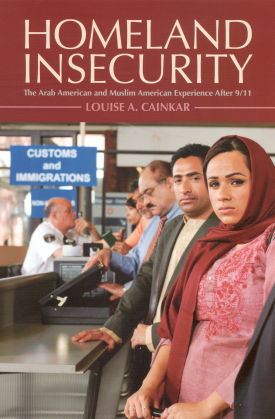
Homeland Insecurity
About This Book
"Homeland Insecurity is rare in its ability to connect governmental policies at the national level with events on the ground in Chicago. Cainkar documents the War on Terror with a strong critical eye, showing how it was animated by a combination of local and global forces, by an American media culture that was prone to depict Muslims and Islam negatively, and by deep historical patterns of anti-Arab racism. Intimate ethnography, based on years of acquaintance with Chicago's Arab communities, and savvy political commentary, backed up by painstaking research, come together in this forceful study, which will double as a guidebook to those who want to understand, and undermine, the mechanics of anti-Arab and anti-Muslim politics in the U.S. today."
-ANDREW SHRYOCK, Arthur F. Thurnau Professor of Anthropology, University of Michigan
"This book turns the Bush Administration's concept of homeland security on its head. Where the government treated Arab Americans and Muslim Americans as potential threats to the security of the United States, Louise Cainkar documents the U.S. government's threats to the security of these minority populations, almost none of whom were ever shown to be dangerous. In the words of one of Cainkar's interviewees, 'After September 11, I don't think anybody felt safe ... but Muslims definitely did not feel safe.'"
-CHARLES KURZMAN, professor of sociology, University of North Carolina
In the aftermath of 9/11, many Arab and Muslim Americans came under intense scrutiny by federal and local authorities, as well as their own neighbors, on the chance that they might know, support, or actually be terrorists. As Louise Cainkar observes, even U.S.-born Arabs and Muslims were portrayed as outsiders, an image that was amplified in the months after the attacks. She argues that 9/11 did not create anti-Arab and anti-Muslim suspicion; rather, their socially constructed images and social and political exclusion long before these attacks created an environment in which misunderstanding and hostility could thrive and the government could defend its use of profiling. Combining analysis and ethnography, Homeland Insecurity provides an intimate view of what it means to be an Arab or a Muslim in a country set on edge by the worst terrorist attack in its history.
Focusing on the metropolitan Chicago area, Cainkar conducted more than a hundred research interviews and five in-depth oral histories. In this, the most comprehensive ethnographic study of the post-9/11 period for American Arabs and Muslims, native-born and immigrant Palestinians, Egyptians, Lebanese, Iraqis, Yemenis, Sudanese, Jordanians, and others speak candidly about their lives as well as their experiences with government, public mistrust, discrimination, and harassment after 9/11. The book reveals that Arab Muslims were more likely to be attacked in certain spatial contexts than others and that Muslim women wearing the hijab were more vulnerable to assault than men, as their head scarves were interpreted by some as a rejection of American culture. Even as the 9/11 Commission never found any evidence that members of Arab- or Muslim-American communities were involved in the attacks, respondents discuss their feelings of insecurity—a heightened sense of physical vulnerability and exclusion from the guarantees of citizenship afforded other Americans.
Yet the vast majority of those interviewed for Homeland Insecurity report feeling optimistic about the future of Arab and Muslim life in the United States. Most of the respondents talked about their increased interest in the teachings of Islam, whether to counter anti-Muslim slurs or to better educate themselves. Governmental and popular hostility proved to be a springboard for heightened social and civic engagement. Immigrant organizations, religious leaders, civil rights advocates, community organizers, and others defended Arabs and Muslims and built networks with their organizations. Local roundtables between Arab and Muslim leaders, law enforcement, and homeland security agencies developed better understanding of Arab and Muslim communities. These post-9/11 changes have given way to stronger ties and greater inclusion in American social and political life.
Will the United States extend its values of freedom and inclusion beyond the politics of “us” and “them” stirred up after 9/11? The answer is still not clear. Homeland Insecurity is keenly observed and adds Arab and Muslim American voices to this still-unfolding period in American history.
LOUISE A. CAINKAR is assistant professor of sociology and social justice at Marquette University.