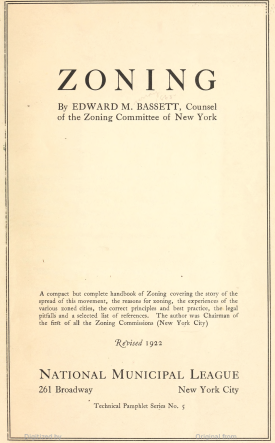
Cover image of the book Zoning
Books

Zoning

Author
Edward M. Bassett
Ebook
Publication Date
41 pages

About This Book

A compact but complete handbook of zoning covering the story of the spread of this movement, the reasons for zoning, the experiences of various zoned cities, the correct principles and best practice, the legal pitfalls and a selected list of reference.

EDWARD M. BASSETT was chairman of the Zoning Committee of New York.

RSF Journal
View Book Series
Sign Up For Our Mailing List
Apply For Funding
Books

Seen But Not Heard

What Medical Records Don’t Tell Us About Women’s Lives
Authors
Jennifer M. Silva
Annemarie G. Hirsch
Paperback
Add to Cart
ISBN
978-0-87154-867-2

About This Book

Coming soon

RSF Journal
View Book Series
Sign Up For Our Mailing List
Apply For Funding
Learning to Lead
Books

Learning to Lead

Youth Organizing in Immigrant Communities
Author
Veronica Terriquez
Paperback
Add to Cart
Publication Date
6 in. × 9 in.
ISBN
978-0-87154-852-8

About This Book

Coming soon

RSF Journal
View Book Series
Sign Up For Our Mailing List
Apply For Funding
Fighting for a Foothold
Books

Fighting for a Foothold

How Government and Markets Undermine Black Middle-Class Suburbia
Author
Angela Simms
Paperback
$39.95
Add to Cart
Publication Date
6 in. × 9 in. 334 pages
ISBN
978-0-87154-825-2

About This Book

"Prince George’s County is a Wakanda of sorts. Its majority-Black residents enjoy higher incomes, stronger homeownership, and longer life expectancy than residents in many places—indeed, more than those in many non-Black-majority areas. As a resident, I affectionately call it ‘Black bougie heaven,’ proudly celebrating its strengths. Angela Simms’s rigorous work shows, however, that as remarkable as PG County is, it could be even better in a world without racism. Fighting for a Foothold invites readers from all places to remove the drags of racism that throttle growth that would otherwise occur."
—ANDRE M. PERRY, senior fellow and director, Center for Community Uplift, Brookings Institution

"Fighting for a Foothold reveals the connection between a long legacy of racist policies in America and the struggle among local leadership in an iconic middle-class Black suburb to provide residents with the kinds of amenities that are taken for granted in neighboring middle-class White suburbs. In doing so, Angela Simms shows middle-class Black homeowners and their elected officials face an uphill battle as they attempt to reap the benefits of living in one of the most coveted spaces in the country—the suburbs."
—KARYN LACY, associate professor of sociology, University of Michigan

Prince George’s County, Maryland, is a suburban jurisdiction in the Washington, D.C., metropolitan area and is home to the highest concentration of Black middle-class residents in the United States. As such, it is well positioned to overcome White domination and anti-Black racism and their social and economic consequences. Yet Prince George’s does not raise tax revenue sufficient to provide consistent high-quality public goods and services. In Fighting for a Foothold, sociologist Angela Simms examines the factors contributing to Prince George’s financial troubles.

Simms draws on two years of observations of Prince George’s County’s budget and policy development processes, interviews with nearly 60 Prince George’s leaders and residents, and budget and policy analysis for Prince George’s County and its two Whiter, wealthier neighbors, Montgomery County, Maryland, and Fairfax County, Virginia. She argues legacy and ongoing government policies and business practices—such as federal mortgage insurance policy prior to 1968, local government reliance on property taxes, and private investment patterns—have resulted in disparities in wealth accumulation between Black and White Americans, not only for individuals and families but local jurisdictions as well. Prince George’s County has a lower cost of living than its Whiter, wealthier neighbors. As the most affordable county bordering D.C., it attracts a disproportionate share of the region’s core middle-class, lower middle-class, working class, and low-income residents, resulting in greater budget pressure.

Prince George’s uses the same strategies as majority-White jurisdictions to increase revenue, such as taxing at similar rates and vying for development opportunities but does not attain the same financial returns. Ultimately, Simms contends Prince George’s endures “relative regional burden” and that the county effectively subsidizes Whiter counties’ wealth accumulation. She offers policy recommendations for removing the constraints Prince George’s County and other majority-Black jurisdictions navigate, including increased federal and state taxes on wealthy Americans and corporations, which will enhance the capacity for government to distribute and redistribute resources equitably; increased state-level funding of public goods and services, which would decrease local jurisdictions’ reliance on locally-generated tax revenue; and the creation of equity funds to remediate harms inflicted upon Black Americans.

Fighting for a Foothold is an in-depth analysis of the fiscal challenges experienced by Prince George’s County and by the suburban Black middle-class and majority-Black jurisdictions, more broadly. The book reveals how race, class, and local jurisdiction boundaries in metropolitan areas interact to create different material living conditions for Americans.

About the Author

ANGELA SIMMS is Assistant Professor of Sociology and Urban Studies, Barnard College, Columbia University.

RSF Journal
View Book Series
Sign Up For Our Mailing List
Apply For Funding
Cover image of the book Southern Mountain Schools Maintained by Denominational and Independent Agencies, Revised Edition
Books

Southern Mountain Schools Maintained by Denominational and Independent Agencies, Revised Edition

Author
No author
Ebook
Publication Date
15 pages

About This Book

In 1911 the Russell Sage Foundation published a directory of Southern Highland Schools. It soon went out of print and in response to numerous requests for up-to-date information, the list in this booklet was prepared. In addition to the schools of the Southern Appalachian region, several schools located in the Ozark Mountains were included. The list was compiled entirely from data supplied by the school authorities, and while other schools were known to exist, only those that responded to requests for information were included.

RSF Journal
View Book Series
Sign Up For Our Mailing List
Apply For Funding
The Journey into Adulthood in Uncertain Times
Books

The Journey into Adulthood in Uncertain Times

Authors
Robert Crosnoe
Shannon E. Cavanagh
Paperback
$45.00
Add to Cart
Publication Date
6 in. × 9 in.
ISBN
978-0-87154-032-4

About This Book

Concerns about the welfare of young adults have received increasing public attention. Numerous magazine and newspaper articles ask, “Are young adults failing to launch?” and “Are global crises creating generations of lost youth?” These questions are driven by worries that young people are either unable or unwilling to transition to adulthood, even when they have aged past traditional definitions of childhood and adolescence. In The Journey into Adulthood in Uncertain Times, sociologists Robert Crosnoe and Shannon E. Cavanagh examine whether young people today are either refusing or failing to grow up.

Drawing on both quantitative and qualitative survey data over five decades, Crosnoe and Cavanagh find that young adults are, in fact, waiting longer to take on “real” adult roles, such as worker or parent. However, this is not out of a reluctance to grow up. Instead, increased inequality and changes in the economy have forced young people to adapt their lives in new ways. Young adults are now spending more time in school, have more trouble finding their footing in the labor force, and consequently postpone getting married and having children. They also mix and match roles in more complicated ways now than in the past—going back and forth between school and work over longer periods of time or disconnecting parenthood from their romantic relationships. While the period from late teens to mid-twenties does look different now than in the past, the change has been slow and steady rather than a dramatic shift due to social crises. The Great Recession, for example, had a more muted effect on young people’s social and economic attainment and family formation than fears of a lost generation would suggest.

Crosnoe and Cavanagh find that while the panic over young adults today may be somewhat overblown, this conclusion should not obscure some clear concerns. Young adults do struggle with their social and emotional well-being. They are more depressed than their counterparts in previous generations, drink less alcohol in ways that suggest less engagement with social life, and express deep distrust of social institutions and the idea of the American Dream. The authors argue that worries about the state of young adulthood today should trigger more reflection about how to support young people rather than how to fix them.

The Journey into Adulthood in Uncertain Times is a comprehensive and illuminating examination of the challenges faced by contemporary young adults.

About the Author

ROBERT CROSNOE is the Rapoport Centennial Professor of Sociology, University of Texas at Austin, and senior associate dean of the College of Liberal Arts.

SHANNON E. CAVANAGH is the chair of the Department of Sociology and a faculty research associate of the Population Research Center, University of Texas at Austin.

RSF Journal
View Book Series
Sign Up For Our Mailing List
Apply For Funding
Cover image of the book How Motion Pictures May Be Obtained
Books

How Motion Pictures May Be Obtained

Author
No author
Ebook
Publication Date
3 pages

About This Book

This one-page article provides information on how motion pictures of educational value may be obtained. It notes that the General Film Company has recently organized an Education Department and that the department has a catalogue of films that will be sent upon request. Rental prices vary from $5 to $10 a day per reel.

RSF Journal
View Book Series
Sign Up For Our Mailing List
Apply For Funding
Cover image of the book Folk Dancing: Illustrating the Educational, Civic, and Moral Value of Folk Dancing
Books

Folk Dancing: Illustrating the Educational, Civic, and Moral Value of Folk Dancing

Author
Luther H. Gulick
Ebook
Publication Date
26 pages

About This Book

This illustrated booklet discusses the moral value of folk dancing. Part I covers folk and national dances. Part II covers the use of folk dancing in a public school system, as shown by its use by the girls’ branch of the Public Schools Athletic League of New York City.

LUTHER H. GULICK was director of the Department of Child Hygiene at the Russell Sage Foundation.

RSF Journal
View Book Series
Sign Up For Our Mailing List
Apply For Funding
Cover image of the book Recreation Bibliography
Books

Recreation Bibliography

Author
No author
Ebook
Publication Date
37 pages

About This Book

This booklet contains a list of books, reports, and magazine articles that deal with the topic of recreation. It is arranged by subject, with annotations on the more formal publications, many of which deal with other phases of recreation than the subject under which they are listed. Subjects include play and games, storytelling, folk dancing, sports, holidays, school gardens, boys’ and girls’ clubs, public parks, and walking clubs, among other topics.

RSF Journal
View Book Series
Sign Up For Our Mailing List
Apply For Funding