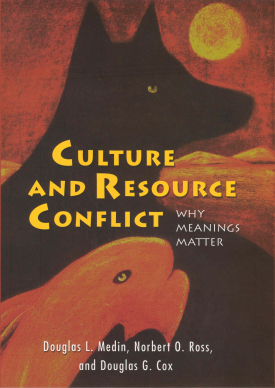
Culture and Resource Conflict
About This Book
"Culture and Resource Conflict will be of great value to people interested in the roots of intergroup conflict, in cultural psychology, and in the way that the human mind operates to understand the physical and social environment."
-RICHARD E. NISBETT, Theodore M. Newcomb Distinguished University Professor, Institute for Social Research, University of Michigan
"A dazzling and singular contribution to two disciplines, bringing rich and disarmingly personal ethnography to psychology, and rigorous cognitive science to ethnology. By far the best collaboration of psychologists and anthropologists to date, providing a unique and innovative purchase on the tragedy of the commons. Culture and Resource Conflict will be the gold standard of interdisciplinary work for a long time to come."
-LAWRENCE A. HIRSCHFELD, professor of anthropology and of psychology, New School for Social Research
In a multi-cultural society, differing worldviews among groups can lead to conflict over competing values and behaviors. Nowhere is this tension more concrete than in the wilderness, where people of different cultures hunt and fish for the same animals. White Americans tend to see nature as something external which they have some responsibility to care for. In contrast, Native Americans are more likely to see themselves as one with nature. In Culture and Resource Conflict, authors Douglas Medin, Norbert Ross, and Douglas Cox investigate the discord between whites and Menominee American Indians over hunting and fishing, and in the process, contribute to our understanding of how and why cultures so often collide.
Based on detailed ethnographic and experimental research, Culture and Resource Conflict finds that Native American and European American hunters and fishermen have differing approaches—or mental models—with respect to fish and game, and that these differences lead to misunderstanding, stereotyping, and conflict. Menominee look at the practice of hunting and fishing for sport as a sign of a lack of respect for nature. Whites, on the other hand, define respect for nature more on grounds of resource management and conservation. Some whites believe—contrary to fact—that Native Americans are depleting animal populations with excessive hunting and fishing, while the Menominee protest that they only hunt what they need and make extensive use of their catch. Yet the authors find that, despite these differences, the two groups share the fundamental underlying goal of preserving fish and game for future generations, and both groups see hunting and fishing as deeply meaningful activities. At its core, the conflict between these two groups is more about mistrust and stereotyping than actual disagreement over values.
Combining the strengths of psychology and anthropology, Culture and Resource Conflict shows how misunderstandings about the motives of others can lead to hostility and conflict. As debates over natural resources rage worldwide, this unique book demonstrates the obstacles that must be overcome for different groups to reach consensus over environmental policy.
DOUGLAS L. MEDIN is professor of psychology and education and social policy at Northwestern University.
NORBERT O. ROSS is assistant professor of anthropology at Vanderbilt University.
DOUGLAS G. COX is an environmental specialist at the Hilary J. Waukau Environmental Services Center on the Menominee reservation in Wisconsin.