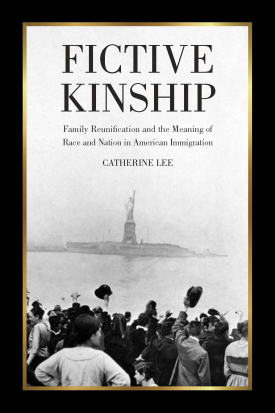
Fictive Kinship
About This Book
“Amid the current debates about immigration, highly skilled and unauthorized immigrants have taken the center stage. But in Catherine Lee’s carefully researched and written account, she reminds us that family unification remains the core of regular immigration policy. She traces family unification back to the nineteenth century and explains why families remain the core of policy and what the meaning of family is for racial and national issues. For those wanting to know what functions family unification serves for immigration policy, Fictive Kinship is required reading. Family unification will no doubt still be the core of policy. For, after all, what will become of the families of the undocumented who might become legal?”
—David M. Reimers, professor emeritus of history, New York University
“Fictive Kinship is a fascinating examination of what family has meant in the history of U.S. immigration. Family reunification has facilitated the entry of many immigrants, and as Professor Lee shows, it has done so long before passage of the 1965 Hart-Cellar Act. The book’s key contribution is showing how family has been fictively constructed, with its meaning shifting to support inclusionary and exclusionary positions and linked to ideas about the nation-state, race, and gender. This is critical reading for all those interested in immigration—and it reveals the critical place that the family plays in this process.”
—Katharine M. Donato, professor and chair, Department of Sociology, Vanderbilt University
Today, roughly 70 percent of all visas for legal immigration are reserved for family members of permanent residents or American citizens. Family reunification—policies that seek to preserve family unity during or following migration—is a central pillar of current immigration law, but it has existed in some form in American statutes since at least the mid-nineteenth century. In Fictive Kinship, sociologist Catherine Lee delves into the fascinating history of family reunification to examine how and why our conceptions of family have shaped immigration, the meaning of race, and the way we see ourselves as a country.
Drawing from a rich set of archival sources, Fictive Kinship shows that even the most draconian anti-immigrant laws, such as the Chinese Exclusion Act of 1882, contained provisions for family unity, albeit for a limited class of immigrants. Arguments for uniting families separated by World War II and the Korean War also shaped immigration debates and the policies that led to the landmark 1965 Immigration Act. Lee argues that debating the contours of family offers a ready set of symbols and meanings to frame national identity and to define who counts as “one of us.” Talk about family, however, does not inevitably lead to more liberal immigration policies. Welfare reform in the 1990s, for example, placed limits on benefits for immigrant families, and recent debates over the children of undocumented immigrants fanned petitions to rescind birthright citizenship. Fictive Kinship shows that the centrality of family unity in the immigration discourse often limits the discussion about the goals, functions and roles of immigration and prevents a broader definition of American identity.
Too often, studies of immigration policy focus on individuals or particular ethnic or racial groups. With its original and wide-ranging inquiry, Fictive Kinship shifts the analysis in immigration studies toward the family, a largely unrecognized but critical component in the regulation of immigrants’ experience in America.
CATHERINE LEE is associate professor of sociology and faculty associate at the Institute for Health, Health Care Policy, and Aging Research at Rutgers University.