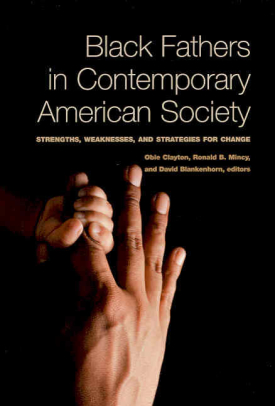
Black Fathers in Contemporary American Society
About This Book
"Perhaps the greatest social science debate as we move into the twenty-first century is the changing nature of the American family, and all the consequences of these changes. Black Fathers in Contemporary American Society is one of the few books that takes a non-politically correct view of these changes. Using research on black fathers as data, the work presents an academic view of the difficult relationships between men and women, who benefits from such relationships, and the differences in socioeconomic categories. This work should set the standard and be a reference for all research in the area of marriage and the family."
-JOHN SIBLEY BUTLER, professor of sociology and management, The University of Texas at Austin
"Fathers must be brought back into the picture, especially in a social context in which a huge absolute percentage of black families are single-parent, female-headed households and in which African Americans, especially young black men, face an alarmingly high lifetime probability of incarceration. Both the research and policymaking communities should sift carefully through this important set of studies, which make a vital contribution to filling the enormous gap in our thinking about African American fathers and families."
-LAWRENCE D. BOBO, Norman Tishman and Charles M. Diker Professor of Sociology and African American Studies, Harvard University, from the foreword of Black Fathers in Contemporary American Society
The majority of African American children live in homes without their fathers, but the proportion of African American children living in intact, two-parent families has risen significantly since 1995. Black Fathers in Contemporary American Society looks at father absence from two sides, offering an in-depth analysis of how the absence of African American fathers affects their children, their relationships, and society as a whole, while countering the notion that father absence and family fragmentation within the African American community is inevitable.
Editors Obie Clayton, Ronald B. Mincy, and David Blankenhorn lead a diverse group of contributors encompassing a range of disciplines and ideological perspectives who all agree that father absence among black families is one of the most pressing social problems today. In part I, the contributors offer possible explanations for the decline in marriage among African American families. William Julius Wilson believes that many men who live in the inner city no longer consider marriage an option because their limited economic prospects do not enable them to provide for a family. Part II considers marriage from an economic perspective, emphasizing that it is in part a wealth-producing institution. Maggie Gallagher points out that married people earn, invest, and save more than single people, and that when marriage rates are low in a community, it is the children who suffer most. In part III, the contributors discuss policies to reduce absentee fatherhood. Wornie Reed demonstrates how public health interventions, such as personal development workshops and work-related skill-building services, can be used to address the causes of fatherlessness. Wade Horn illustrates the positive results achieved by fatherhood programs, especially when held early in a man's life. In the last chapter, Enola Aird notes that from 1995 to 2000, the proportion of African American children living in two-parent, married couple homes rose from 34.8 to 38.9 percent; a significant increase indicating the possible reversal of the long-term shift toward black family fragmentation.
Black Fathers in Contemporary American Society provides an in-depth look at a problem affecting millions of children while offering proof that the trend of father absence is not irrevocable.
OBIE CLAYTON is professor and chair of the Sociology Department at Morehouse College and executive director of the Morehouse Research Institute.
RONALD B. MINCY is the Maurice V. Russell Professor of Social Policy and Social Work Practice at the School of Social Work, Columbia University.
DAVID BLANKENHORN is president of the Institute for American Values.
CONTRIBUTORS: Enola G. Aird, David Blankenhorn, Lawrence D. Bobo, Obie Clayton, Maggie Gallagher, Wade F. Horn, Ronald B. Mincy, Joan W. Moore, Barbara Morrison-Rodriguez, Steven L. Nock, Hillard Pouncy, Wornie L. Reed, and William Julius Wilson.