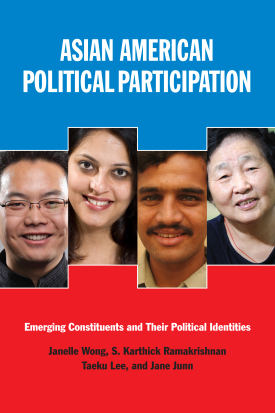
Asian American Political Participation
About This Book
"Asian American Political Participation provides a revealing and nuanced analysis of the political attitudes and voting preferences of the rapidly growing, highly diverse, and increasingly influential population of sixteen million Asian Americans. Based on the first-ever large-scale, multilingual national survey, this work is a 'must read' for all who study or participate in American electoral politics, the politics of race and ethnicity, and the political acculturation of immigrants. The team of Janelle Wong, S. Karthick Ramakrishnan, Taeku Lee, and Jane Junn has made an exceptional contribution to public knowledge and research about the growing impact and visibility of Asian American voters, donors, activists, and politicians."
-DON T. NAKANISHI, University of California, Los Angeles
"In this theoretically nuanced and empirically sophisticated study, these brilliant young political scientists not only decipher the paradoxes of Asian American political engagement, they show why it requires us to redefine our understanding of political participation in America-and how to do so. Destined to be a classic."
-JOHN MOLLENKOPF, CUNY Graduate Center
"Path-breaking in its evidence and in the sophistication of interpretation, Asian American Political Participation is an indispensable study for anyone interested in Asian Americans in American politics. The four authors, all leading specialists, offer rich insights into why Asian Americans are voting as they are. With Asian Americans becoming an increasingly important constituency, this book is useful and most timely."
-GORDON H. CHANG, Stanford University
"This book is outstanding for explaining participation rates across Asian American individuals and groups. Using new national survey data, the authors of this breakthrough study identify commonalities among Asian Americans, but also differences by national origin that produce significant variation in civic engagement. Although much is known about the general causes of political activity, the valuable lesson of Asian American Political Participation is that theory depends critically on group contexts that are rooted in politics, geography, history, and race."
-DENNIS CHONG, Northwestern University
Asian Americans are a small percentage of the U.S. population, but their numbers are steadily rising—from less than a million in 1960 to more than 15 million today. They are also a remarkably diverse population—representing several ethnicities, religions, and languages—and they enjoy higher levels of education and income than any other U.S. racial group. Historically, socioeconomic status has been a reliable predictor of political behavior. So why has this fast-growing American population, which is doing so well economically, been so little engaged in the U.S. political system? Asian American Political Participation is the most comprehensive study to date of Asian American political behavior, including such key measures as voting, political donations, community organizing, and political protests. The book examines why some groups participate while others do not, why certain civic activities are deemed preferable to others, and why Asian socioeconomic advantage has so far not led to increased political clout.
Asian American Political Participation is based on data from the authors’ groundbreaking 2008 National Asian American Survey of more than 5,000 Chinese, Indian, Vietnamese, Korean, Filipino, and Japanese Americans. The book shows that the motivations for and impediments to political participation are as diverse as the Asian American population. For example, native-born Asians have higher rates of political participation than their immigrant counterparts, particularly recent adult arrivals who were socialized outside of the United States. Protest activity is the exception, which tends to be higher among immigrants who maintain connections abroad and who engaged in such activity in their country of origin. Surprisingly, factors such as living in a new immigrant destination or in a city with an Asian American elected official do not seem to motivate political behavior—neither does ethnic group solidarity. Instead, hate crimes and racial victimization are the factors that most motivate Asian Americans to participate politically. Involvement in non-political activities such as civic and religious groups also bolsters political participation. Even among Asian groups, socioeconomic advantage does not necessarily translate into high levels of political participation. Chinese Americans, for example, have significantly higher levels of educational attainment than Japanese Americans, but Japanese Americans are far more likely to vote and make political contributions. And Vietnamese Americans, with the lowest levels of education and income, vote and engage in protest politics more than any other group.
Lawmakers tend to favor the interests of groups who actively engage the political system, and groups who do not participate at high levels are likely to suffer political consequences in the future. Asian American Political Participation demonstrates that understanding Asian political behavior today can have significant repercussions for Asian American political influence tomorrow.
JANELLE WONG is associate professor of political science and American studies and ethnicity at the University of Southern California and director of the Institute of Public Service at Seattle University.
S. KARTHICK RAMAKRISHNAN is associate professor of political science at the University of California, Riverside.
TAEKU LEE is professor of political science and law at the University of California, Berkeley.
JANE JUNN is professor of political science at the University of Southern California.