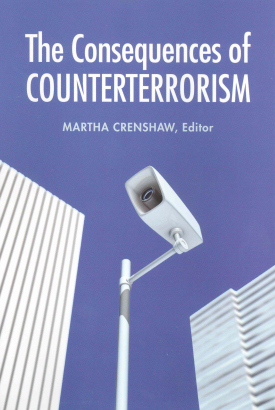
The Consequences of Counterterrorism
About This Book
“It is past time to take stock of the costs and benefits of, and the alternatives to, the most important post-9/11 changes in the practices of Western nations to deal with terrorism. Under the leadership of one of our most distinguished experts in terrorism, Professor Martha Crenshaw, a set of scholars has produced a book that does review the changed policies and practices with the breadth of coverage and depth of examination of major decisions the subject demands. There is much to be learned from The Consequences of Counterterrorism in terms of assessment of the successes and failures and unexplored costs of our past efforts.”
–Philip B. Heymann, Harvard Law School
“Sweeping statutory and institutional alterations mark liberal democratic responses to terrorism post-9/11. The political and legal costs of these provisions, however, have gone virtually unnoticed in the political science literature. The Consequences of Counterterrorism fills this vacuum, surveying an impressive array of countries in Asia, Europe, the Middle East, and North America. With ground-breaking research, the volume is a must-read for anyone seeking to better understand the effects of counterterrorist law.”
–Laura Donohue, Georgetown Law School
“Martha Crenshaw has assembled a first-rate team of international scholars to assess the effects on democratic governance of the counterterrorism measures adopted by Britain, France, Germany, Spain, Israel, and Japan. The result is an excellent and essential volume for all those concerned with the rule of law, the protection of civil liberties, and more generally, the striking of the right balance between protecting democracies from terrorists, on the one hand, and preserving the foundations of democracy, on the other.”
–Robert J. Art, Brandeis University
The 9/11 terrorist attacks opened America’s eyes to a frightening world of enemies surrounding us. But have our eyes opened wide enough to see how our experiences compare with other nations’ efforts to confront and prevent terrorism? Other democracies have long histories of confronting both international and domestic terrorism. Some have undertaken progressively more stringent counterterrorist measures in the name of national security and the safety of citizens. The Consequences of Counterterrorism examines the political costs and challenges democratic governments face in confronting terrorism.
Using historical and comparative perspectives, The Consequences of Counterterrorism presents thematic analyses as well as case studies of Britain, France, Germany, Spain, Japan, and Israel. Contributor John Finn compares post-9/11 antiterrorism legislation in the United States, Europe, Canada, and India to demonstrate the effects of hastily drawn policies on civil liberties and constitutional norms. Chantal de Jonge Oudraat and Jean-Luc Marret assert that terrorist designation lists are more widespread internationally than ever before. The authors examine why governments and international organizations use such lists, how they work, and why they are ineffective tools. Gallya Lahav shows how immigration policy has become inextricably linked to security in the EU and compares the European fear of internal threats to the American fear of external ones.
A chapter by Dirk Haubrich explains variation in the British government’s willingness to compromise democratic principles according to different threats. In his look at Spain and Northern Ireland, Rogelio Alonso asserts that restricting the rights of those who perpetrate ethnonationalist violence may be acceptable in order to protect the rights of citizens who are victims of such violence. Jeremy Shapiro considers how the French response to terrorist threats has become more coercive during the last fifty years. Israel’s “war model” of counterterrorism has failed, Ami Pedahzur and Arie Perliger argue, and is largely the result of the military elite’s influence on state institutions. Giovanni Cappocia explains how Germany has protected basic norms and institutions. In contrast, David Leheny stresses the significance of change in Japan’s policies.
Preventing and countering terrorism is now a key policy priority for many liberal democratic states. As The Consequences of Counterterrorism makes clear, counterterrorist policies have the potential to undermine the democratic principles, institutions, and processes they seek to preserve.
MARTHA CRENSHAW is senior fellow at the Center for International Security and Cooperation and Freeman Spogli Institute for International Studies at Stanford University, and a professor of political science by courtesy, as well as professor of government, emerita, at Wesleyan University.
CONTRIBUTORS: Rogelio Alonso, Giovanni Capoccia, Martha Crenshaw, Chantal de Jonge Oudraat, John E. Finn, Dirk Haubrich, Gallya Lahav, David Leheny, Jean-Luc Marret, Ami Pedahzur, Arie Perliger, and Jeremy Shapiro.