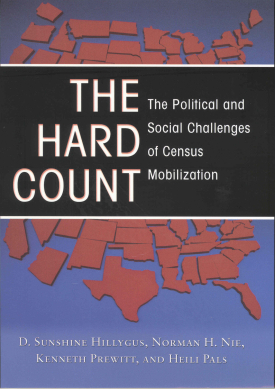
The Hard Count
About This Book
"The Hard Count is rich in implications for both the practical business of the census and the understanding of the influence of communications on public attitudes and behavior. It should command the discipline's attention, and much more frequently than every ten years."
-POLITICAL SCIENCE QUARTERLY
"Using survey statistics, social theory, and informed and thoughtful explanations of Americans' response to the 2000 census, this book provides new insights on those who respond to surveys and those who do not. All who are interested in the quality of census data on which government policy is built should read The Hard Count."
-JANET L. NORWOOD, former U.S. Commissioner of Labor Statistics
"Aptly named, The Hard Count examines the challenges in conducting the 2000 decennial census and examines empirically the roots of participation. The authors provide some important recommendations for future censuses, as well as challenging some conventional wisdom on the determinants of civic participation. I recommend it to anyone interested in the future of the census and the federal statistical system."
-NORMAN M. BRADBURN, Tiffany and Margaret Blake Distinguished Service Professor Emeritus, Harris Graduate School of Public Policy Studies, University of Chicago
"A highly accessible portrayal of the seemingly arcane but fundamentally important relationship between census data collectors and respondents. All who make decisions about our next decennial enumeration can profit from a few hours spent with The Hard Count."
-KATHERINE K. WALLMAN, chief statistician, U.S. Office of Management and Budget
American democracy relies on an accurate census to fairly allocate political representation and billions of dollars in federal funds. Declining participation in previous censuses and a general waning of civic engagement in society raised the possibility that the 2000 count would miss many Americans—disproportionately ethnic and racial minorities—depriving them of their share of influence in American society and yielding an unfair distribution of federal resources. Faced with this possibility, the Census Bureau launched a massive mobilization campaign to encourage Americans to complete and return their census forms. In The Hard Count, former Census Bureau director Kenneth Prewitt, D. Sunshine Hillygus, Norman H. Nie, and Heili Pals present a rigorous evaluation of this campaign. Can a busy, mobile, disengaged public be motivatived to participate in this civic activity? Using a rich set of data and drawing on theories of civic mobilization, political persuasion, and media effects, the authors assess the factors that influenced participation in the 2000 census.
The Hard Count profiles a watershed moment in the history of the American census. As the mobilization campaign was underway, political opposition to the census sprang up, citing privacy issues and seeking to limit the kind of data the census could collect. Hillygus, Nie, Prewitt, and Pals analyze the competing effects of the mobilization campaign and the privacy controversy on public attitudes and cooperation with the census. Using an internet based survey, the authors tracked a representative sample of Americans over time to gauge changes in census attitudes, privacy concerns, and their eventual decision whether or not to return their census form. The study uniquely captures the public’s exposure to census advertising, community mobilization, and news stories, and was designed so people could view video clips and photos of actual campaign advertisements on their sets in their homes. The authors find that the Census Bureau campaign did in fact raise awareness of the census and census participation. The mobilization campaign was especially effective at increasing participation among groups historically undercounted by the census. They also find that census participation would have been higher if not for the privacy controversy, which discouraged many people from cooperating with the census and led others to omit information from their census form. The findings of The Hard Count have important policy implications for future census counts and offer theoretical insights regarding the influence of mobilization campaigns on civic participation.
The goal of full and equal cooperation with the decennial census and other government surveys is an important national priority. The Hard Count shows that a mobilization campaign can dramatically increase voluntary participation in the decennial headcount and identifies emerging social and political challenges that may threaten future census counts and contribute to the growing fragility of our national statistical system.
D. SUNSHINE HILLYGUS is assistant professor of government at Harvard University.
NORMAN H. NIE is director of the Stanford Institute for the Quantitative Study of Society.
KENNETH PREWITT is Carnegie Professor of Public Affairs at Columbia University.
HEILI PALS is a doctoral student in the Department of Sociology at Stanford University.
A Volume in the RSF Census Series