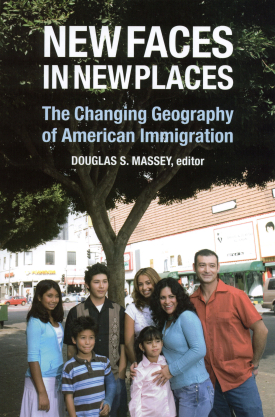
New Faces in New Places
About This Book
"In this volume Douglas Massey has brought together some of the best of the first wave scholarship on these 'new destinations.' With an eclectic mix of demography, quantitative analysis, in-depth interviews, and ethnography New Faces in New Places provides the best overview we have so far of what is happening in these communities"
-CONTEMPORARY SOCIOLOGY
"The historically unprecedented geographic dispersal of U.S. immigrants is redefining inter-group relations and labor markets. Using a range of quantitative and qualitative methods, Douglas S. Massey and his collaborators address myriad aspects of this unfolding social narrative to identify its causes and consequences for the newcomers, for their host communities, for their employers, and for their families. This volume should be required reading for state and local officials in the new immigrant destinations, for political pundits obsessed with enforcement, and U.S. representatives who will reform future immigration laws. New Faces in New Places is another home run!"
-MARTA TIENDA, Maurice P. During '22 Professor in Demographic Studies and professor of sociology and public affairs, Princeton University
"This enlightening volume aims to explain the dramatic shift in the geography of immigrant settlement since the 1990s, and to explore its wide-ranging consequences for new receiving communities in the South and Midwest-from changed intergroup relations to the responses of local institutions and the immigrants themselves. New Faces in New Places is essential reading to grasp this historic transformation of American communal and national life."
-RUBEN G. RUMBAUT, professor of sociology, University of California, Irvine
"The rapid dispersion of immigrants to rural areas, big cities, towns and suburbs in every region of the United States is one of the most important sociological and demographic developments of the turn of the century. As immigrants arrive and begin to change the face of their newly found gateways, local residents react and often resist the sudden transformation of familiar landscapes. The essays brought together by Douglas Massey in this volume show that whether in the nation's capital, in vibrant Nashville, or in the meatpacking towns of the Midwest, the sinuous path that lies ahead will provide many surprises. Aptly balancing macro and micro perspectives and quantitative and qualitative approaches, New Faces in New Places maps out the complex route of settlement, incorporation, and inter-group relations in new immigrant destinations, and is bound to become a necessary point of reference in this burgeoning field."
-RUBÉN HERNÁNDEZ-LEÓN, assistant professor of sociology, University of California, Los Angeles
Beginning in the 1990s, immigrants to the United States increasingly bypassed traditional gateway cites such as Los Angeles and New York to settle in smaller towns and cities throughout the nation. With immigrant communities popping up in so many new places, questions about ethnic diversity and immigrant assimilation confront more and more Americans. New Faces in New Places, edited by distinguished sociologist Douglas Massey, explores today’s geography of immigration and examines the ways in which native-born Americans are dealing with their new neighbors.
Using the latest census data and other population surveys, New Faces in New Places examines the causes and consequences of the shift toward new immigrant destinations. Contributors Mark Leach and Frank Bean examine the growing demand for low-wage labor and lower housing costs that have attracted many immigrants to move beyond the larger cities. Katharine Donato, Charles Tolbert, Alfred Nucci, and Yukio Kawano report that the majority of Mexican immigrants are no longer single male workers but entire families, who are settling in small towns and creating a surge among some rural populations long in decline. Katherine Fennelly shows how opinions about the growing immigrant population in a small Minnesota town are divided along socioeconomic lines among the local inhabitants. The town’s leadership and professional elites focus on immigrant contributions to the economic development and the diversification of the community, while working class residents fear new immigrants will bring crime and an increased tax burden to their communities. Helen Marrow reports that many African Americans in the rural south object to Hispanic immigrants benefiting from affirmative action even though they have just arrived in the United States and never experienced historical discrimination. As Douglas Massey argues in his conclusion, many of the towns profiled in this volume are not equipped with the social and economic institutions to help assimilate new immigrants that are available in the traditional immigrant gateways of New York, Los Angeles, and Chicago. And the continual replenishment of the flow of immigrants may adversely affect the nation’s perception of how today’s newcomers are assimilating relative to previous waves of immigrants.
New Faces in New Places illustrates the many ways that communities across the nation are reacting to the arrival of immigrant newcomers, and suggests that patterns and processes of assimilation in the twenty-first century may be quite different from those of the past. Enriched by perspectives from sociology, anthropology, and geography New Faces in New Places is essential reading for scholars of immigration and all those interested in learning the facts about new faces in new places in America.
DOUGLAS S. MASSEY is Henry G. Bryant Professor of Sociology and Public Affairs at the Woodrow Wilson School.
CONTRIBUTORS: Carl L. Bankston III, Frank D. Bean, Chiara Capoferro, Katharine M. Donato, Katherine Fennelly, David Griffith, Charles Hirschman, Michael Jones-Correa, William Kandel, Yukio Kawano, Mark A. Leach, Helen B. Marrow, Alfred Nucci, Emilio A. Parrado, Debra Lattanzi Shutika, Charles Tolbert, Jamie Winders.