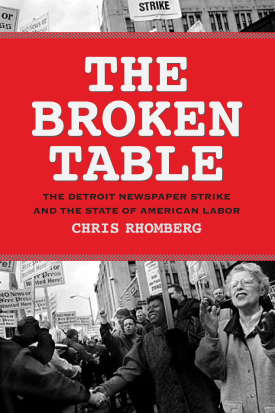
The Broken Table
About This Book
Winner of the 2013 Distinguished Scholarly Book Award of the Labor and Labor Movements Section of the American Sociological Association
“Chris Rhomberg provides a rich example of why, in an era of emboldened corporate power, worker-community solidarity and filing legal challenges are no longer enough to win strikes and collective bargaining agreements.”
—Kate L. Bronfenbrenner, Cornell University
“In prose both accessible and dramatic, Chris Rhomberg has given us a profound and carefully detailed analysis of a landmark struggle between labor and management in the ’90s. But Professor Rhomberg’s work is not only an authoritative chronicle of the 1995 Detroit newspaper strike—one of the most important cases to come before me during my National Labor Relations Board tenure. It is also a broad, sweeping, and profound examination of the state of labor-management relations today and historically in the United States and an important discussion about the ongoing need for labor law reform. His book effectively links the changing bargaining table and its erosion to the growing inequality in our society. The Broken Table is must reading for all concerned with the changing labor landscape, Detroit, and the political-economic challenges ahead.”
—William B. Gould IV, National Labor Relations Board
“Chris Rhomberg brings to his account of this epic conflict the kind of historical understanding, sociological insight, and legal acumen that illuminates the world of work in our day. The Broken Table is essential reading for anyone who wants to grasp the profound economic and ideological ruptures that have so decimated American unions and eroded working-class living standards during the last three decades.”
—Nelson N. Lichtenstein, University of California, Santa Barbara
When the Detroit newspaper strike was settled in December 2000, it marked the end of five years of bitter and violent dispute. No fewer than six local unions, representing 2,500 employees, struck against the Detroit News, the Detroit Free Press, and their corporate owners, charging unfair labor practices. The newspapers hired permanent replacement workers and paid millions of dollars for private security and police enforcement; the unions and their supporters took their struggle to the streets by organizing a widespread circulation and advertising boycott, conducting civil disobedience, and publishing a weekly strike newspaper. In the end, unions were forced to settle contracts on management's terms, and fired strikers received no amnesty.
In The Broken Table, Chris Rhomberg sees the Detroit newspaper strike as a historic collision of two opposing forces: a system in place since the New Deal governing disputes between labor and management, and decades of increasingly aggressive corporate efforts to eliminate unions. As a consequence, one of the fundamental institutions of American labor relations—the negotiation table—has been broken, Rhomberg argues, leaving the future of the collective bargaining relationship and democratic workplace governance in question.
The Broken Table uses interview and archival research to explore the historical trajectory of this breakdown, its effect on workers' economic outlook, and the possibility of restoring democratic governance to the business-labor relationship. Emerging from the New Deal, the 1935 National Labor Relations Act protected the practice of collective bargaining and workers' rights to negotiate the terms and conditions of their employment by legally recognizing union representation. This system became central to the democratic workplace, where workers and management were collective stakeholders. But efforts to erode the legal protections of the NLRA began immediately, leading to a parallel track of anti-unionism that began to gain ascendancy in the 1980s. The Broken Table shows how the tension created by these two opposing forces came to a head after a series of key labor disputes over the preceding decades culminated in the Detroit newspaper strike. Detroit union leadership charged management with unfair labor practices after employers had unilaterally limited the unions' ability to bargain over compensation and work conditions. Rhomberg argues that, in the face of management claims of absolute authority, the strike was an attempt by unions to defend workers' rights and the institution of collective bargaining, and to stem the rising tide of post-1980s anti-unionism.
In an era when the incidence of strikes in the United States has been drastically reduced, the 1995 Detroit newspaper strike stands out as one of the largest and longest work stoppages in the past two decades. A riveting read full of sharp analysis, The Broken Table revisits the Detroit case in order to show the ways this strike signaled the new terrain in labor-management conflict. The book raises broader questions of workplace governance and accountability that affect us all.
CHRIS RHOMBERG is associate professor of sociology at Fordham University.