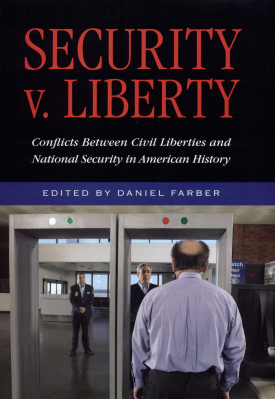
Security v. Liberty
About This Book
“This outstanding collection of essays, by an accomplished group of historians and legal academics, describes how civil liberties have been limited in the name of real or imagined threats to the nation’s security in the past—and then shows how we might apply the lessons of earlier eras to our current situation. It is hard to think of a more important subject, or of a group of authors who are better qualified to teach us about it.”
—David A. Strauss , Gerald Ratner Distinguished Service Professor of Law, University of Chicago Law School
“Since 9/11 the tension between national security and civil liberties has again become a pressing issue of public concern. The concise, thoughtful, and well-written essays in this volume provide valuable perspectives on current debates by analyzing this tension during key episodes throughout American history. Contributed by a diverse group of leading scholars, Security v. Liberty raises fascinating questions and reaches provocative conclusions about both the similarities and the differences between the response to 9/11 and the experience of the past.”
—David M. Rabban, Dahr Jamail, Randall Hage Jamail, and Robert Lee Jamail Regents Chair in Law and Distinguished Teaching Professor, University of Texas School of Law
“What is and what is not unprecedented about national security in a post-9/11 world? What is or is not unprecedented about the Bush administration’s reaction to that world? Security v. Liberty helps us break out of our reflexive debate about civil liberties in times of crisis by looking back to our historical experience, and then insisting on distinguishing between appropriate and outmoded historical lessons. These essays by lawyers, historians, and political and legal scholars challenge our assumptions about just what may be at risk in an emergency that is both very similar and very different from those we have confronted in the past, and press us to consider not only the traditional concerns about speech and the freedom to criticize the government and its policies, but also about some very different threats to liberty involving the judicial and political branches of government itself, and their ability to check and balance each other. How those institutions have-and how they might yet-respond to these new challenges is the debate we need to have, and Security v. Liberty provides a provocative and compelling foundation on which to build that debate.”
—Gordon Silverstein, assistant professor of political science, University of California, Berkeley
In the weeks following 9/11, the Bush administration launched the Patriot Act, rejected key provisions of the Geneva Convention, and inaugurated a sweeping electronic surveillance program for intelligence purposes—all in the name of protecting national security. But the current administration is hardly unique in pursuing such measures. In Security v. Liberty, Daniel Farber leads a group of prominent historians and legal experts in exploring the varied ways in which threats to national security have affected civil liberties throughout American history. Has the government’s response to such threats led to a gradual loss of freedoms once taken for granted, or has the nation learned how to restore civil liberties after threats subside and how to put protections in place for the future?
Security v. Liberty focuses on periods of national emergency in the twentieth century—from World War I through the Vietnam War—to explore how past episodes might bear upon today’s dilemma. Distinguished historian Alan Brinkley shows that during World War I the government targeted vulnerable groups—including socialists, anarchists, and labor leaders—not because of a real threat to the nation, but because it was politically expedient to scapegoat unpopular groups. Nonetheless, within ten years the Supreme Court had rolled back the most egregious of the World War I restrictions on civil liberties. Legal scholar John Yoo argues for the legitimacy of the Bush administration’s War on Terror policies—such as the detainment and trials of suspected al Qaeda members—by citing historical precedent in the Roosevelt administration’s prosecution of World War II. Yoo contends that, compared to Roosevelt’s sweeping use of executive orders, Bush has exercised relative restraint in curtailing civil liberties. Law professor Geoffrey Stone describes how J. Edgar Hoover used domestic surveillance to harass anti-war protestors and civil rights groups throughout the 1960s and early 1970s. Congress later enacted legislation to prevent a recurrence of the Hoover era excesses, but Stone notes that the Bush administration has argued for the right to circumvent some of these restrictions in its campaign against terrorism. Historian Jan Ellen Lewis looks at early U.S. history to show how an individual’s civil liberties often depended on the extent to which he or she fit the definition of “American” as the country’s borders expanded. Legal experts Paul Schwartz and Ronald Lee examine the national security implications of rapid advances in information technology, which is increasingly driven by a highly globalized private sector, rather than by the U.S. government.
Security v. Liberty shows that civil liberties are a not an immutable right, but the historically shifting result of a continuous struggle that has extended over two centuries. This important new volume provides a penetrating historical and legal analysis of the trade-offs between security and liberty that have shaped our national history—trade-offs that we confront with renewed urgency in a post-9/11 world.
DANIEL FARBER is Sho Sato Professor of Law at the University of California, Berkeley.
CONTRIBUTORS: Alan Brinkley, Stephen Holmes, Ronald D. Lee, Jan Ellen Lewis, L.A. Powe Jr., Ellen Schrecker, Geoffrey R. Stone, John Yoo.