U.S. employment law prohibits discrimination on the basis of age, race, or sex. However, studies have found evidence of illegal discrimination by randomly assigning names that signify race or other protected characteristics to fictitious resumes submitted to actual job vacancies. Several of these experiments reveal substantially lower callback rates for names associated with minority groups.
Books
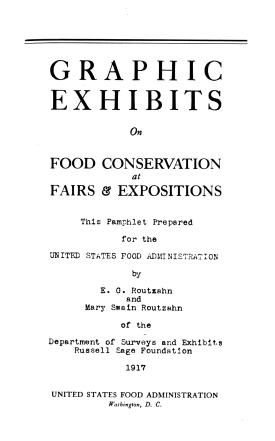
Graphic Exhibits on Food Conservation at Fairs and Expositions
Publication Date
31 pages
About This Book
A study of food conservation efforts as documented across exhibits and demonstrations at state, district, and county fairs in the United States, focusing on efforts to conserve wheat and fats.
EVART G. ROUTZAHN was associate director of the Department of Surveys and Exhibits at the Russell Sage Foundation.
MARY SWAIN ROUTZAHN was director of the Department of Social Work Interpretation at the Russell Sage Foundation.
Download
RSF Journal
View Book Series
Sign Up For Our Mailing List
Apply For Funding
Co-funded with the Washington Center for Equitable Growth
The employment of prime-aged men has been declining since the 1980s. Economists have focused on the role of stagnant or declining real wages in discouraging work and on the underlying causes of those declining wages. However, they have paid little attention to the long-term patterns and dynamics of male prime-age non-employment and the long-term consequences of non-employment for individual men.
Co-funded with the Washington Center for Equitable Growth
Research on the effects of family leave laws shows that, on average, the availability of paid leave increases leave taking. However, the evidence on the effects of paid leave on parents’ careers or their children’s outcomes in the short term for families at different places in the income distribution is limited. There is also a lack of research on the long-run effects of these programs on parents’ careers, childbearing, and marital stability.
Books
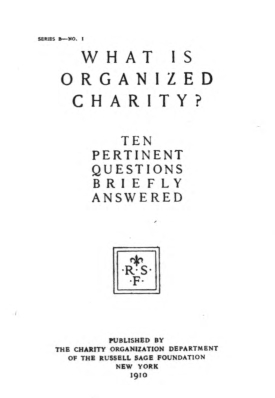
What Is Organized Charity?
Ten Pertinent Questions Briefly Answered
Publication Date
16 pages
About This Book
A 1910 pamphlet published by the Charity Organization Department of the Russell Sage Foundation explaining the work and aims of associated charities and their role in society.
Download
RSF Journal
View Book Series
Sign Up For Our Mailing List
Apply For Funding
This project will use a field experiment to determine whether or not individuals value food differently when obtained from a food pantry versus a store. Data will be collected through a willingness to pay activity with food pantry clients as experiment participants.
Books
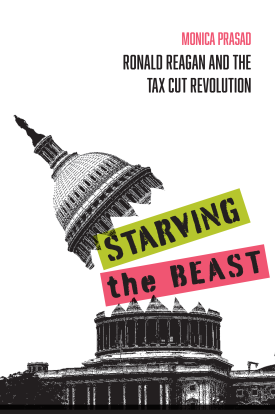
Starving the Beast
Ronald Reagan and the Tax Cut Revolution
About This Book
Winner of the 2019 Viviana Zelizer Best Book Award from the Section of Economic Sociology of the American Sociological Association
“Monica Prasad begins with an unabashedly favorable view of European welfare states yet gives validity to conservative concerns over taxing production rather than consumption. Readers from all political suasions shouldn’t be deterred by whether they agree with theses like these. By reading Starving the Beast, they will garner much better understanding of the history, events, and forces surrounding the conversion of the Republican party to being the Santa Claus of tax cutting.”
—Eugene Steuerle, Institute Fellow and Richard B. Fisher Chair, The Urban Institute
“Republican commitment to tax cuts is one of most consequential and problematic features of modern American politics. Monica Prasad's fascinating book, Starving the Beast, offers a compelling new explanation of how this came to be.”
—Lane Kenworthy, professor of sociology and Yankelovich Chair in Social Thought University of California, San Diego
Since the Reagan Revolution of the early 1980s, Republicans have consistently championed tax cuts for individuals and businesses, regardless of whether the economy is booming or in recession or whether the federal budget is in surplus or deficit. In Starving the Beast, sociologist Monica Prasad uncovers the origins of the GOP’s relentless focus on tax cuts and shows how this is a uniquely American phenomenon.
Drawing on never-before seen archival documents, Prasad traces the history of the 1981 tax cut—the famous “supply side” tax cut, which became the cornerstone for the next several decades of Republican domestic economic policy. She demonstrates that the main impetus behind this tax cut was not business group pressure, racial animus, or a belief that tax cuts would pay for themselves.
Rather, the tax cut emerged because in America--unlike in the rest of the advanced industrial world—progressive policies are not embedded within a larger political economy that is favorable to business. Since the end of World War II, many European nations have combined strong social protections with policies to stimulate economic growth such as lower taxes on capital and less regulation on businesses than in the United State. Meanwhile, the United States emerged from World War II with high taxes on capital and some of the strongest regulations on business in the advanced industrial world. This adversarial political economy could not survive the economic crisis of the 1970s.
Starving the Beast suggests that taking inspiration from the European model of progressive policies embedded in market-promoting political economy could serve to build an American economy that works better for all.
MONICA PRASAD is professor of sociology and faculty fellow in the Institute for Policy Research at Northwestern University.
Download
RSF Journal
View Book Series
Sign Up For Our Mailing List
Apply For Funding
Co-funded with the Carnegie Corporation
About two-thirds of the 11 million undocumented immigrants living in the U.S. have been here for a decade or more. Most are employed, have U.S.-born children and participate in the economic and social life of their communities. In industries such as agriculture, construction, housekeeping, and food services, undocumented workers represent a significant share of the labor force. The number of undocumented immigrants grew substantially during the 1990s and through 2006, but has since stabilized.