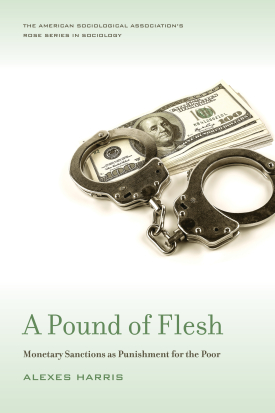
A Volume in the American Sociological Association’s Rose Series in Sociology
“A Pound of Flesh is a critical and timely book on a great contemporary American injustice: the imposition of legal fines and fees through the criminal courts. Alexes Harris’ pioneering research documents the widespread practice of charging fines and fees to people who have contact with the criminal justice system—including some who are never convicted of a crime. The imposition of fines and fees creates a two-tiered legal system that separates those who have the ability to pay from those who don’t. Through careful fieldwork and revealing interviews, Harris shows how judges and court clerks use fines and fees to punish poor people in unequal and enduring ways. Even small amounts of legal debt can be insurmountable obstacles for people living on the margins. A Pound of Flesh is a revolutionary book that has already made an impact on the national policy conversation. It provides an eye-opening account of how the American legal system shapes inequality and how inequality impacts access to justice.”
—Becky Pettit, professor of sociology, The University of Texas at Austin
“A Pound of Flesh is a rich and disturbing account of the new administrative penology that has seeped into every corner of contemporary criminal justice. Alexes Harris uses a full analytic toolkit to show the structure of legal financial obligations that have eclipsed the traditional adjudication role of the courts. Everyone pays, both the guilty and the innocent. Her chilling account reveals the strong embrace of these fines and fees—a regime of defendant taxation—in the everyday culture of criminal justice. Harris sounds an alarm for those who place the principles of due process above the power of the administrative state.”
—Jeffrey Fagan, Isidor and Seville Sulzbacher Professor of Law, Columbia Law School
“Until recently, monetary sanctions remained a largely hidden element of the criminal justice system. Alexes Harris exposes the costs and consequences of these sanctions through a detailed and far-reaching examination. Drawing on legal precedent, state practices, and in-depth interviews, Harris uncovers the unique penalties faced by the poor in encounters with the criminal justice system, as unpayable legal debt becomes a source of permanent punishment. A Pound of Flesh is a must read for those interested in punishment and inequality in America.”
—Devah Pager, professor of sociology and public policy,John F. Kennedy School of Government, Harvard University
Over seven million Americans are either incarcerated, on probation, or on parole, with their criminal records often following them for life and affecting access to higher education, jobs, and housing. Court-ordered monetary sanctions that compel criminal defendants to pay fines, fees, surcharges, and restitution further inhibit their ability to reenter society. In A Pound of Flesh, sociologist Alexes Harris analyzes the rise of monetary sanctions in the criminal justice system and shows how they permanently penalize and marginalize the poor. She exposes the damaging effects of a little-understood component of criminal sentencing and shows how it further perpetuates racial and economic inequality.
Harris draws from extensive sentencing data, legal documents, observations of court hearings, and interviews with defendants, judges, prosecutors, and other court officials. She documents how low-income defendants are affected by monetary sanctions, which include fees for public defenders and a variety of processing charges. Until these debts are paid in full, individuals remain under judicial supervision, subject to court summons, warrants, and jail stays. As a result of interest and surcharges that accumulate on unpaid financial penalties, these monetary sanctions often become insurmountable legal debts which many offenders carry for the remainder of their lives. Harris finds that such fiscal sentences, which are imposed disproportionately on low-income minorities, help create a permanent economic underclass and deepen social stratification.
A Pound of Flesh delves into the court practices of five counties in Washington State to illustrate the ways in which subjective sentencing shapes the practice of monetary sanctions. Judges and court clerks hold a considerable degree of discretion in the sentencing and monitoring of monetary sanctions and rely on individual values—such as personal responsibility, meritocracy, and paternalism—to determine how much and when offenders should pay. Harris shows that monetary sanctions are imposed at different rates across jurisdictions, with little or no state government oversight. Local officials’ reliance on their own values and beliefs can also push offenders further into debt—for example, when judges charge defendants who lack the means to pay their fines with contempt of court and penalize them with additional fines or jail time.
A Pound of Flesh provides a timely examination of how monetary sanctions permanently bind poor offenders to the judicial system. Harris concludes that in letting monetary sanctions go unchecked, we have created a two-tiered legal system that imposes additional burdens on already-marginalized groups.
ALEXES HARRIS is associate professor of sociology at the University of Washington.