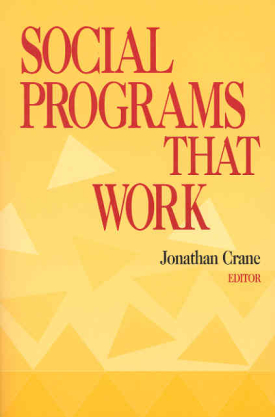
Cover image of the book Social Programs That Work
Books

Social Programs That Work

Editor
Jonathan Crane
Paperback
$24.95
Add to Cart
Publication Date
6 in. × 9 in. 336 pages
ISBN
978-0-87154-174-1
Also Available From

About This Book

"This book demonstrates how we can make substantial progress in the fight against educational failure, family dissolution, violent crime, substance abuse, unemployment, and poverty. It also shows that to do so we must insist that social programs produce demonstrable results and that demonstrably successful programs are replicated across the country. Social Programs that Work is one of the most encouraging and important public policy books written in recent years. Policy makers, educators, parents, everyone who cares about our children and our society should read it."
-CONGRESSMAN RICHARD A. GEPHARDT

"This book offers a powerful antidote to the nihilistic, 'nothing works' mentality that pervades much of the discussion of social policy today. It evidences a candid, rigorous, and often skeptical search for programs that pass a high threshold for impact and credibility. Each program is presented and examined with care and clarity. Social Programs that Work not only offers essential evidence that some programs really ought to be expanded, it also illustrates how rigorous evaluation can allow a nation to learn about and expand those special programs that really do make a difference. Anyone looking for ways to fight our social ills should read this book."
-DAVID ELLWOOD, Harvard University

Many Americans seem convinced that government programs designed to help the poor have failed. Social Programs That Work shows that this is not true. Many programs have demonstrably improved the lives of people trapped at the bottom of the social and economic ladder. Social Programs That Work provides an in-depth look at some of the nation's best interventions over the past few decades, and considers their potential for national expansion.

Examined here are programs designed to improve children's reading skills, curb juvenile delinquency and substance abuse, and move people off welfare into the workforce. Each contributor discusses the design and implementation of a particular program, and assesses how well particular goals were met. Among the critical issues addressed: Are good results permanent, or do they fade over time? Can they be replicated successfully under varied conditions? Are programs cost effective, and if so are the benefits seen immediately or only over the long term? How can public support be garnered for a large upfront investment whose returns may not be apparent for years? Some programs discussed in this volume were implemented only on a small, experimental scale, prompting discussion of their viability at the national level.

An important concern for social policy is whether one-shot programs can lead to permanent results. Early interventions may be extremely effective at reducing future criminal behavior, as shown by the results of the High/Scope Perry preschool program. Evidence from the Life Skills Training Program suggests that a combination of initial intervention and occasional booster sessions can be an inexpensive and successful approach to reducing adolescent substance abuse. Social Programs That Work also acknowledges that simply placing welfare recipients in jobs isn't enough; they will also need long-term support to maintain those jobs.

The successes and failures of social policy over the last thirty-five years have given us valuable feedback about the design of successful social policy. Social Programs That Work represents a landmark attempt to use social science criteria to identify and strengthen the programs most likely to make a real difference in addressing the nation's social ills.

JONATHAN CRANE is director of the National Center for Research on Social Programs in Chicago, Illinois.

CONTRIBUTORS: Clancy Blair, Gilbert J. Bovin, Frances A. Campbell, Patricia Chamberlain, Barbara Devaney, Marcella Dianda, Lawrence J. Dolan, Phyllis L. Ellickson, George Farkas, Nancy A. Madden, Lawrence M. Mead, Kevin Moore, Craig T. Ramey, Arthur J. Reynolds, Steven M. Ross, Lawrence J. Schweinhart, Robert E. Slavin, Lana J. Smith, Barbara A. Wasik, David P. Weikart.

RSF Journal
View Book Series
Sign Up For Our Mailing List
Apply For Funding
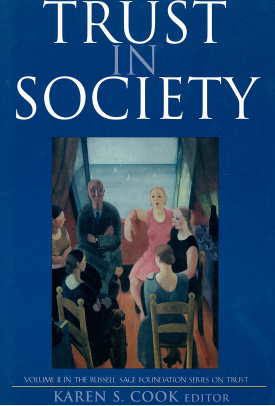
Cover image of the book Trust in Society
Books

Trust in Society

Editor
Karen S. Cook
Paperback
$34.95
Add to Cart
Publication Date
6 in. × 9 in. 432 pages
ISBN
978-0-87154-181-9
Also Available From

About This Book

"The Russell Sage project on trust has been one of the most intellectually fecund enterprises anywhere in the social sciences over the last five years. This latest compendium of the fruits of that project is a wonderfully rich introduction to the research frontiers in the rapidly evolving study of trust, ranging across approaches as diverse as political philosophy, anthropological field work, microeconomic theory, and comparative survey research."
-ROBERT D. PUTNAM, Harvard University

"Drawing insights from a variety of social science disciplines, each essay in Trust in Society is a gem in its own right, but together, the package of chapters underscores how much we know about the dynamics of trust, and yet, how much there is to learn. It is rare for a book to stimulate a scholarly agenda for further theorizing and research, while at the same time, to provide so many leads for public policy and practice. I recommend this book to my fellow theorists, to researchers in search of important new lines of inquiry, and to policymakers.Trust in Society has something for all."
-JONATHAN H. TURNER, University of California, Riverside

"Trust in Society brings together a broad set of scholars from multiple disciplines, all of whom have something insightful to say about trust. Trust plays a crucial role in all social relationships as varying as those of incorporating immigrants in a society, building trust among members of corporate team, or creating a viable congregation. Readers from all disciplines will find many chapters that they can immediately use in their own research and in teaching graduate and undergraduate students."
-ELINOR OSTROM, Indiana University 

Trust plays a pervasive role in social affairs, even sustaining acts of cooperation among strangers who have no control over each other's actions. But the full importance of trust is rarely acknowledged until it begins to break down, threatening the stability of social relationships once taken for granted. Trust in Society uses the tools of experimental psychology, sociology, political science, and economics to shed light on the many functions trust performs in social and political life. The authors discuss different ways of conceptualizing trust and investigate the empirical effects of trust in a variety of social settings, from the local and personal to the national and institutional.

Drawing on experimental findings, this book examines how people decide whom to trust, and how a person proves his own trustworthiness to others. Placing trust in a person can be seen as a strategic act, a moral response, or even an expression of social solidarity. People often assume that strangers are trustworthy on the basis of crude social affinities, such as a shared race, religion, or hometown. Likewise, new immigrants are often able to draw heavily upon the trust of prior arrivals—frequently kin—to obtain work and start-up capital.

Trust in Society explains how trust is fostered among members of voluntary associations—such as soccer clubs, choirs, and church groups—and asks whether this trust spills over into other civic activities of wider benefit to society. The book also scrutinizes the relationship between trust and formal regulatory institutions, such as the law, that either substitute for trust when it is absent, or protect people from the worst consequences of trust when it is misplaced. Moreover, psychological research reveals how compliance with the law depends more on public trust in the motives of the police and courts than on fear of punishment.

The contributors to this volume demonstrate the growing analytical sophistication of trust research and its wide-ranging explanatory power. In the interests of analytical rigor, the social sciences all too often assume that people act as atomistic individuals without regard to the interests of others. Trust in Society demonstrates how we can think rigorously and analytically about the many aspects of social life that cannot be explained in those terms.

KAREN S. COOK is the Ray Lyman Wilbur Professor of Sociology at Stanford University.

CONTRIBUTORS: Michael Bacharach, Jean Ensminger, Diego Gambetta, Robert Gibbons, Russell Hardin, Carol A. Heimer, Jack Knight, Roderick M. Kramer, Gerry Mackie, David M. Messick, Gary Miller, Victor Nee, Jimy Sanders, Dietlind Stolle, Tom R. Tyler, Toshio Yamagishi.

A Volume in the Russell Sage Foundation Series on Trust

RSF Journal
View Book Series
Sign Up For Our Mailing List
Apply For Funding
Cover image of the book Meta-Analysis for Explanation
Books

Meta-Analysis for Explanation

A Casebook
Editor
Thomas D. Cook
Paperback
$32.00
Add to Cart
Publication Date
6 in. × 9 in. 392 pages
ISBN
978-0-87154-228-1
Also Available From

About This Book

Social science research often yields conflicting results: Does juvenile delinquent rehabilitation work? Is teenage pregnancy prevention effective? In an effort to improve the value of research for shaping social policy, social scientists are increasingly employing a powerful technique called meta-analysis. By systematically pulling together findings of a particular research problem, meta-analysis allows researchers to synthesize the results of multiple studies and detect statistically significant patterns among them.

Meta-Analysis for Explanation brings exemplary illustrations of research synthesis together with expert discussion of the use of meta-analytic techniques. The emphasis throughout is on the explanatory applications of meta-analysis, a quality that makes this casebook distinct from other treatments of this methodology. The book features four detailed case studies by Betsy Jane Becker, Elizabeth C. Devine, Mark W. Lipsey, and William R. Shadish, Jr. These are offered as meta-analyses that seek both to answer the descriptive questions to which research synthesis is traditionally directed in the health and social sciences, and also to explore how a more systematic method of explanation might enhance the policy yield of research reviews.

To accompany these cases, a group of the field’s leading scholars has written several more general chapters that discuss the history of research synthesis, the use of meta-analysis and its value for scientific explanation, and the practical issues and challenges facing researchers who want to try this new technique. As a practical resource, Meta-Analysis for Explanation guides social scientists to greater levels of sophistication in their efforts to synthesize the results of social research.

"This is an important book...[it is] another step in the continuing exploration of the wider implications and powers of meta-analytic methods." —Contemporary Psychology

THOMAS D. COOK is at Northwestern University.

HARRIS COOPER is at the University of Missouri.

DAVID S. CORDRAY is at Vanderbilt University.

HEIDI HARTMANN is at Institute for Women's Policy Research.

LARRY V. HEDGES is at University of Chicago.

RICHARD J. LIGHT is at Harvard University.

THOMAS A. LOUIS is at University of Minnesota.

FREDERICK MOSTELLER is at Harvard University.

RSF Journal
View Book Series
Sign Up For Our Mailing List
Apply For Funding