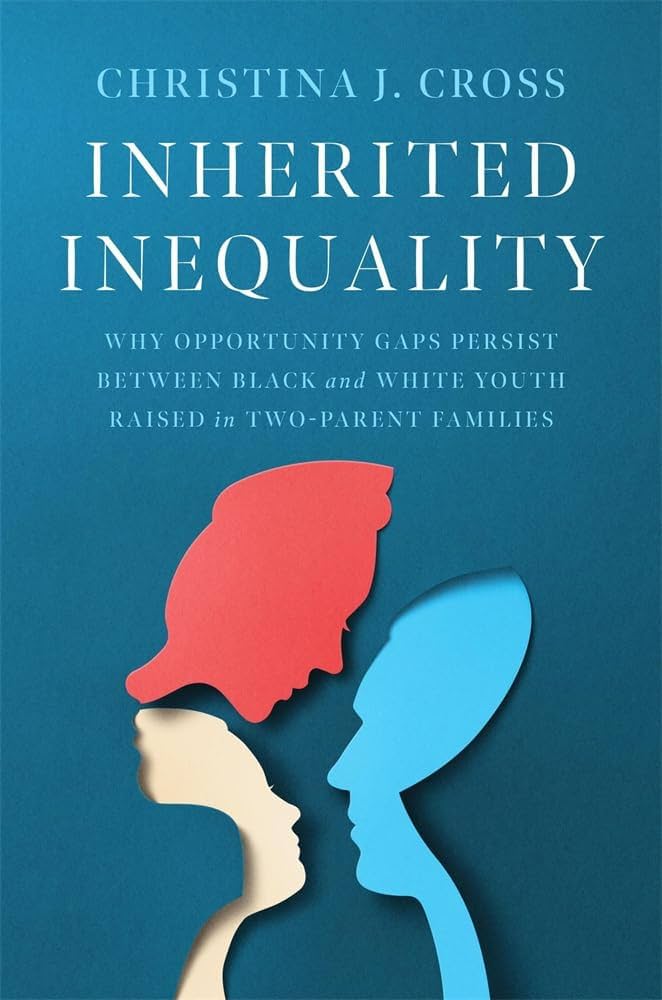
Christina Cross is an RSF visiting scholar and the author of Inherited Inequality: Why Opportunity Gaps Persist between Black and White Youth Raised in Two-Parent Families. Inherited Inequality is a groundbreaking study that challenges basic tenets of U.S. social welfare policy with proof that raising Black children in two-parent families does not close racial gaps in life outcomes. In a new interview with the foundation, Cross discusses her findings. The interview has been edited for length and clarity.
Christina Cross is an associate professor of sociology at Harvard University.
Q. What motivated you to write Inherited Inequality? Why is it important to examine how family structure differentially impacts children’s life chances?
I have a personal connection to this research and also an intellectual one, and just a general interest in this broad topic of family structure and racial inequality. I'm from Milwaukee, Wisconsin, and growing up many folks in my community—be it at church, at school, in my neighborhood—were trying to understand some of the challenges that existed in my low-income African American community. One of the things that frequently came up—almost invariably came up—was the topic of family structure and this idea that the way that children were being raised in my community was different from how it happened in the past. At that time, and even increasingly now, there were more children being raised by a single parent. There were fewer two-parent families, and many folks in my community believe that lied at the center of a lot of the challenges that we were facing and that we’re facing now.
This perspective, as I came to realize, wasn't unique to my community. Recent opinion poll data show that 60% of African Americans, 70% of Hispanic Americans, and 80% of White Americans believe that differences in family background, particularly family structure, lie at the center of the socioeconomic gap between Black and White Americans. So, this is a way of thinking that many Americans embrace.
As I began to do my research, I began to realize that the consequences of living in a two-parent family, or even a single parent family, were not the same across all groups. I thought it was really important to share that, especially as I came to learn how much of our own federal spending was devoted to promoting the two-parent family. One of our largest social safety net programs, Temporary Assistance for Needy Families (TANF)—many people just refer to it as welfare—spends hundreds of millions of dollars each year trying to promote the two-parent family, not only as a way to improve children's life outcomes, but also to reduce racial inequality. Given the broad sort of appeal of this topic and given that there was so little actual information on Black two-parent families, I thought it was important to write a book about it.
Q. In what ways does society valorize marriage and two-parent households?
As I was doing background research for this project, I was really surprised to find the number of laws, programs, and policies that, in one way or another, are promoting the two-parent family. Family scholars and historians have counted, and they estimate that there are over a thousand laws, policies, and practices that promote, protect, or endorse the two-parent family over all other types of family forms. So TANF is just one example where you see very clearly this emphasis on the two-parent family. Three of the four goals of TANF focus on promoting marriage, promoting the two-parent family, and reducing nonmarital births—or out of wedlock births as folks used to call it. But it's not the only program. There's also the Healthy Marriage Initiative, which is a federally funded program that allocates 150 million taxpayer dollars each year to try to encourage individuals to get married and to stay married. So, between TANF and the Healthy Marriage Initiative, we’re already talking about a half billion dollars. But even our tax code is set up in a way to offer the largest tax cuts to married couples and typically married couples that fit the male breadwinner-female caregiver arrangement where one partner brings in the bulk of the income. And so, you see, in many ways, how our own federal government incentivizes, encourages, and rewards a particular type of family structure, the two-parent family over other types of families.
Q. Is marriage and living in a two-parent home a “Great Equalizer”? How do you measure that?
We know that African Americans, on average, in the U.S. tend to have lower educational and economic outcomes. If we think about an equalizer as being the thing that levels the playing field between groups, a “Great Equalizer” would be the thing that led to parity between African Americans and other groups, and so I decided to tackle that head on in my book. I wanted to look at the academic and labor market trajectories of Black and White children who grew up in two-parent families. If this family structure was the “Great Equalizer,” then we really wouldn't expect to see much of a difference in their outcomes. But unfortunately, I found that while their family structures are the same, the outcomes for Black and White children in two-parent families are drastically different, with Black children being at a significant disadvantage in schools and also in the labor market. So, unfortunately, it's not the “Great Equalizer “that many Americans imagine it to be.
I think it's important to get a sense of the magnitude of these gaps. What I found in my research is that, in many cases, the gap between Black and White children in two-parent families is as wide as the gap in outcomes between a child from a single parent family and a two-parent family. There's been a ton of talk about why we should be concerned about children in single parent families and how far behind they are relative to their peers in two-parent families. We should have that same type of concern here, when we see this racial gap among children in two-parent families.
Another thing that I found was really striking as well, and that just really makes it abundantly clear that two-parent families aren’t a “Great Equalizer” is that Black children in two-parent families had outcomes were about the same as White children in single parent families. And, so, in some ways, unfortunately, they're experiencing this perverse two-for one-discount: in order to have the same outcomes as a White child with one parent, a Black child has to have two parents. Given these circumstances, I think it just makes it very clear that this is not a “Great Equalizer” and more needs to be done to support families.
Q. Why have traditional models of family structure failed to anticipate or explain disparities in young adult outcomes between Black and White young adults raised in two-parent families?
Well, the way that we have traditionally thought about family structure and why it matters for children has had a tendency to think about it as being a universal experience, right? That when people live in a two-parent family that, regardless of racial background, the types of resources that are available to individuals in this family structure will be the same, which is going to lead to similar outcomes for children. But unfortunately, that is not the case in the U.S. Economic resources, like wealth and income, are unequally distributed, and there are huge disparities between Black and White two-parent families along these dimensions, as well as others. So, if we don't take into account these disparities, then we're not going to be able to see why growing up in a two-parent family is not going to be the same for African American children as their White peers.
Q. How and how much do differences in economic and parenting resources impact young adult outcomes between Black and White youth? What are parenting resources?
Parenting resources are the types of assets that enable high quality parenting. So, parent’s mental health, for example, is really important. It's hard to show up for your child and offer the emotional energy and attention that they need if, say, you are severely depressed or you struggle with some sort of psychological condition. That's one example of a parenting resource, because it allows you to parent the way that you want to. Other things that researchers describe as parenting resources are materials that might exist within a home that promote children's cognitive and emotional development—things like books or even toys. These are the types of objects that parents can use to interact with their children in ways that help to develop their children. And, unsurprisingly, parenting resources are connected to economic resources. So, the fewer economic resources you have the harder time you're going to have accessing parenting resources. If you don't have a lot of money, that's stressful, right? If you don't have a lot of money, it's going to be hard to even pay for things like books and other types of educational materials.
The differences in economic and parenting resources matter a ton. It really depends on the outcome that I'm examining, but across the board, I found that disparities in economic and parenting resources explain up to 60% of the gap in outcomes between Black and White children in two-parent families. If you break down that 60%, about up to 40% can be attributed to disparities in economic resources, like income and wealth and parental education. Then those parenting resources account for 10% to 20%. So, they matter a whole lot, even though we tend to assume that that there's no difference regardless of race.
Q. What role does racism play in discrepancies in outcomes between Black and White young adults?
Racism has a way of rearing its head in so many aspects of people's everyday lives. It's actually difficult to fully capture the degree to which racism shapes Black two-parent families experiences differently from that of White two-parent families and their children. But in my book, I offer some examples of where we could see it happening. I mentioned economic resources, for example, and those gaps. Those gaps in economic resources partially reflect racist activities that have been visited upon Black two-parent families—things like redlining and hypersegregation that have made it more difficult for African Americans in this country to accumulate wealth. Then you have a situation where, historically, Black Americans have been excluded from economic opportunities, and that shows up in the resources that are available to Black youth in two-parent families. That's part of the reason why I called my book Inherited Inequality, because across generations there's this unequal access to resources as a result of racism.
But there are also more direct ways in which Black young adults experience racism, and that it undermines their wellbeing. I had access to some data from the National Survey of American Life, where I looked at Black young adults’ reports of various forms of discrimination. What we might think about that as interpersonal racism—the type of experience you have with another individual, one-on-one, versus a structural situation. And there I was surprised and concerned to find that Black youth, regardless of family structure, reported experiencing a wide range of forms of discrimination pretty early. The overwhelming majority reported experiencing discrimination at some point, but the majority of them experienced it before age 14. These are young children who are saying, “I have been in school, and I have been treated like I'm less smart than my peers.” Or “I have been followed around in a grocery store because people assumed that I was going to steal or engage in some type of criminal activity.” And that has a way, over time, of undermining their sense of self confidence—their psychological wellbeing. They might have to deal with stereotype threat, which is the concern that they're going to live down to these negative expectations about them. I found in my data that these things were associated with a lower likelihood of earning high grades in school. This is just one example of how it can impact their academic outcomes.
Q. What interventions do you suggest to better support African American families?
One of the key findings from my book is that these gaps in educational and employment opportunities for Black youth in two-parent families versus White youth in two-parent families was the result of disparities in resources. So, to take that a step further, one of the things that I would recommend is that we bolster the resources of African American families and also to try to leverage their existing assets. What could that look like? Well, for example, we could think about our social safety net and think about the hundreds of millions of dollars that we spend on marriage promotion that research has shown have not been effective at increasing rates of two-parent families in the first place. What if we took that money and we used it to make sure that parents had access to resources to pay for education or to subsidize childcare? What if we just directly alleviated financial hardships for them so that they're able to pay for groceries? You know, it's hard to learn when you're hungry. And unfortunately, we're in a moment where we're seeing the opposite happening, where funds for key social safety net programs like SNAP, like Children's Health Insurance Plan, like Medicaid, family disaster relief are being cut dramatically. So, one recommendation is to do the very opposite of that, to help bolster those resources.
The other thing I mentioned is that it's important to leverage the existing assets of families. I think there can sometimes be a tendency to look at what African American families don't have, and then folks will overlook what they do have. Perhaps they have things that are different than, say, mainstream America, but that are useful, that work for them. For example, I've done quite a bit of research on extended families in the U.S. and African Americans are much more likely to live with extended relatives or to live in close proximity to them and to exchange types of support with them—be it emotional support or help with chores or what have you. Well, given how central the extended family is for many African Americans, we could think about how to better support that type of arrangement. Many policies today that are meant to support families don't take into account the extended family, they only offer support for the nuclear family. Like family leave policies at the federal level, who counts as family is limited to your spouse or maybe even a parent. But what if you are the primary caregiver for an aunt, an uncle, a cousin, or they help you out, and you're in a situation where you need to take time off from your job, but you can't without having to miss out on income? Well, if we simply just change the way that we define family to offer a broader, more inclusive definition, then these individuals would not have to make such a difficult trade off and they'd be able to care for their loved ones and also maintain an income, as just one example.
Recent Books