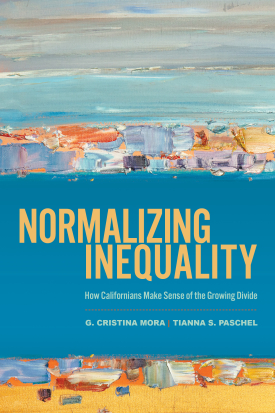
Normalizing Inequality
About This Book
“Normalizing Inequality offers a compelling and deeply insightful examination of how people living amid stark economic and racial disparities interpret and navigate the inequalities that shape their everyday lives. A beautifully written and groundbreaking contribution to the study of race, ethnicity, immigration, class, and political culture in the United States.”
—LORRIE FRASURE, Ralph J. Bunche Endowed Chair and professor of political science and African American studies, University of California, Los Angeles
“Normalizing Inequality is a timely and exceptional book that carefully unpacks how members of the precarious middle class make sense of inequality in their own lives and in the broader social world. Focusing on four racial groups in California, it offers new insights into how people understand the origins of inequality—particularly as it relates to class, race, and immigration— and how they perceive its consequences and explain its persistence. By identifying the interpretive strategies people use to downplay structural constraints while emphasizing agency and individualism, G. Cristina Mora and Tianna S. Paschel show how everyday beliefs—shaped by enduring narratives of the American Dream—can normalize inequality and contribute to its reproduction. The result is a nuanced and powerful analysis of the cultural dimensions of stratification in contemporary America.”
—DINA OKAMOTO, Class of 1948 Herman B. Wells Professor, Department of Sociology, Indiana University
“As an economist by training, I have long documented the widening inequality in America— and how that process has played out on steroids in my home state of California. In this brilliant book, two daughters of the Golden State bring both their own experience and an amazing wealth of interviews to take on a key question: how do those who are part of the ‘precarious middle’ make sense of their experience in an economy that seems to be foreclosing their mobility? G. Cristina Mora and Tianna S. Paschel stress that people are not fooled: they are aware of the structural forces limiting their progress and they rely on individualist stories that offer the glimmer of an escape route. Noting that the belief that hard work can overcome hard luck is even more prevalent for Black and Latino residents facing multiple barriers, the authors bring complexity to a subject too important to be ignored. Elegantly written and analytically rich, Normalizing Inequality smartly offers extended stories and quotes in which they let those they study speak for themselves. A remarkable contribution to sociological practice, this volume is essential for those working to restore the promise of the American and California Dream.”
—MANUEL PASTOR, Distinguished Professor of Sociology, American Studies and Ethnicity, and Turpanjian Chair in Civil Society and Social Change, University of Southern California
California has long been mythologized as the quintessential land of opportunity and reinvention—a place where anyone, regardless of origin, can forge a new life and realize their aspirations. Yet beneath this gilded narrative lies a starker reality: California ranks among the most unequal states in one of the world’s most unequal countries, where the middle class finds itself increasingly squeezed. Economic inequality is not an anomaly but part of a broader global phenomenon, as disparities deepen across the world. While we know a lot about its contours, its evolution over time, and its intersections with race and immigration, we understand far less about how ordinary people interpret and internalize it. In Normalizing Inequality, sociologists G. Cristina Mora and Tianna S. Paschel illuminate how middle-class Californians perceive and come to accept the inequalities that surround them.
Drawing on extensive interviews and surveys, Mora and Paschel uncover a profound paradox at the heart of middle-class consciousness. They find that Californians are keenly aware of the systemic causes of inequality—they recognize policies engineered to benefit the wealthy, and they acknowledge how structural racism makes it hard for some groups to get ahead—yet they consistently minimize these forces. Instead, they gravitate toward explanations rooted in individualism, moral character, and the idea that things are worse in other places. Racism and racial inequality in California become palatable when framed as “not as bad as the South.” Immigrant exploitation, however severe, transforms into evidence of the American Dream fulfilled simply upon arrival. Economic pressures that displace others become surmountable through personal industriousness and forbearance.
These beliefs about inequality grow more troubling still. Middleclass Californians sometimes blame disempowered people for their circumstances—acknowledging structural barriers facing homeless and undocumented populations while simultaneously faulting them for insufficient drive or criminal behavior that compounds their difficulties. When contemplating California’s future, interviewees envision economic prosperity propelled by technological innovation, yet remain curiously unconcerned with how present inequalities might shape that tomorrow. Their imagined future is one where White and Asian American populations thrive, while Black, Latino, and economically marginalized Californians either vanish through displacement or fade into irrelevance. As respondents use these interpretive frameworks to make sense of inequality, they lean heavily on California’s foundational narratives of opportunity, sanctuary, and multiracial promise.
Normalizing Inequality offers an incisive examination of how ordinary citizens make sense of inequality and, through that very process of sense-making, how they tolerate and passively reproduce the conditions they often claim to deplore.
Related Books - Sociology