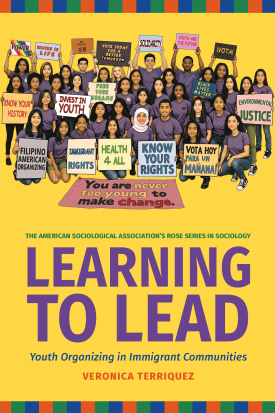
Learning to Lead
About This Book
A volume in the American Sociological Association's Rose Series in Sociology
“The future of our democracy depends on who learns to lead, and how. Veronica Terriquez’s inspiring and carefully researched book shows how youth organizations combine care, critical consciousness, and civic skills to enable a new generation to advance immigrant rights, racial justice, and social equity. By focusing on those who face some of the highest barriers in exercising their political voice, Learning to Lead advances our understanding of political socialization and provides actionable lessons for political change.”
—IRENE BLOEMRAAD, University of British Columbia
“In this remarkable volume, Veronica Terriquez draws upon decades of research and a lifetime of commitment to offer a definitive study of youth organizing for social justice. An organizer in her own younger days, Terriquez combines theoretical and empirical rigor with a rich suite of stories that give us a nuanced and real-world sense of what really drives youth to join groups and pursue change. In her capable hands, often overused terms like ‘intersectionality’ are made concrete as she illustrates how youth themselves connect various dimensions of oppression and experience to weave together common purpose. For those who wish to support young people on their journey to leadership, this volume offers key lessons, stressing that political socialization requires putting together supportive services, civic education, and the learning by doing that comes from policy engagement. There is no one who knows this landscape better than Veronica Terriquez—and it shows. Learning to Lead is a must-read for anyone interested in social movements, immigrant incorporation, and youth development.”
—MANUEL PASTOR, University of Southern California
Children of immigrants make up more than one in four people in the United States under the age of thirty. Amid today’s multipronged attacks on immigrant communities and growing threats to democratic participation, these young people often encounter significant barriers to political participation. Despite these challenges, some children of immigrants and refugees engage in nonpartisan grassroots campaigns, addressing issues such as education, health, environmental justice, immigrant rights, housing, and voting rights. In Learning to Lead, sociologist Veronica Terriquez examines how youth organizing groups facilitate the civic and political engagement of low-income, second-generation immigrant adolescents, enabling them to collectively exercise power alongside their non-immigrant peers and adult allies.
Drawing on extensive surveys, semi-structured interviews, and other data, Terriquez shows that nonprofit youth organizing groups strengthen adolescents’ capacity to address the systemic challenges facing their communities through political engagement. These groups generally share a commitment to supporting young people’s healthy development, offer a critical form of civics education, and provide extensive guidance on how to participate in civic life. They adapt their programming in response to local demographic and political dynamics.
Many adolescents who join grassroots organizing groups face overlapping stresses related to poverty, immigration status, neighbor-hood violence, and other hardships. In response, youth organizing groups create spaces that support emotional well-being while also encouraging academic success and job readiness. They help young people develop a critical understanding of social inequality, power, and public policy. This education often motivates immigrant and refugee youth to work with their non-immigrant Black and Indigenous peers and deepens their understanding of the historical, economic, and political roots of community problems, as well as potential policy solutions. Organizing groups also provide these youth with sustained, hands-on training in how to collectively exercise their voice in policy debates and government elections, effectively offering civic apprenticeships. Staff and experienced members mentor newer participants in basic civic skills such as public speaking, event planning, and community out-reach, while also coaching them on strategies for mobilizing peers and adult allies to contribute to nonpartisan campaigns.
Adolescents who participate in youth organizing during high school tend to remain highly active in civic life into early adulthood. Terriquez concludes that these groups offer important lessons for schools and other youth-serving institutions seeking to strengthen engagement in a multiracial democracy.
Learning to Lead offers a thorough examination of how young people acquire the capacities to become a meaningful political force.
Download
Related Books - Demography