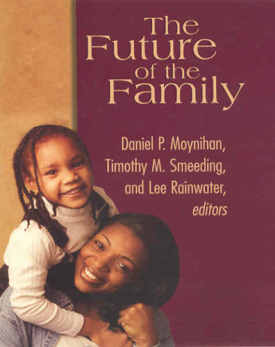
The Future of the Family
About This Book
"The Future of the Family is a singular contribution to our understanding of one of the most important social issues of the twenty-first century. The editors have brought together scholars who collectively represent the world's foremost experts on family systems. The net result is a volume replete with important comparative findings and insights on the changing family and family policies in the United States and other countries."
-WILLIAM JULIUS WILSON, Lewis P. and Linda L. Geyser University Professor, Harvard University
"This book provides an excellent review of what we do and do not know about changes in marriage and childbearing in the United States. It's readable and it's thorough. The policy implications of these changes are discussed by persons from a variety of political and policy viewpoints. If you want to understand what the current debate on marriage and families is all about, The Future of the Family is the book to read."
-REBECCA M. BLANK, Henry Carter Adams Professor of Policy and dean, Gerald R. Ford School of Public Policy, University of Michigan
"This book is a fitting final legacy of Senator Patrick Moynihan, who did so much as a scholar and politician to call attention to the plight of the family in America. Like Senator Moynihan, The Future of the Family is difficult to characterize ideologically, which is its great strength. It presents the facts as we know them clearly and dispassionately. It assesses the effects of family change with clarity and balance, giving in neither to pessimism or to Pollyanna-like optimism. And most remarkably, it presents the policy recommendations of both conservatives and liberals in sensible dialogue. If policymakers and scholars have enough sense to use it in their work, our national dialogue will be greatly enriched."
-MARY JO BANE, Thornton Bradshaw Professor of Public Policy and Management, John F. Kennedy School of Government, Harvard University
High rates of divorce, single-parenthood, and nonmarital cohabitation are forcing Americans to reexamine their definition of family. This evolving social reality requires public policy to evolve as well. The Future of the Family brings together the top scholars of family policy—headlined by editors Lee Rainwater, Tim Smeeding, and, in his last published work, the late Senator Daniel Patrick Moynihan—to take stock of the state of the family in the United States today and address the ways in which public policy affects the family and vice versa.
The volume opens with an assessment of new forms of family, discussing how reduced family income and lower parental involvement can disadvantage children who grow up outside of two-parent households. The book then presents three vastly dissimilar recommendations—each representing a different segment of the political spectrum—for how family policy should adapt to these changes. Child psychologist Wade Horn argues the case of political conservatives that healthy two-parent families are the best way to raise children and therefore should be actively promoted by government initiatives. Conversely, economist Nancy Folbre argues that government’s role lies not in prescribing family arrangements but rather in recognizing and fostering the importance of caregivers within all families, conventional or otherwise. Will Marshall and Isabel Sawhill borrow policy prescriptions from the left and the right, arguing for more initiatives that demand personal responsibility from parents, as well as for an increase in workplace flexibility and the establishment of universal preschool programs. The book follows with commentary by leading policy analysts Samuel Preston, Frank Furstenberg Jr., and Irwin Garfinkel on the merits of the conservative and liberal arguments. Each suggests that marriage promotion alone is not enough to ensure a happy, healthy, and prosperous future for American children who are caught up in the vortex of family change. They agree that government investments in children, however, can promote superior developmental outcomes and even potentially encourage traditional families by enlarging the pool of “marriageable” individuals for the next generation.
No government action can reverse trends in family formation or return America to the historic nuclear family model. But understanding social change is an essential step in fashioning effective policy for today’s families. With authoritative insight, The Future of the Family broadens and updates our knowledge of how public policy and demography shape one another.
DANIEL PATRICK MOYNIHAN was university professor at Syracuse University until his untimely death in March 2003, as well as a former United States senator and ambassador to India and the United Nations.
TIMOTHY M. SMEEDING is the Maxwell Professor of Public Policy at the Maxwell School of Syracuse University and overall director of the Luxembourg Income Study.
LEE RAINWATER is professor of sociology emeritus at Harvard University and research director of the Luxembourg Income Study.
CONTRIBUTORS: Daniel P. Moynihan, Lee Rainwater, Timothy M. Smeeding, P. Lindsay Chase-Lansdale, David T. Ellwood, Nancy Folbre, Frank F. Furstenberg, Irwin Garfinkel, Janet C. Gornick, Wade F. Horn, Christopher Jencks, Kathnleen Kiernan, Will Marshall, Sara McLanahan, Samuel H. Preston, Isabel V. Sawhill, Wendy Sigle-Rushton, and Douglas A. Wolf.
An Institute for Research on Poverty Affiliated Book on Poverty and Public Policy