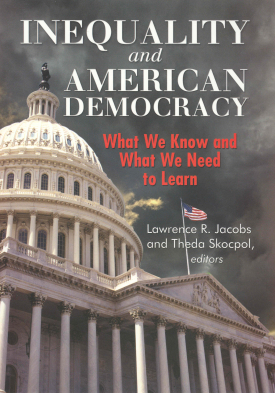
Inequality and American Democracy
About This Book
"Contemporary American politics are riven by elite polarization and rising inequality. This 'state of the art' volume on inequality and American democracy succeeds admirably in linking rigorous scholarship to transcendently important questions about political participation and governmental responsiveness. By synthesizing and evaluating previous studies and outlining an agenda for future research, its superb contributors demonstrate brilliantly how political science, and social science more generally, can once again grapple with fundamental issues of democratic performance."
-THOMAS E. MANN, W. Averell Harriman Chair and senior fellow, The Brookings Institution
"The American Political Science Association rarely takes positions on the institutional issues of governance and politics that are studied by its academic membership. Now, for the first time in more than fifty years, the APSA has spoken with a clear, concise, and tough examination of social and political inequality and its impact on American democracy. Inequality and American Democracy, by a group of the most eminent political scholars, is an expansion of the APSA report. The essays evaluate a massive body of research, and come to the collective conclusion that economic and political inequalities are persistent and rising, and that they threaten our ideals of equal citizenship and responsive government. The research is thorough, the pedigree of the authors impeccable, the conclusions compelling. The book offers a blueprint for future scholarship. There are no easy answers in the realms of political reforms and social policy. But this lively and penetrating volume makes it clear that the problems are neither exaggerated nor trivial, and should command the attention and focus of policymakers, pundits, journalists, students, and scholars alike."
-NORMAN J. ORNSTEIN, resident scholar, American Enterprise Institute for Public Policy Research
In the twentieth century, the United States ended some of its most flagrant inequalities. The "rights revolution" ended statutory prohibitions against women’s suffrage and opened the doors of voting booths to African Americans. Yet a more insidious form of inequality has emerged since the 1970s—economic inequality—which appears to have stalled and, in some arenas, reversed progress toward realizing American ideals of democracy. In Inequality and American Democracy, editors Lawrence Jacobs and Theda Skocpol headline a distinguished group of political scientists in assessing whether rising economic inequality now threatens hard-won victories in the long struggle to achieve political equality in the United States.
Inequality and American Democracy addresses disparities at all levels of the political and policy-making process. Kay Lehman Scholzman, Benjamin Page, Sidney Verba, and Morris Fiorina demonstrate that political participation is highly unequal and strongly related to social class. They show that while economic inequality and the decreasing reliance on volunteers in political campaigns serve to diminish their voice, middle class and working Americans lag behind the rich even in protest activity, long considered the political weapon of the disadvantaged. Larry Bartels, Hugh Heclo, Rodney Hero, and Lawrence Jacobs marshal evidence that the U.S. political system may be disproportionately responsive to the opinions of wealthy constituents and business. They argue that the rapid growth of interest groups and the increasingly strict party-line voting in Congress imperils efforts at enacting policies that are responsive to the preferences of broad publics and to their interests in legislation that extends economic and social opportunity. Jacob Hacker, Suzanne Mettler, and Dianne Pinderhughes demonstrate the feedbacks of government policy on political participation and inequality. In short supply today are inclusive public policies like the G.I. Bill, Social Security legislation, the War on Poverty, and the Voting Rights Act of 1965 that changed the American political climate, mobilized interest groups, and altered the prospect for initiatives to stem inequality in the last fifty years.
Inequality and American Democracy tackles the complex relationships between economic, social, and political inequality with authoritative insight, showcases a new generation of critical studies of American democracy, and highlights an issue of growing concern for the future of our democratic society.
LAWRENCE R. JACOBS is Walter F. and Joan Mondale Chair for Political Studies and director of the Center for the Study of Politics and Governance in the Humphrey Institute of Public Affairs and the Department of Political Science at the University of Minnesota.
THEDA SKOCPOL is Victor S. Thomas Professor of Government and Sociology and director of the Center for American Political Studies at Harvard University.
CONTRIBUTORS: Larry M. Bartels, Morris P. Fiorina, Jacob S. Hacker, Hugh Heclo, Rodney E. Hero, Suzanne Mettler, Benjamin I. Page, Dianne Pinderhughes, Kay Lehman Schlozman, Sidney Verba.