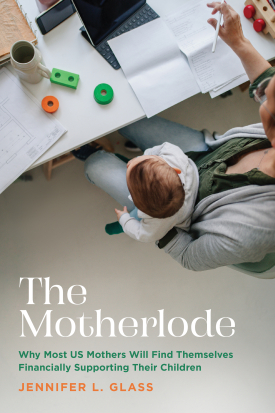
Jennifer L. Glass is the author of RSF book The Motherlode: Why Most U.S. Mothers Will Find Themselves Financially Supporting Their Children. In The Motherlode, Glass traces the rise of mothers as the primary financial providers for their children, investigates the causes of this increase, and evaluates the consequences of this shift for mothers and families. The interview has been edited for length and clarity.
Glass is a professor emeritus at the University of Texas at Austin. She is a former RSF visiting scholar and a contributor to RSF: The Russell Sage Foundation of the Social Sciences double issue “Three Decades Since Making Ends Meet: What We Know About How Single Mothers Survive Today.”
Listen to the interview.
Q. What motivated you to write The Motherlode? What percentage of mothers are the primary breadwinners of their family? Why is it important to study mothers’ breadwinning?
I decided to write The Motherlode because of a Pew Research report that came out around 2014 showing that forty-two percent of kids were primarily being supported economically by their mothers. That was a really high figure; I thought, “Forty-two percent!” That led me to another question, that I assumed I would easily find an answer to, which is: Looking at it from a mom's point of view, what is her risk—right now in the United States—of becoming the primary breadwinner for her family? Not just in cross section in one year, but over the course of her first child's life—the first eighteen years of motherhood? It took some digging to find some data to address this question. About four years, in fact. Some colleagues and I finally did find that data and were astonished by the answer. The answer was that over seventy percent of American mothers are going to find themselves being the primary breadwinner for their household for at least a year. And for the mothers who transition into becoming the primary breadwinner, the average length of time they’re the breadwinner is about six years out of the first eighteen years of their motherhood. So, it's a long time, and I think that we have seen this slip under the radar and are not paying enough attention to it.
It's important to study mothers' breadwinning because we're watching what was, at first, a slow imperceptible shift that no one was paying attention to into a rapidly escalating social change. Now the question of who pays for childhood is really up in the air. It's more and more mothers rather than fathers with much less assistance from government and employers. This is now pervasive and noticeable across demographic groups in America. But even more important, almost all of the recent growth in mothers' breadwinning for their families has come from partnered mothers—mostly married mothers. This is not a story of increased divorce or non-marital childbearing. The new mom breadwinners are mostly living in two-parent families and are partnered.
Q. Does the likelihood of becoming the primary breadwinner vary for mothers of different groups?
Yes, the likelihood of becoming a primary breadwinner varies for mothers in different demographic groups, but not by as much as we think. It varies from a low of about sixty-one percent, for example, for mothers of Asian origin to eighty-one percent for African American mothers. But there's no group—based on their marital status at the time of their first birth, their level of education, or their race ethnicity—that has a probability of becoming a breadwinner of less than fifty percent. So, the probability is high; it's more than fifty percent for all mothers in the United States. What we're seeing is a real transformation in what mothers need to think about when they think about having children. The likelihood that they will be fiscally responsible for their children has grown significantly over time and it's more than fifty percent for every demographic group.
Q. What has led to this extraordinary increase in mothers’ breadwinning in the U.S.?
I think this is the central and important question, and I don't have full and complete answers. Some of the answer, however, is mostly good news about changes in mothers' labor market preparation and performance. And by that, specifically, I mean the growth in the number of mothers who have completed college before they have their first child. It's up at about thirty-five percent right now, and twenty-five years ago it was only about twenty percent, so, we've seen tremendous growth—almost a doubling—in the number of mothers who are going to college and finishing their degrees. And an even larger group are going to college for at least a few years, even if they're not finishing degrees, so they have some post-secondary education. So, we do know that mothers are performing better in the labor market, they're getting better jobs at higher wages, and they're also working more full-time and year-round. So, that's the good news. But the bad news is that this extraordinary increase in mothers' breadwinning is also being pushed by declines in the security of men's jobs and legislative changes on the part of government that force more poor mothers into the labor force in order to receive public assistance.
Q. Overall, would you say this increase in mother’s breadwinning a good or bad thing?
People are always asking me, “Well, is this a good or a bad thing?” And I'm always saying, “I'm not a philosopher.” Is this a bad thing? Demographers don't know the answers to those questions. I did look into the financial consequences, and about half of families are doing better when mom becomes the breadwinner. So, you look at the family income before and after she becomes a breadwinner, and if you look at that the transition, you find that in half of all families are actually richer once she becomes the breadwinner. Now, this unfortunately means that they were really poor before and might have been on public assistance. So, the income gains that you get in those that half of the distribution are pretty small, like a few thousand dollars better.
The other half are losing, and they lose a lot more than the gainers gain. The losers are the moms whose partners have left—they’re getting divorced or separated—and they've lost tens of thousands of dollars. Or the mothers whose partners have been laid off or fired and are, again, losing tens of thousands of dollars. The losses are much bigger in that half of the distribution than the gains are among the moms who have now gone to work and their families are making more money.
When we ask, “Are you doing better?” it generally means more money. And, if that's your only yardstick, then I would have to say half are doing better and half are doing worse. But if you ask, “Is this the feminist dream come true? Are mom's taking over because women are doing so great?” I would say that's about twenty percent. In about twenty percent of cases, I can see that nothing else has changed in this family, mom just got a raise or a promotion or started back at work, and she's doing great. That's the progress of the women's movement. Unfortunately, that's only twenty percent. Eighty percent are these situations where you're either forced to go back into the labor force in order to get basic things like Medicaid or food stamps, or you're coerced into it because your partner has lost their job or they've left the household or they've gotten sick. All of which are pretty negative events. And that seems to me to be what's really driving the phenomenon, more so than the good news of mothers' increased income and education and labor market attachment. I don't want to put that down—that is a feminist success story. If all these things happened to male employment and women couldn't pick up the slack, we would be in really sad shape.
I think of the fact that women are getting so much more education, they are in the labor force, oftentimes living independently from their parents before they partner and have children, as a feminist success story. All of these things are positive. They are much more likely to control the resources that enable them to live a good life and provide their children a good life. All of that is really wonderful news, and I would never want women to go back to a position where they're completely dependent on other people and they cannot choose or enact the quality of life that they want for their children. So, I think, in that sense, the motherlode is empowering. Women have taken the opportunities available to them and done as much as they can. What's bad is that we've made it too hard for them. It's too hard to work and to care at the same time, and we're one of the few nations on earth that have not recognized this and done something about it.
Q. Can you briefly talk about the role of employers in the motherlode?
It turns out that employers have a prominent role here because we've seen a tremendous change in the security of mostly male, physical labor jobs. So, things like construction or agriculture or factory jobs. If you think about what has really been changing over the past thirty to forty years, it's automation and offshoring of many of the jobs that don't require a college degree. So, we've seen this shift to better educated salaried employment that will provide you with a decent standard of living and then a bunch of other jobs, that don't require an advanced degree, that are very insecure and pay relatively low wages.
But it's worse than that -- employers, in their willingness to pay for salaried employees in decent jobs, have decided that it’s costly, and they’re going to make those people work very long hours in return. And so the United States has lots and lots of employers who think that dedication to your job is the most important thing if you're to be promoted or to get wage increases over time. This has really been harmful for families and for men's job security and men's performance in the family, in particular. But it's also made it more difficult for women who find themselves supporting their families. Now women have to compete in a world in which family devotion and family care is less valued by employers and seen as an impediment to their success.
Q. What role does the government play?
Government has kind of colluded in this process by not really changing our labor regulations to respect the fact that more and more of our employees have dependents, either children at home or elderly people that they're caring for. We’ve seen virtually no change in government regulations since the Fair Labor Standards Act of 1936, despite the fact that our economy has totally changed. So, things like mandatory overtime—even if it's paid at a higher rate, which it usually isn't—or the total lack of regulation of work hours for salaried employees are things that really harm families and particularly harm mothers who are tasked with the responsibility of both family care and providing income to support their children.
But probably the worst thing that government has done is that it's increasingly promoted a view that people on public assistance are lazy and don't deserve the benefits that they get. So, in order for them to qualify for things like food stamps or Medicaid, they need to provide lots of documentation of their employment and make sure that they fall within the purview of employment hours that qualify you for public assistance.
If you think about what government has done, government has insisted that mothers support the children they bear financially and provide the physical and emotional care and support that children need. It’s now become formal government policy that if you are unfortunate enough to bear a child and don't have male or other family support, it's just too bad. You're going to have to support that child financially as well. We have now declared that citizens are not eligible for assistance if “all” they do is bear and raise children; that's not enough of a social contribution. Now, you have to actually earn money to support those children as well. That's a real big sea change. It's the first time in the history of the United States that government has pretty formally said that child-rearing is not enough of a contribution in and of itself to qualify for government assistance.
Q. How do fathers ease or worsen mothers’ loads?
I think the role that fathers play is the trickiest one here, because I certainly don't want to blame fathers for the rapid increase in mothers' breadwinning. A lot of what's been going on is that the jobs that were heavily unionized in manufacturing and in agriculture and mining and mineral development—all of those jobs—have changed over time. The ability of men to earn what we used to call a “breadwinner wage” has really fallen over the past forty to fifty years. We've seen a decline in labor unions. We've seen a lot of automation of jobs that used to be done by human beings that are now done by robots or done by computers. All of this, as well as the growing global integration of the economy, has meant that the jobs of fathers, especially fathers with less than a college degree, are less stable than they used to be. The key ticket to a secure job that can help you support your family has been a college degree. Unfortunately, men have been getting a message for a long time that maybe college isn't important or college isn't for them or education isn't really worth the investment, and so we see an increase in the number of fathers who are in insecure and underpaid employment.
Now, sometimes those fathers, when they find they can't provide as much financially as perhaps they want, will play a bigger role in child-rearing. But an awful lot of men don't seem to have a role model for masculinity and fatherhood that includes contributing to the family in ways that women do, which is both in care and in money. I think that's one of the things that worsens mothers' loads, and I think it's one of the things that needs to change if breadwinning is going to become this shared responsibility. If mothers are increasingly going to do it alone, fathers have got to realize that fatherhood is more than just dropping dollars in the family bank, that it also involves supporting your partner and supporting your children emotionally and materially in care work itself.
Q. How have mothers responded to this growing financial pressure?
Mothers as a group have been, I think, much more willing to change their labor force preparation than fathers have been. If you look at mothers as a group over the past forty years, they have dramatically increased their level of education prior to their first birth and they have dramatically increased their age at first birth. So, mothers have much more education and much more labor force experience now than in earlier generations when they had their first birth. They're also leaving the labor force to bear and raise children much less than in previous generations. We see many, many women who take only brief periods of time out of the labor force—sometimes with an unpaid or a paid parental leave—and then return to their previous job. This is a huge, huge change that has meant rapid growth in the wages that mothers can earn. One of the worst things you can do is jump in and out of the labor force. More continuous labor force participation and the ability to have a baby and stay in the same job and not have to quit has really increased mothers' earnings. So, mothers have mostly responded to this growing financial pressure by doing two things: one is to really, really raise their ability to make money and the other is to delay their childbearing and reduce the number of children that they bear. I think both of those are very vital and important to recognize.
Q. What are some policies you would recommend to help mothers? What are some of the consequences if the U.S. does not implement policies to help mothers?
In terms of policies that would really help mothers, probably the biggest would start with major changes in federal labor policy, things as basic as a fully paid national four-to-six-month parental leave. Every other nation on earth has this, especially in advanced industrialized societies. We need to recognize that when you shortchange women, in either wages or job security, you’re also shortchanging children—either the children they already have or the children they’ll have in the future.
We need to stop thinking of mothers as casual workers or mothers' jobs as unimportant or women, themselves, as unimportant for raises and promotions. We know that when you steer more money to women it will filter to their children and it will improve their development, cognitively, socially, and emotionally. So, what we need is a recognition that the federal labor policies that were put in place in 1936 are wholly inadequate to deal with mothers—and fathers—who need to provide both income and care to their children. We need to have an employment regime that makes that possible. Telling employers that they can put people on a salary at a very low level in their company and then force them to work fifty or sixty hours a week without any change in compensation and with no time to take care of their families is simply wrong. So, I think I would start there.
I also think that what we need to do is really reckon with the idea that our COVID experiment with remote work worked. This means we need better data, better information, on when people need to be together at work for creativity, for deliberation, for good decision making, and when they need to be left alone and how we could accommodate family life more by allowing people to have a more flexible orientation in terms of the location that they work in. Allowing more mothers to work remotely would be helpful, especially when combined with other changes in federal labor policy.
I think we also need to look at young men. I think that we need to do a better job of helping young men see the value of schooling and help them better understand the vulnerabilities of jobs that don't require a college degree in terms of their longevity – is this something you can do not just at age twenty-five but at age sixty-five? And, also in terms of security, is this something where you can earn more money as you grow older and your family responsibilities increase? Or is this something that's going to be more difficult, where you're going to be subject to layoffs or reorganizations, mergers and acquisitions, that could leave you for long periods of time less than fully employed?
Those are the two areas that I would like to see policy changes. But there are a lot of other areas as well. We do a very poor job of regulating the environments that children live in, and I mean not just schools, but also streets and housing policy and communities. So, I think once we recognize the extent of the burden on mothers, we need to provide that village from the African proverb to help mothers with their responsibilities by giving them an environment in which they feel supported.
Now, you also asked about what some of the consequences might be if the U.S. does not implement policies to help mothers. I think the one that we're seeing most strongly is declining fertility. It's interesting because the conversations on declining fertility in the United States, in particular, are not really talking about anything other than the physicality of birth and child-rearing: “Oh, what can we do to get mothers to have children earlier in life?” Well, I can tell you that women are not going to have children earlier in life if they are then expected to financially support those children.
Declining fertility has been studied with an eye to family income: family income is changing, is that why we're seeing fewer children? We're not really looking at who's generating the family income. And I think economists have missed the boat on this because I think the period of declining fertility is also the period of rapidly increasing fiscal responsibility for children that mothers are facing. I don't think that's a coincidence.
But even if it wasn't a problem for fertility in and of itself—the idea that women want children that they decide not to have because too much of the burden falls on them—even if that didn't exist, we would still have this problem of an overburdened population of mothers. This is going to lead to, and has led to, increased maternal distress and higher child poverty. That means lower academic achievement and well-being among children as well as mothers. So, do we care about the well-being of mothers and their children? Do we care about their financial security? Do we care about their well-being in old age after their children have grown? Do we care about the ability of mothers to raise children who will be responsible and effective citizens when they grow up? All of these are very, very vital and important questions. And I think right now, especially when it comes to declining fertility, we're asking all the wrong ones. They’re asking, “How can we coerce women into becoming the Stepford wives of the past or the trad wives of the past?” rather than recognizing what has happened to family life in the United States and dealing with what's going on right now in young women's lives.
Recent Books