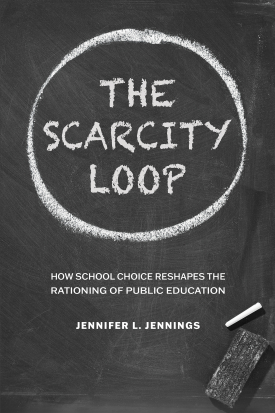
The Scarcity Loop
About This Book
“The Scarcity Loop is essential reading for anyone seeking to understand why school choice policies so often fail to deliver on their promise. With a rare combination of meticulous research and genuine readability, Jennings shows that a policy conversation focused on who gets access to too few ‘good schools’ is one that has already conceded too much.”
—JON VALANT, director, Brown Center on Education Policy, and senior fellow, Governance Studies, The Brookings Institution
“Jennings provides a definitive answer to one of the most vital policy questions of our time: What to do when there aren’t enough good schools? School choice is not the answer or a golden ticket to a good education. Encompassing in breadth and penetrating in depth, this is a ground-up view of the nation’s largest school choice system as it is experienced by the students, parents, counselors, teachers, and principals who inhabit it. The Scarcity Loop should be required reading for educational researchers, practitioners, and educators, and anyone who cares about fairness in our schools.”
—KATHRYN J. EDIN, William Church Osborn Professor of Sociology and Public Affairs, Princeton University
“How do families and students select schools? Cutting through the political noise around the subject, Jennings has produced our first sophisticated, historically grounded account of the ways school choice actually happens in urban America. In the guise of enhancing opportunities, it reinforces disparities. And it defers the hard conversations we need about who gets access to quality education, and why. Anyone who wants to understand inequality in our schools—or in our country— will have to read this bold and incisive book.”
—JONATHAN ZIMMERMAN, Judy and Howard Berkowitz Professor in Education and professor of history of education, University of Pennsylvania
School choice promises to free families from the limits of where they live. The Scarcity Loop asks what happens when that promise is made in school systems where more children seek desirable schools than those schools can serve. Focused on New York City’s high school admissions system, sociologist Jennifer L. Jennings argues that choice becomes another way to ration scarce educational opportunity, shifting where rationing happens, who must manage it, and how families understand the outcomes that follow.
Jennings begins with the admissions process itself. New York City asks every eighth grader to choose from hundreds of options. On paper, the system offers extraordinary possibility. But that possibility still has to be converted into a seat. Someone has to learn the rules, compare schools, manage deadlines, make trips, and decide how much risk a thirteen-year-old can bear. Jennings calls this the work of getting in and shows that the capacity to do that work is not evenly distributed. Some families enter choice systems with the flu-ency and flexibility to turn options into opportunity. Others confront these systems with fewer supports and far less room for error. Some teenagers shoulder decisions with little adult help. Counselors trans-late complicated rules under impossible constraints. Principals are not passive actors: Jennings shows how they recruit and adapt as they try to build, manage demand for, and maintain the reputation of schools that families will choose.
Jennings contends that reforms meant to expand access can reorganize the very competition they aim to resolve. As one barrier recedes, another becomes more consequential. Residence matters less, but advantage does not disappear; it travels through information, timing, and familiarity with the rules. Inequality persists, not because nothing changes, but because advantage finds new points of entry as reforms change rules. As the work of securing opportunity shifts, so do understandings of inequality. Unequal outcomes can come to look less like consequences of how educational opportunities are organized and more like reflections of how families navigate the system.
Drawing on more than 450 interviews, participant observation, administrative data, and archival research, The Scarcity Loop follows students, parents, counselors, and principals as they navigate school choice at scale. Jennings traces who must do the work of making choice real, clarifying what is at stake when public education becomes something families must know how to secure.