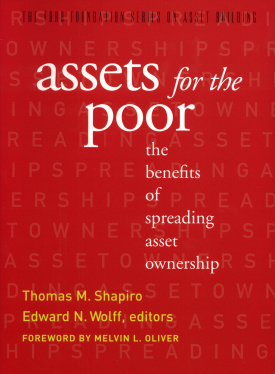
Assets for the Poor
About This Book
"The collection contains an incredibly rich amount of information, historical background, statistics, and ideas. It provides a significant contribution to our understanding of social reproduction, economic inequality, poverty, and the institutional mechanisms that shape wealth inequality. This book should be of interest to a broad audience."
- CONTEMPORARY SOCIOLOGY
"Assets for the Poor makes an important contribution to the debate on how the wealth-creating opportunities available to upper- and middle- class Americans can be extended to low income families. Many critical issues of asset development are discussed in this important book, which will be an essential resource for anyone concerned about the twin problems of poverty and inequality in American society today."
-JAMES MIDGLEY, University of California, Berkeley
"For those already convinced of the importance of assets for poor families, this comprehensive compendium will add breadth and depth. For those wavering as to whether asset-based policies are a useful anti- poverty tool, this book is likely to win you over."
- JARED BERNSTEIN, Economic Policy Institute, Washington, D.C.
'Assets for the Poor is the scholarly treatise on America's 'third revolution,' the movement to democratize capitalism. While the first struggle overcame foreign tyranny and the second defeated slavery to usher in an extended era of civil rights, the coming revolution will be over economic justice... an effort to secure for all families a share in the fruits of our democracy."
-J. LARRY BROWN, Brandeis University
Over the past three decades, average household wealth in the United States has declined among all but the richest families, with a near 80 percent drop among the nation's poorest families. Although the national debate about inequality has focused on income, it is wealth—the private assets amassed and passed on within families—that provides the extra economic cushion needed to move beyond mere day-to-day survival. Assets for the Poor is the first full-scale investigation into the importance of family wealth and the need for policies to encourage asset-building among the poor.
Assets for the Poor shows how institutional mechanisms designed to encourage acquisition of capital and property favor middle-class and high-income families. For example, the aggregate value of home mortgage tax deductions far outweighs the dollar amount of the subsidies provided by Section 8 rental vouchers and public housing. Banking definitions of creditworthiness largely exclude minorities, and welfare rules have made it nearly impossible for single mothers to accumulate savings, let alone stocks or real estate. Due to persistent residential segregation, even those minority families who do own homes are often denied equal access to better schools and public services.
The research in this volume shows that the poor do make use of the assets they have. Cash gifts—although small in size—are frequent within families and often lead to such positive results as homebuying and debt reduction, while tangible assets such as tools and cars help increase employment prospects. Assets for the Poor examines policies such as Individual Development Account tax subsidies to reward financial savings among the poor, and more liberal credit rules to make borrowing easier and less costly. The contributors also offer thoughtful advice for bringing the poor into mainstream savings institutions and warn against developing asset building policies at the expense of existing safety net programs.
Asset-building for low-income families is a powerful idea that offers hope to families searching for a way out of poverty. Assets for the Poor challenges current thinking regarding poverty reduction policies and proposes a major shift in the way we think about families and how they make a better life.
THOMAS M. SHAPIRO is professor of sociology at Northeastern University.
EDWARD N. WOLFF is professor of economics at New York University.
CONTRIBUTORS: Richard V. Burkhauser, John Sibley Butler, Stacie Carney, Dalton Conley, Nancy A. Denton, Kathryn Edin, William G. Gale, Robert Haveman, Lelvin L. Oliver, Laurence S. Seidman, Thomas M. Shapiro, Michael Sherraden, Seymour Spilerman, Mark J. Stern, Robert Weathers, Mark O. Wilhelm, Edward N. Wolff
A Volume in the Ford Foundation Series on Asset Building