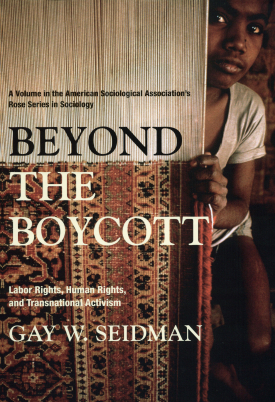
Beyond the Boycott
About This Book
A Volume in the American Sociological Association’s Rose Series in Sociology
"Excellent for anyone studying social change and social movements, as well as for business leaders."
-CHOICE
"Beyond the Boycott draws on careful analysis of cases ranging across time and space from the operation of the Sullivan Principles in South Africa in the apartheid era to monitoring apparel sub-contractors in contemporary Guatemala to generate a provocative and original proposition on the effectiveness of transnational labor rights campaigns. Gay Seidman's well-argued thesis that transnational activists should focus less on corporations and 'workers' rights as human rights' and more on states and 'workers' rights as citizenship rights' is a fresh and stimulating addition to debates on transnational activism that is sure to have a lasting impact."
-PETER B. EVANS, University of California, Berkeley
"In this imaginative study, Gay Seidman explores the implications of the pivotal shift among labor advocates in the anti-globalizaiton movement from a traditional 'labor rights' discourse targeting the national state to a focus on human rights at the global level that relies on 'stateless regulation.' The three case studies reveal the potential of this new form of transnational labor activism, but also expose its limitations-most importantly the ways in which it constructs workers as victims rather than as agents of social transformation. No one else has examined the anti-sweatshop movement and corporate 'codes of conduct' with such a subtle comparative touch. Beyond the Boycott is a must read for anyone concerned about labor and globalization, for scholars and advocates alike."
-RUTH MILKMAN, UCLA
"In Beyond the Boycott, the eminent labor sociologist Gay Seidman provides an indispensable analysis of one of the most urgent questions of our time: How can labor rights be enforced in a global system now devoted to the rights of capital and commerce? By critically examining three major attempts to use the tools of 'stateless regulation,' Seidman makes a powerful argument that transnational activists should refocus their campaigns on restoring the promise of state institutions and democratic citizenship. This gem of a book will be required reading for anyone concerned about social justice in an era of globalization."
-MARK BARENBERG, Columbia University
As the world economy becomes increasingly integrated, companies can shift production to wherever wages are lowest and unions weakest. How can workers defend their rights in an era of mobile capital? With national governments forced to compete for foreign investment by rolling back legal protections for workers, fair trade advocates are enlisting consumers to put market pressure on companies to treat their workers fairly. In Beyond the Boycott, sociologist Gay Seidman asks whether this non-governmental approach can reverse the “race to the bottom” in global labor standards.
Beyond the Boycott examines three campaigns in which activists successfully used the threat of a consumer boycott to pressure companies to accept voluntary codes of conduct and independent monitoring of work sites. The voluntary Sullivan Code required American corporations operating in apartheid-era South Africa to improve treatment of their workers; in India, the Rugmark inspection team provides ‘social labels’ for handknotted carpets made without child labor; and in Guatemala, COVERCO monitors conditions in factories producing clothing under contract for major American brands. Seidman compares these cases to explore the ingredients of successful campaigns, as well as the inherent limitations facing voluntary monitoring schemes. Despite activists’ emphasis on educating individual consumers to support ethical companies, Seidman finds that, in practice, they have been most successful when they mobilized institutions—such as universities, churches, and shareholder organizations. Moreover, although activists tend to dismiss states’ capabilities, all three cases involved governmental threats of trade sanctions against companies and countries with poor labor records. Finally, Seidman points to an intractable difficulty of independent workplace monitoring: since consumers rarely distinguish between monitoring schemes and labels, companies can hand pick monitoring organizations, selecting those with the lowest standards for working conditions and the least aggressive inspections. Transnational consumer movements can increase the bargaining power of the global workforce, Seidman argues, but they cannot replace national governments or local campaigns to expand the meaning of citizenship.
As trade and capital move across borders in growing volume and with greater speed, civil society and human rights movements are also becoming more global. Highly original and thought-provoking, Beyond the Boycott vividly depicts the contemporary movement to humanize globalization—its present and its possible future.
GAY W. SEIDMAN is professor of sociology at the University of Wisconsin, Madison.