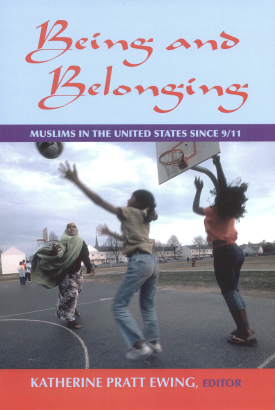
Being and Belonging
About This Book
"This well-edited collection of significant findings about Muslims in the United States after 9/11 focuses on Muslims in public and institutional settings. All of the contributors, even those with quantitative studies, bring the voices of their subjects into the text. Most of the voices come from young American Muslims, important agents in the transformations of self and community. The comparative nature of the book is another of its strengths-featuring Muslims and others in a small New England town, the Detroit-Dearborn area of Michigan, the Raleigh-Durham area of North Carolina, Houston, Texas, and the Bridgeview suburb south of Chicago, Illinois. The book's fine concluding discussion suggests that citizenship discourses and disciplining practices are strongly reshaping American Muslim communities, even as they are subjected to constraints that challenge their attainment of full or 'normal' citizenship. Being and Belonging offers high quality scholarly research, and it should reach the general public as well as students in undergraduate and graduate courses across the nation."
-KAREN LEONARD, University of California, Irvine
"Not all Arabs are Muslims. Not all South Asians are Hindus, and not all African Americans are Christians. If the dominant subset of twenty-first century America remains Anglo, there have also emerged adaptive expressions of American identity. The push and pull between assimilation (losing yourself in the dominant culture) and accommodation (connecting to others but retaining your niche identity) persists. The marvel of Being and Belonging-at once original and evocative-is its piebald pertinence to the struggle for locating and projecting immigrant identities. Arab-Asian-Muslim-American identity appears here as a revolving kaleidoscope. For newly American Muslims, it is accommodation rather than assimilation that emerges as the major, visible trend for the near, and possibly long, term development of a specific and robust American Muslim identity."
-BRUCE LAWRENCE, Duke Islamic Studies Center
The terrorist attacks of September 11, 2001, instantly transformed many ordinary Muslim and Arab Americans into suspected terrorists. In the weeks and months following the attacks, Muslims in the United States faced a frighteningly altered social climate consisting of heightened surveillance, interrogation, and harassment. In the long run, however, the backlash has been more complicated. In Being and Belonging, Katherine Pratt Ewing leads a group of anthropologists, sociologists, and cultural studies experts in exploring how the events of September 11th have affected the quest for belonging and identity among Muslims in America—for better and for worse.
From Chicago to Detroit to San Francisco, Being and Belonging takes readers on an extensive tour of Muslim America—inside mosques, through high school hallways, and along inner city streets. Jen’nan Ghazal Read compares the experiences of Arab Muslims and Arab Christians in Houston and finds that the events of 9/11 created a “cultural wedge” dividing Arab Americans along religious lines. While Arab Christians highlighted their religious affiliation as a means of distancing themselves from the perceived terrorist sympathies of Islam, Muslims quickly found that their religious affiliation served as a barrier, rather than a bridge, to social and political integration. Katherine Pratt Ewing and Marguerite Hoyler document the way South Asian Muslim youth in Raleigh, North Carolina, actively contested the prevailing notion that one cannot be both Muslim and American by asserting their religious identities more powerfully than they might have before the terrorist acts, while still identifying themselves as fully American. Sally Howell and Amaney Jamal distinguish between national and local responses to terrorism. In striking contrast to the erosion of civil rights, ethnic profiling, and surveillance set into motion by the federal government, well-established Muslim community leaders in Detroit used their influence in law enforcement, media, and social services to empower the community and protect civil rights. Craig Joseph and Barnaby Riedel analyze how an Islamic private school in Chicago responded to both September 11 and the increasing ethnic diversity of its student body by adopting a secular character education program to instruct children in universal values rather than religious doctrine. In a series of poignant interviews, the school’s students articulate a clear understanding that while 9/11 left deep wounds on their community, it also created a valuable opportunity to teach the nation about Islam.
The rich ethnographies in this volume link 9/11 and its effects to the experiences of a group that was struggling to be included in the American mainstream long before that fateful day. Many Muslim communities never had a chance to tell their stories after September 11. In Being and Belonging, they get that chance.
KATHERINE PRATT EWING is associate professor of cultural anthropology and religion at Duke University.
CONTRIBUTORS: Melissa J. K. Howe, Sally Howell, Marguerite Hoyler, Amaney Jamal, Craig M. Joseph, Sunaina Maira, Bill Maurer, Jen'nan Ghazal Read, Katherine Pratt Ewing, Barnaby Riedel, Andrew Shryock, Richard A. Shweder, and Charlotte van den Hout.