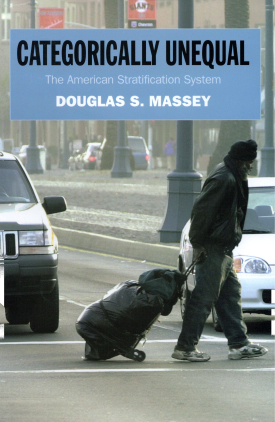
Categorically Unequal
About This Book
"A breathtaking expose of how humans are fine-tuned for creating categorical inequali ties of class, race, and gender and how markets and other institutions can be fashioned to exploit this human capacity in especially devilish ways. At once a general treatise on inequality and a historical treatise on the recent takeoff in inequality, Categorically Unequal combines the analytic smarts of a Robert Hauser with the muckraking sensibility of a C. Wright Mills and the synthetic reach of a Talcott Parsons. The long wait is over: We now have the sociological response to narrowly-drawn economistic accounts of poverty and inequality."
-DAVID B. GRUSKY, Stanford University
"Douglas S. Massey documents how divided Americans are and how we got this way. He blends theory and data to explain why U.S. race, class, and gender inequalities run so deep. After acknowledging how human nature prompts us to differentiate one group from another, Massey directs our attention to why American inequalities exceed those of other rich nations. The most novel finding in Categorically Unequal is that progress on one front often goes with losses on the others. The era of egalitarian capitalism (1933-1974) tamed class inequalities but tolerated exclusion of women and African Americans. Women's gains in the last thirty years have exacerbated resurgent class dif ferences. Anyone who worries about the persistence of poverty and discrimination should read this book."
-MICHAEL HOUT, University of California, Berkeley
The United States holds the dubious distinction of having the most unequal income distribution of any advanced industrialized nation. While other developed countries face similar challenges from globalization and technological change, none rivals America’s singularly poor record for equitably distributing the benefits and burdens of recent economic shifts. In Categorically Unequal, Douglas Massey weaves together history, political economy, and even neuropsychology to provide a comprehensive explanation of how America’s culture and political system perpetuates inequalities between different segments of the population.
Categorically Unequal is striking both for its theoretical originality and for the breadth of topics it covers. Massey argues that social inequalities arise from the universal human tendency to place others into social categories. In America, ethnic minorities, women, and the poor have consistently been the targets of stereotyping, and as a result, they have been exploited and discriminated against throughout the nation’s history. African-Americans continue to face discrimination in markets for jobs, housing, and credit. Meanwhile, the militarization of the U.S.-Mexican border has discouraged Mexican migrants from leaving the United States, creating a pool of exploitable workers who lack the legal rights of citizens. Massey also shows that women’s advances in the labor market have been concentrated among the affluent and well-educated, while low-skilled female workers have been relegated to occupations that offer few chances for earnings mobility. At the same time, as the wages of low-income men have fallen, more working-class women are remaining unmarried and raising children on their own. Even as minorities and women continue to face these obstacles, the progressive legacy of the New Deal has come under frontal assault. The government has passed anti-union legislation, made taxes more regressive, allowed the real value of the federal minimum wage to decline, and drastically cut social welfare spending. As a result, the income gap between the richest and poorest has dramatically widened since 1980. Massey attributes these anti-poor policies in part to the increasing segregation of neighborhoods by income, which has insulated the affluent from the social consequences of poverty, and to the disenfranchisement of the poor, as the population of immigrants, prisoners, and ex-felons swells.
America’s unrivaled disparities are not simply the inevitable result of globalization and technological change. As Massey shows, privileged groups have systematically exploited and excluded many of their fellow Americans. By delving into the root causes of inequality in America, Categorically Unequal provides a compelling argument for the creation of a more equitable society.
DOUGLAS S. MASSEY is the Henry G. Bryant Professor of Sociology and Public Affairs at Princeton University.
A Volume in the the Russell Sage Foundation's Centennial Series