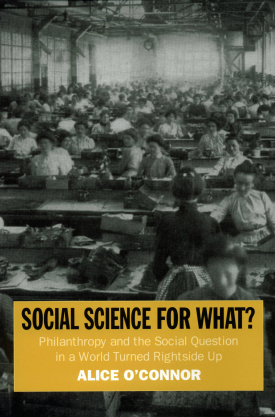
Social Science for What?
About This Book
"For more than a hundred years, philanthropists have invested in social science because they thought the knowledge it produced would help solve social problems and improve the human condition. And indeed, social scientists sought to inform public debate and public action, pursuing agendas shaped by the famous 'social question" of labor and inequality. But, as Alice O'Connor shows in this splendid history, the relatienship between social science and philanthropy was not automatic. It could come unstuck when social scientists claimed their work was self-justifying as the pursuit of knowledge in itself, and also with political challenges to the idea of neutral (or liberal) expertise. O'Connor rightly reveals that this early history has shaped enduring orientations and oppositions, and she traces these into our era of think tanks and a new gospel of wealth. She also challenges us to ask again what social science is for in an era when inequality seems once again to be increasing, and to wonder whether its connection with philanthropy can be restored. Social Science for What? is important reading for twentieth-century history and it eloquently poses crucial questions for twenty-first century social science."
-CRAIG CALHOUN, Social Science Research Council
This discerning history celebrates an important legacy of the Progressive Era: the best advocates for social reform sought to maintain their objectivity. Then, as now, true idealists tried to steer clear of ideology. Everyone concerned about the relationship between the theory and the practice of social science should read Social Science for What?"
-NANCY FOLBRE, University of Massachusetts
"In this fine book, based on both insider knowledge and academic research, Alice O'Connor explains why the great liberal foundations have been bested by conservative 'think tanks.' And she argues, astutely, that there is only one way the liberal foundations can compete- by openly embracing the progressive values that animated early social science. Social Science for What? is a must for those interested in contemporary conservatism, philanthropy, and social science."
-LINDA GORDON, New York University
Much like today, the early twentieth century was a period of rising economic inequality and political polarization in America. But it was also an era of progressive reform—a time when the Russell Sage Foundation and other philanthropic organizations were established to promote social science as a way to solve the crises of industrial capitalism. In Social Science for What? Alice O’Connor relates the history of philanthropic social science, exploring its successes and challenges over the years, and asking how these foundations might continue to promote progressive social change in our own politically divided era.
The philanthropic foundations established in the early 1900s focused on research which, while intended to be objective, was also politically engaged. In addition to funding social science research, in its early years the Russell Sage Foundation also supported social work and advocated reforms on issues from child welfare to predatory lending. This reformist agenda shaped the foundation’s research priorities and methods. The Foundation’s landmark Pittsburgh Survey of wage labor, conducted in 1907-1908, involved not only social scientists but leaders of charities, social workers, and progressive activists, and was designed not simply to answer empirical questions, but to reframe the public discourse about industrial labor. After World War II, many philanthropic foundations disengaged from political struggles and shifted their funding toward more value-neutral, academic social inquiry, in the belief that disinterested research would yield more effective public policies. Consequently, these foundations were caught off guard in the 1970s and 1980s by the emergence of a network of right-wing foundations, which was successful in promoting an openly ideological agenda. In order to counter the political in-roads made by conservative organizations, O’Connor argues that progressive philanthropic research foundations should look to the example of their founders. While continuing to support the social science research that has contributed so much to American society over the past 100 years, they should be more direct about the values that motivate their research. In this way, they will help foster a more democratic dialogue on important social issues by using empirical knowledge to engage fundamentally ethical concerns about rising inequality.
O’Connor’s message is timely: public-interest social science faces unprecedented challenges in this era of cultural warfare, as both liberalism and science itself have come under assault. Social Science for What? is a thought-provoking critique of the role of social science in improving society and an indispensable guide to how progressives can reassert their voice in the national political debate.
ALICE O’CONNOR is associate professor of history at the University of California, Santa Barbara.
A Volume in the the Russell Sage Foundation's Centennial Series