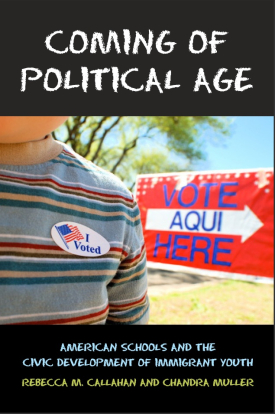
Coming of Political Age
About This Book
“This book will bring joy to the hearts of high school debaters who study social sciences: these experiences build active citizenship in later adulthood, especially among the children of immigrants who may grow up in neighborhoods that are low on civic engagement. Coming of Political Age is a clear-eyed, carefully justified plan for just how schools can help us address the decline of political engagement.”
—John Mollenkopf, Distinguished Professor of Political Science and Sociology and director, Center for Urban Research, the Graduate Center, CUNY
“Coming of Political Age offers valuable insight into how schools serve as an important force in the political socialization and education of children of immigrants. Through careful analysis of nationally representative longitudinal survey data and qualitative data, Rebecca M. Callahan and Chandra Muller convincingly argue that civic goals of schools in twenty-first-century America are as relevant as academic goals in shaping America’s future citizenry and that expanding social science curriculum is central to achieving civic goals. This book is an essential reading for scholars, school administrators, policymakers, and citizens concerning school reform and student outcomes.”
—Min Zhou, professor of sociology and Asian American studies, University of California, Los Angeles
As one of the fastest-growing segments of the American population, the children of immigrants are poised to reshape the country’s political future. The massive rallies for immigration rights in 2006 and the recent push for the DREAM Act, both heavily supported by immigrant youth, signal the growing political potential of this crucial group. While many studies have explored the political participation of immigrant adults, we know comparatively little about what influences civic participation among the children of immigrants. Coming of Political Age persuasively argues that schools play a central role in integrating immigrant youth into the political system. The volume shows that the choices we make now in our educational system will have major consequences for the country’s civic health as the children of immigrants grow and mature as citizens.
Coming of Political Age draws from an impressive range of data, including two large surveys of adolescents in high schools and interviews with teachers and students, to provide an insightful analysis of trends in youth participation in politics. Although the children of both immigrant and native-born parents register and vote at similar rates, the factors associated with this likelihood are very different. While parental educational levels largely explain voting behavior among children of native-born parents, this volume demonstrates that immigrant children’s own education, in particular their exposure to social studies, strongly predicts their future political participation. Learning more about civic society and putting effort into these classes may encourage an interest in politics, suggesting that the high school civics curriculum remains highly relevant in an increasingly disconnected society. Interestingly, although their schooling predicts whether children of immigrants will vote, how they identify politically depends more on family and community influences. As budget cuts force school administrators to realign academic priorities, this volume argues that any cutback to social science programs may effectively curtail the political and civic engagement of the next generation of voters.
While much of the literature on immigrant assimilation focuses on family and community, Coming of Political Age argues that schools—and social science courses in particular—may be central to preparing the leaders of tomorrow. The insights and conclusions presented in this volume are essential to understand how we can encourage more participation in civic action and improve the functioning of our political system.
REBECCA M. CALLAHAN is assistant professor of education at the University of Texas at Austin.
CHANDRA MULLER is professor of sociology at the University of Texas at Austin.