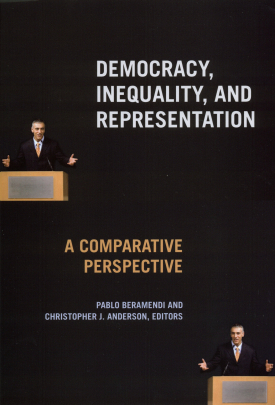
Democracy, Inequality, and Representation
About This Book
“Pablo Beramendi and Christopher J. Anderson have assembled an all-star team to reflect on the politics of inequality in rich democracies. Breaking new ground in the quantitative study of the welfare state while pushing the boundaries of recent theorizing, the distinguished contributors to Democracy, Inequality, and Representation have produced readable, rewarding analyses of the leading issues in the field. An essential resource for experts on social policy, political economy, and electoral politics, as well as engaged readers simply wishing to understand why countries differ so much with regard to the priority placed on economic equality and security.”
—JACOB S. HACKER, professor of political science, Yale University
“The unprecedented and sustained increase in income inequality across many countries has sparked interest and concern across the fields of social science. This excellent collection of papers represents state-of-the-art analysis of this new and growing inequality. Political parties play a central role, but inequality reflects the interactive effects of political and economic institutions working in diverse ways through popular preferences for redistribution, characteristics of the labor market, institutional complexity, political mobilization and participation, partisan polarization, and the public budget. No serious scholar in political economy should pass over Democracy, Inequality, and Representation.”
—JAMES E. ALT, Frank G. Thomson Professor of Government, Harvard University
“Simply the best summary of the current state of knowledge both about the impact of politics on economic inequality and of inequality on politics. Combining perspectives from economics, sociology, and political science, Democracy, Inequality, and Representation is as rich in new insights as in new questions.”
—ADAM PRZEWORSKI, Carroll and Milton Petrie Professor of Politics, New York University
The gap between the richest and poorest Americans has grown steadily over the last thirty years, and economic inequality is on the rise in many other industrialized democracies as well. But the magnitude and pace of the increase differs dramatically across nations. A country’s political system and its institutions play a critical role in determining levels of inequality in a society. Democracy, Inequality, and Representation argues that the reverse is also true—inequality itself shapes political systems and institutions in powerful and often overlooked ways.
In Democracy, Inequality, and Representation, distinguished political scientists and economists use a set of international databases to examine the political causes and consequences of income inequality. The volume opens with an examination of how differing systems of political representation contribute to cross-national variations in levels of inequality. Torben Iverson and David Soskice calculate that taxes and income transfers help reduce the poverty rate in Sweden by over 80 percent, while the comparable figure for the United States is only 13 percent. Noting that traditional economic models fail to account for this striking discrepancy, the authors show how variations in electoral systems lead to very different outcomes.
But political causes of disparity are only one part of the equation. The contributors also examine how inequality shapes the democratic process. Pablo Beramendi and Christopher Anderson show how disparity mutes political voices: at the individual level, citizens with the lowest incomes are the least likely to vote, while high levels of inequality in a society result in diminished electoral participation overall. Thomas Cusack, Iverson, and Philipp Rehm demonstrate that uncertainty in the economy changes voters’ attitudes; the mere risk of losing one’s job generates increased popular demand for income support policies almost as much as actual unemployment does. Ronald Rogowski and Duncan McRae illustrate how changes in levels of inequality can drive reforms in political institutions themselves. Increased demand for female labor participation during World War II led to greater equality between men and women, which in turn encouraged many European countries to extend voting rights to women for the first time.
The contributors to this important new volume skillfully disentangle a series of complex relationships between economics and politics to show how inequality both shapes and is shaped by policy. Democracy, Inequality, and Representation provides deeply nuanced insight into why some democracies are able to curtail inequality—while others continue to witness a division that grows ever deeper.
PABLO BERAMENDI is assistant professor of political science at Duke University.
CHRISTOPHER J. ANDERSON is professor of government at Cornell University.
CONTRIBUTORS: Christopher J. Anderson, Pablo Beramendi, Andrea Brandolini, Thomas R. Cusack, Robert J. Franzese Jr., Jude C. Hays, Torben Iversen, Duncan C. McRae, Jonas Pontusson, Philipp Rehm, Ronald Rogowski, David Rueda, Lyle Scruggs, Timothy M. Smeeding, and David Soskice.