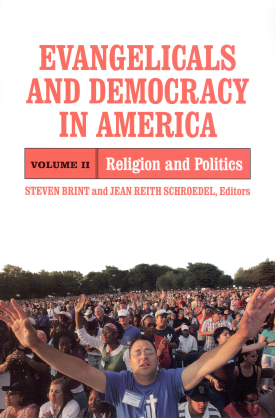
Evangelicals and Democracy in America, Volume II
About This Book
"Brint and Schroedel's two volume series is, quite simply, an outstanding exploration of America's conservative Protestants and their interaction with democratic politics .... The essays tackle a wide range of issues: social movement theory, survey data on values and voting, historical development, the implications of partisan involvement, race, and much more .... There may not be a more informative 700 pages on the historical sociology of American evangelicals for many years to come."
-CANADIAN JOURNAL OF SOCIOLOGY
"At a time when the discussion of religion in America has become increasingly polemical, this volume offers a refreshingly level-headed look at the evidence. Combining rigor with relevance, Evangelicals and Democracy in America sets the record straight on the influence evangelicals do, and do not, have on American politics. Evangelicals' apologists and critics alike will learn much from the analysis done by this illustrious group of scholars."
-DAVID E. CAMBELL, John Cardinal O'Hara, CSC Associate Professor of Political Science, University of Notre Dame
"An important, timely, wise, cool-headed appraisal of the evangelical influence on American politics, Evangelicals and Democracy in America draws on an impressive lineup of thinkers and approaches-political science, history, sociology, theology-to illuminate one of the vital themes of our time. Religion matters. These essays explore how and why."
-JAMES A. MORONE, chair and professor of political science, Brown University
Separation of church and state is a bedrock principal of American democracy, and so, too, is active citizen engagement. Since evangelicals comprise one of the largest and most vocal voting blocs in the United States, tensions and questions naturally arise. In the two-volume Evangelicals and Democracy in America, editors Steven Brint and Jean Reith Schroedel have assembled an authoritative collection of studies of the evangelical movement in America. Religion and Politics, the second volume of the set, focuses on the role of religious conservatives in party politics, the rhetoric evangelicals use to mobilize politically, and what the history of the evangelical movement reveals about where it may be going.
Part I of Religion and Politics explores the role of evangelicals in electoral politics. Contributor Pippa Norris looks at evangelicals around the globe and finds that religiosity is a strong predictor of ideological leanings in industrialized countries. But the United States remains one of only a handful of post-industrial societies where religion plays a significant role in partisan politics. Other chapters look at voting trends, especially the growing number of higher-income evangelicals among Republican ranks, how voting is influenced both by “values” and race, and the management of the symbols and networks behind the electoral system of moral-values politics. Part II of the volume focuses on the mobilizing rhetoric of the Christian Right. Nathaniel Klemp and Stephen Macedo show how the rhetorical strategies of the Christian Right create powerful mobilizing narratives, but frequently fail to build broad enough coalitions to prevail in the pluralistic marketplace of ideas. Part III analyzes the cycles and evolution of the Christian Right. Kimberly Conger looks at the specific circumstances that have allowed evangelicals to become dominant in some Republican state party committees but not in others. D. Michael Lindsay examines the “elastic orthodoxy” that has allowed evangelicals to evolve into a formidable social and political force. The final chapter by Clyde Wilcox presents a new framework for understanding the relationship between the Christian Right and the GOP based on the ecological metaphor of co-evolution.
With its companion volume on religion and society, this second volume of Evangelicals and Democracy in America offers the most complete examination yet of the social circumstances and political influence of the millions of Americans who are white evangelical Protestants. Understanding their history and prospects for the future is essential to forming a comprehensive picture of America today.
STEVEN BRINT is professor of sociology at the University of California, Riverside, director of the Colleges & Universities 2000 study, and associate dean of the College of Humanities, Arts, and Social Sciences.
JEAN REITH SCHROEDEL is dean of the School of Politics and Policy at Claremont Graduate University.
CONTRIBUTORS: Steven Brint, Jean Reith Schroedel, Seth Abrutyn, Wayne Baker, Connie J. Boudens, Kimberly H. Conger, Andrew Greeley, Peter Dobkin Hall, Michael Hout, Julie Ingersoll, Nathaniel Klemp, D. Michael Lindsay, Stephen Macedo, Pippa Norris, Clyde Wilcox, and Rhys H. Williams.