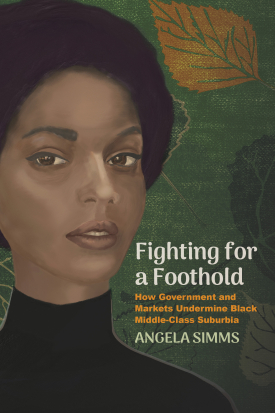
Fighting for a Foothold
About This Book
"Prince George’s County is a Wakanda of sorts. Its majority-Black residents enjoy higher incomes, stronger homeownership, and longer life expectancy than residents in many places—indeed, more than those in many non-Black-majority areas. As a resident, I affectionately call it ‘Black bougie heaven,’ proudly celebrating its strengths. Angela Simms’s rigorous work shows, however, that as remarkable as PG County is, it could be even better in a world without racism. Fighting for a Foothold invites readers from all places to remove the drags of racism that throttle growth that would otherwise occur."
—ANDRE M. PERRY, senior fellow and director, Center for Community Uplift, Brookings Institution
"Fighting for a Foothold reveals the connection between a long legacy of racist policies in America and the struggle among local leadership in an iconic middle-class Black suburb to provide residents with the kinds of amenities that are taken for granted in neighboring middle-class White suburbs. In doing so, Angela Simms shows middle-class Black homeowners and their elected officials face an uphill battle as they attempt to reap the benefits of living in one of the most coveted spaces in the country—the suburbs."
—KARYN LACY, associate professor of sociology, University of Michigan
Prince George’s County, Maryland, is a suburban jurisdiction in the Washington, D.C., metropolitan area and is home to the highest concentration of Black middle-class residents in the United States. As such, it is well positioned to overcome White domination and anti-Black racism and their social and economic consequences. Yet Prince George’s does not raise tax revenue sufficient to provide consistent high-quality public goods and services. In Fighting for a Foothold, sociologist Angela Simms examines the factors contributing to Prince George’s financial troubles.
Simms draws on two years of observations of Prince George’s County’s budget and policy development processes, interviews with nearly 60 Prince George’s leaders and residents, and budget and policy analysis for Prince George’s County and its two Whiter, wealthier neighbors, Montgomery County, Maryland, and Fairfax County, Virginia. She argues legacy and ongoing government policies and business practices—such as federal mortgage insurance policy prior to 1968, local government reliance on property taxes, and private investment patterns—have resulted in disparities in wealth accumulation between Black and White Americans, not only for individuals and families but local jurisdictions as well. Prince George’s County has a lower cost of living than its Whiter, wealthier neighbors. As the most affordable county bordering D.C., it attracts a disproportionate share of the region’s core middle-class, lower middle-class, working class, and low-income residents, resulting in greater budget pressure.
Prince George’s uses the same strategies as majority-White jurisdictions to increase revenue, such as taxing at similar rates and vying for development opportunities but does not attain the same financial returns. Ultimately, Simms contends Prince George’s endures “relative regional burden” and that the county effectively subsidizes Whiter counties’ wealth accumulation. She offers policy recommendations for removing the constraints Prince George’s County and other majority-Black jurisdictions navigate, including increased federal and state taxes on wealthy Americans and corporations, which will enhance the capacity for government to distribute and redistribute resources equitably; increased state-level funding of public goods and services, which would decrease local jurisdictions’ reliance on locally-generated tax revenue; and the creation of equity funds to remediate harms inflicted upon Black Americans.
Fighting for a Foothold is an in-depth analysis of the fiscal challenges experienced by Prince George’s County and by the suburban Black middle-class and majority-Black jurisdictions, more broadly. The book reveals how race, class, and local jurisdiction boundaries in metropolitan areas interact to create different material living conditions for Americans.
Related Books - Sociology