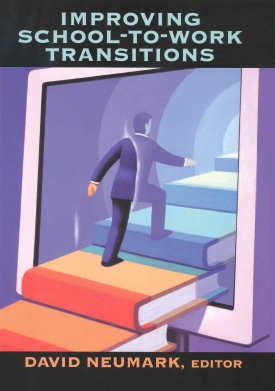
Improving School-to-Work Transitions
About This Book
“Improving School-to-Work Transitions contains some of the best empirical research to date on a timely and important issue—namely, the value of school-to-work activities for young people in high school, and how they might be improved. While the political fortunes of career-oriented education have been declining, these authors suggest that these programs may be more effective than we previously thought. David Neumark’s book provides some much-needed evidence and sensible thinking about how to prepare disadvantaged young people for a changing labor market.”
—HARRY J. HOLZER, professor of public policy, Georgetown University
“Improving School-to-Work Transitions provides valuable insights into the school-to-work transitions of the neglected half of American youth who do not graduate high school and proceed directly to college. This segment of American society is growing because the proportion of immigrant and minority youth is growing. The essays in this volume describe the problems raised by this trend and evaluate the institutions put in place to deal with it.”
—JAMES HECKMAN, Henry Schultz Distinguished Service Professor in Economics, University of Chicago
“Nearly two decades after The Forgotten Half reports, youth and young adults without four-year college degrees continue to be neglected in public policy debates. David Neumark has brought together an insightful set of chapters that assess some of the more promising pathways to labor market success for this segment of the population, reminding us that even as we strive to improve academic achievement of all young people we cannot simply assume that they will all go to college. Job skills are important and they can be taught, along with academic skills, in career academies and other school-to-work strategies.”
—STEPHEN F. HAMILTON, professor of human development and associate provost for outreach, Cornell University
As anxieties about America’s economic competitiveness mounted in the 1980s, so too did concerns that the nation’s schools were not adequately preparing young people for the modern workplace. Spurred by widespread joblessness and job instability among young adults, the federal government launched ambitious educational reforms in the 1990s to promote career development activities for students. In recent years, however, the federal government has shifted its focus to test-based reforms like No Child Left Behind that emphasize purely academic subjects. At this critical juncture in education reform, Improving School-To-Work Transitions, edited by David Neumark, weighs the successes and failures of the ’90s-era school-to-work initiatives, and assesses how high schools, colleges, and government can help youths make a smoother transition into stable, well-paying employment.
Drawing on evidence from national longitudinal studies, surveys, interviews, and case studies, the contributors to Improving School-To-Work Transitions offer thought-provoking perspectives on a variety of aspects of the school-to-work problem. Deborah Reed, Christopher Jepsen, and Laura Hill emphasize the importance of focusing school-to-work programs on the diverse needs of different demographic groups, particularly immigrants, who represent a growing proportion of the youth population. David Neumark and Donna Rothstein investigate the impact of school-to-work programs on the “forgotten half,” students at the greatest risk of not attending college. Using data from the 1997 National Longitudinal Study of Youth, they find that participation by these students in programs like job shadowing, mentoring, and summer internships raise employment and college attendance rates among men and earnings among women. In a study of nine high schools with National Academy Foundation career academies, Terry Orr and her fellow researchers find that career academy participants are more engaged in school and are more likely to attend a four-year college than their peers. Nan Maxwell studies the skills demanded in entry-level jobs and finds that many supposedly “low-skilled” jobs actually demand extensive skills in reading, writing, and math, as well as the “new basic skills” of communication and problem-solving. Maxwell recommends that school districts collaborate with researchers to identify which skills are most in demand in their local labor markets.
At a time when test-based educational reforms are making career development programs increasingly vulnerable, it is worth examining the possibilities and challenges of integrating career-related learning into the school environment. Written for educators, policymakers, researchers, and anyone concerned about how schools are shaping the economic opportunities of young people, Improving School-To-Work Transitions provides an authoritative guide to a crucial issue in education reform.
DAVID NEUMARK is professor of economics at the University of California, Irvine, senior fellow at the Public Policy Institute of California, research associate at the NBER, and research fellow at IZA.
CONTRIBUTORS: Oscar A. Aliaga, Thomas Bailey, Charles Dayton, Laura E. Hill, Katherine L. Hughes, Christopher Jepsen, Melinda Mechur Karp, Gregory S. Kienzl, Andrew Maul, Nan L. Maxwell, Margaret Terry Orr, Ann E. Person, Deborah Reed, James E. Rosenbaum, Donna Rothstein, David Stern, James R. Stone III, Christopher Wu.