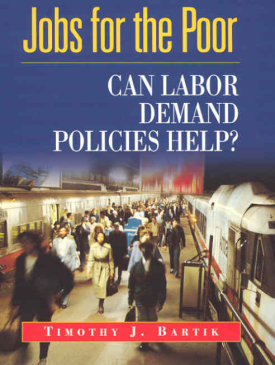
Jobs for the Poor
About This Book
"In the United States and elsewhere, efforts to maintain the incomes of the low- skilled have turned away from welfare to work. Timothy Bartik takes apart both the demand and supply sides of the labor market in which people with low human capital operate, and reveals the relative potentials of policy measures that operate on each side of this market. By combining solid analytics, a judicious review of the evidence, and his own estimates, he concludes that past U. S. policy has overemphasized measures to increase work effort by the poor, while neglecting measures designed to increase employer demands for the services of the low-skilled. He leaves us with a convincing two-pronged policy proposal emphasizing demand side incentives, which avoid the drawbacks of past efforts. His analysis and program deserve airing among policymakers and scholars, and will be used as the analytic core of courses concerned with the economics of labor market and social policy."
-Robert Haveman, University of Wisconsin, Madison
"Why have so many less-skilled workers had such a hard time finding and keeping jobs during the economic booms of the 1980s and 1990s? Timothy Bartik documents that a key reason is our failure to adopt labor demand policies focused on the least-skilled workers who have been left behind in our rapidly- changing economy. Jobs for the Poor provides a comprehensive review about what we have learned from thirty years of employment and training programs. Academics, policymakers, and students can all learn much about what has worked and what has not in our struggle to achieve full employment. Bartik advocates subsidizing employers to hire the disadvantaged and convinces us that labor supply policies alone will not do the job."
-Sheldon Danziger, University of Michigan, Ann Arbor
Even as the United States enjoys a booming economy and historically low levels of unemployment, millions of Americans remain out of work or underemployed, and joblessness continues to plague many urban communities, racial minorities, and people with little education. In Jobs for the Poor, Timothy Bartik calls for a dramatic shift in the way the United States confronts this problem. Today, most efforts to address this problem focus on ways to make workers more employable, such as job training and welfare reform. But Bartik argues that the United States should put more emphasis on ways to increase the interest of employers in creating jobs for the poor—or the labor demand side of the labor market.
Bartik's bases his case for labor demand policies on a comprehensive review of the low-wage labor market. He examines the effectiveness of government interventions in the labor market, such as Welfare Reform, the Earned Income Tax Credit, and Welfare-to-Work programs, and asks if having a job makes a person more employable. Bartik finds that public service employment and targeted employer wage subsidies can increase employment among the poor. In turn, job experience significantly increases the poor's long-run earnings by enhancing their skills and reputation with employers. And labor demand policies can avoid causing inflation or displacing other workers by targeting high-unemployment labor markets and persons who would otherwise be unemployed.
Bartik concludes by proposing a large-scale labor demand program. One component of the program would give a tax credit to employers in areas of high unemployment. To provide disadvantaged workers with more targeted help, Bartik also recommends offering short-term subsidies to employers—particularly small businesses and nonprofit organizations—that hire people who otherwise would be unlikely to find jobs. With experience from subsidized jobs, the new workers should find it easier to obtain future year-round employment.
Although these efforts would not catapult poor families into the middle class overnight, Bartik offers a powerful argument that having a full-time worker in every household would help improve the lives of millions. Jobs for the Poor makes a compelling case that full employment can be achieved if the country has the political will and adopts policies that address both sides of the labor market.
Copublished with the W. E. Upjohn Institute for Economic Research.
TIMOTHY J. BARTIK is senior economist at the W. E. Upjohn Institute for Employment Research.