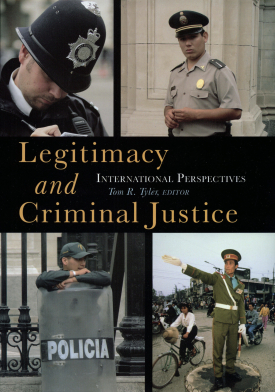
Legitimacy and Criminal Justice
About This Book
"Over the last fifteen years or so research on legitimacy and procedural justice has made a decisive contribution to our understandings of policing, of the dynamics of compliance and, more generally, of people's encounters with authorities. In Legitimacy and Criminal Justice, Tom Tyler and a distinguished group of coeditors and contributors extend this discussion beyond its American stronghold and into the streets, legislatures, and political controversies of numerous other countries. This book issues the clearest possible clarion call for a new and genuinely comparative, international inquiry into the conditions of legitimacy and their relation to social order and social change around the world."
-RICHARD SPARKS, University of Edinburgh
"I learned a lot from Legitimacy and Criminal Justice. The essays in it extend the application of Tom Tyler's path-breaking work on legitimacy and law enforcement procedures to legal systems in Europe, South Africa, and Latin America. They provide rich, detailed accounts of the ways in which members of the public interact with the police, the courts, and other institutions. And on that empirical basis, the authors are able to offer some very helpful reflections on the different ways in which legitimacy can be enhanced (as well as the various ways in which it can be undermined). This is a fine contribution to the socio-legal literature on legitimacy and I suspect, too, that it will become an indispensable resource for serious students of law enforcement."
-JEREMY WALDRON, New York University Law School
The police and the courts depend on the cooperation of communities to keep order. But large numbers of urban poor distrust law enforcement officials. Legitimacy and Criminal Justice explores the reasons that legal authorities are or are not seen as legitimate and trustworthy by many citizens.
Legitimacy and Criminal Justice is the first study of the perceived legitimacy of legal institutions outside the U.S. The authors investigate relations between courts, the police, and communities in the U.K., Western Europe, South Africa, Slovenia, South America, and Mexico, demonstrating the importance of social context in shaping those relations. Gorazd Meško and Goran Klemenčič examine Slovenia’s adoption of Western-style “community policing” during its transition to democracy. In the context of Slovenia’s recent Communist past—when “community policing” entailed omnipresent social and political control—citizens regarded these efforts with great suspicion, and offered little cooperation to the police. When states fail to control crime, informal methods of law can gain legitimacy. Jennifer Johnson discusses an extra-legal policing system carried out by farmers in Guerrero, Mexico—complete with sentencing guidelines and initiatives to reintegrate offenders into the community. Feeling that federal authorities were not prosecuting the crimes that plagued their province, the citizens of Guerrero strongly supported this extra-legal arrangement, and engaged in massive protests when the central government tried to suppress it. Several of the authors examine how the perceived legitimacy of the police and courts varies across social groups. Graziella Da Silva, Ignacio Cano, and Hugo Frühling show that attitudes toward the police vary greatly across social classes in harshly unequal societies like Brazil and Chile. And many of the authors find that ethnic minorities often display greater distrust toward the police, and perceive themselves to be targets of police discrimination. Indeed, Hans-Jöerg Albrecht finds evidence of bias in arrests of the foreign born in Germany, which has fueled discontent among Berlin’s Turkish youth. Sophie Body-Gendrot points out that mutual hostility between police and minority communities can lead to large-scale violence, as the Parisian banlieu riots underscored.
The case studies presented in this important new book show that fostering cooperation between law enforcement and communities requires the former to pay careful attention to the needs and attitudes of the latter. Forging a new field of comparative research, Legitimacy and Criminal Justice brings to light many of the reasons the law’s representatives succeed—or fail—in winning citizens’ hearts and minds.
ANTHONY BRAGA is a senior research associate at the Kennedy School of Government, Harvard University, and at the Berkeley Center for Criminal Justice at the University of California, Berkeley.
JEFFREY FAGAN is professor of law and public health at Columbia University, and director of the Center for Crime, Community and Law at Columbia Law School.
TRACEY MEARES is professor of law at Yale Law School.
ROBERT SAMPSON is Henry Ford II Professor of the Social Sciences at Harvard University.
TOM R. TYLER is University Professor of Psychology at New York University.
CHRIS WINSHIP is Diker-Tishman Professor of Sociology at Harvard University and also a member of the faculty of the Kennedy School of Government.
CONTRIBUTORS: Hans-Jorg Albrecht, Catrien Bijleveld, Sophie Body-Gendrot, Anthony Braga, John Braithwaite, Ignacio Cano, Jean Camaroff, John Camaroff, Jeffrey Fagan, Hugo Fruhling, Heike Goudriaan, Mike Hough, Jennifer L. Johnson, Goran Klemencic, Marijke Malsch, Tracey Meares, Gorazd Mesko, Graziella Moraes, Sebastian Roche, Robert Sampson, David J. Smith, Michael Tonry, Chris Winship.
A Volume in the Russell Sage Foundation Series on Trust