Since California’s 1988 Street Terrorism Enforcement and Prevention Act, anti-gang laws have spread rapidly across the U.S. Currently, all fifty states have enacted anti-gang legislation. Yet, we still lack a systematic, reproducible method for measuring what these laws authorize and how their governing logic varies across jurisdictions. Criminologist Angela Zorro Medina will create and analyze a statute-level dataset of state anti-gang legislation enacted from 1988 to 2024.
Most convictions result from guilty pleas. However, we know little about how plea-bargaining negotiations take place, what is said, and why plea deals are accepted even when the accused is innocent. Criminologists Theodore Wilson and Christi Metcalfe will examine how guilt, trust in one’s lawyer, and likelihood of conviction at trial influence plea deal acceptance. They will conduct a survey vignette experiment for their study.
Disparities in the criminal legal system are exacerbated by combined effects of racial oppression and criminal stigma. These effects often persist through interpersonal and structural mechanisms among justice-involved people of color. Psychologist Terrill Taylor and higher education scholar Royel Johnson will conduct a pilot study to develop and test JusticeReFramed, a digital storytelling intervention aimed to counteract these effects by fostering narrative-driven empathy and challenging negative stereotypes among employers.
Books
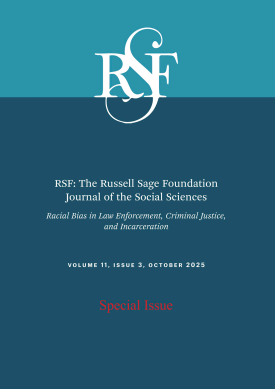
RSF: Racial and Ethnic Bias in Law Enforcement, Criminal Justice, and Incarceration
Publication Date
7 in. × 10 in.
347 pages
ISBN
978-0-87154-836-8
About This Book
Racial disparities in criminal justice system contact are a pressing concern for both scholars and the public. For 25 years, the Russell Sage Foundation has been at the forefront of this issue and has supported research on law enforcement, the criminal justice system, and incarceration with an emphasis on examining racial and ethnic disparities. Since then, the literature on these topics has expanded and we now have a vast body of research on them. In this special issue of RSF, an interdisciplinary group of contributors review research from over the past two decades to advance our understanding of racial and ethnic bias in law enforcement, criminal justice processes, and incarceration.
Shawn Bushway and colleagues review literature on racial disparities in pretrial detention, sentencing, and outcomes of community corrections programs, such as probation, parole, halfway houses, and work-release programs. They find that systematic issues, rather than individual bias, are the main driver for these disparities and that reforms, such as eliminating pretrial detention for nonviolent offenders, who are not on probation or parole, can be effective tools for reducing racial disparities without creating significant harms to public safety. Alia Nahra and colleagues review literature on the difficulties the formerly incarcerated face when they transition from prison into their communities, a process referred to as reentry. They find that criminalization and punishment, such as criminal record discrimination in housing and employment and parole and probation supervision, stymie reintegration, while support from family and welfare programs help reintegration. They also found that formerly incarcerated Black men and women face greater obstacles when reentering their communities. Emily Ryo and colleges review literature on the criminalization of immigration. They find that while immigration law is considered federal civil law, immigration enforcement has come substantially intertwined with criminal law enforcement. They also find that criminalizing immigration results in the categorization of certain groups as dangerous and results in sustaining and promoting policies that target or have disproportionate impact on certain immigrant groups. Additionally, they find that the U.S. has outsourced immigration enforcement to other countries, such as Mexico, Guatemala, and El Salvador, therefore, the effects of criminalizing immigration are not limited to the U.S.
This volume of RSF provides a fascinating look back at the research conducted on racial disparities in the criminal justice system thus far and offers new avenues for future research.
RSF Journal
View Book Series
Sign Up For Our Mailing List
Apply For Funding
Books
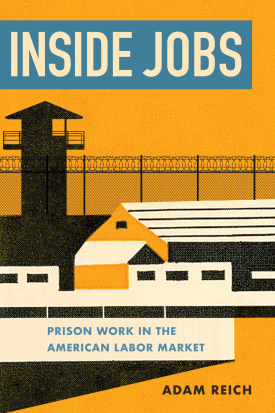
Inside Jobs
Prison Work in the American Labor Market
Publication Date
6 in. × 9 in.
272 pages
ISBN
978-0-87154-854-2
About This Book
“Inside Jobs is a landmark study of prison labor practices in the US, past and present. Instead of viewing penal labor in isolation, Adam Reich locates it on a broader field of ‘outside’ labor markets, production regimes, labor struggles, and social and political developments. The result is a distinctive and deeply rewarding account of prison labor, the conflicts that surround it, and how and why they have changed over time. Inside Jobs is carefully researched and beautifully written. It should appeal to undergraduate students and deserves to be widely read by scholars, advocates, and practitioners inside and outside of government.”
—JOE SOSS, Cowles Chair for the Study of Public Service, Hubert H. Humphrey School of Public Affairs, University of Minnesota, Twin Cities
“With intellectual range, moral clarity, and a keen sociological eye, Adam Reich has produced a remarkable book. In Inside Jobs, he offers a compelling account of the long and changing relationship between prison labor and the American labor market. Refusing to treat prison as a world apart, he shows how ideas about work, discipline, freedom, and coercion have been produced through the prison and then carried beyond it. Ambitious in scope and clear in argument, this is an important book.”
—SANDRA SUSAN SMITH, Daniel and Florence Guggenheim Professor of Criminal Justice and faculty chair for the Program in Criminal Justice Policy and Management at the Harvard Kennedy School
“Adam Reich has written a brilliant and inspiring book about prison labor in the United States. It’s beautifully written, full of stories, and a must-read for everyone who cares about the future of workers in the US. Inside Jobs digs deeply into the interconnections between the criminal punishment system, wage labor, and the development of American capitalism. It reminds us of how racism undergirds everything related to workers and the US economy. This book will be a great tool for organizing forward to create a more fair and just economy and a criminal justice system that is actually rooted in equity and justice.”
—MADELINE JANIS, ESQ., executive director, Jobs to Move America
From the stone quarries of Sing Sing that supplied marble for early New York City landmarks to twenty-first-century construction projects staffed by formerly incarcerated workers, Inside Jobs traces the relationship between prison work and the labor market over the past two hundred years. Sociologist Adam Reich demonstrates how prison labor has repeatedly been used to solve economic problems—disciplining workers, lowering labor costs, managing unemployment—revealing unexpected connections that challenge our assumptions about freedom, coercion, and labor itself.
Reich examines the history of work in prisons to understand how it has related to the free labor market. He finds that the organization of prison work, and debates over it, have changed dramatically over time. In the mid- to late nineteenth century, prisons helped shape the emerging factory system as the apprentice-based labor market gave way to industrial production. Labor unions opposed prison labor as immoral, and in the early to mid-twentieth century, the moral character of the workforce became central to economic life within the prison and without. Therapeutic professionals worked in prisons to rehabilitate the incarcerated and determine what motivated them to work. Following prison uprisings in the late twentieth century, prison work became a tool of population control. Yet, paradoxically, work programs were remodeled to mirror the free labor market, requiring applications and hiring processes.
Blending archival research, political economy, and sociological theory, Inside Jobs offers a powerful new framework for understanding mass incarceration and reentry today. Reich examines how the dynamics of mass incarceration have begun to shift. He explores how the “mark of a criminal record”—the stigma traditionally associated with felony convictions—has given way to a “market” for criminal records, as employers discover advantages in hiring disadvantaged, dependent, and disciplined workers recently released from prison. Looking toward the future, Reich focuses on promising efforts to transform this system.
Inside Jobs is an illuminating examination of prison work’s history, its relationship to work outside prison walls, and how the criminal justice system disempowers workers both behind bars and beyond.
RSF Journal
View Book Series
Sign Up For Our Mailing List
Apply For Funding

Books
Delinquency and Corrections: Part II, Topeka Improvement Survey
Publication Date
64 pages
About This Book
More than sixteen hundred people were arrested in Topeka in 1913. This booklet seeks to investigate how the city’s police department, courts, jails, and probation officers are treating the offenders. It discusses the police department, court penalties, city and county jails, probation and parole for adults, juvenile delinquency, and preventive work and the provides general conclusions.
ZENAS L. POTTER worked in the Department of Surveys and Exhibits at the Russell Sage Foundation.
RSF Journal
View Book Series
Sign Up For Our Mailing List
Apply For Funding
About This Book
This booklet contains a report of living conditions in Scranton, Pennsylvania, conducted by the Department of Surveys and Exhibits of the Russell Sage Foundation and published by the Century Club of Scranton. It covers the following topics: community assets, education, public health and sanitation, civic improvement, betterment agencies, recreation, taxation and public finance, work conditions and relations, and delinquency.
RSF Journal
View Book Series
Sign Up For Our Mailing List
Apply For Funding
About This Book
This booklet covers the development in the United States of schools for the training of guards and other prison officers modeled on one in England. Topics include the U.S. Training School at 427 West Street in New York City, the Keepers’ Training School on New York’s Welfare Island (now Roosevelt Island), and the British Training School in Wakefield, England. The booklet also contains forms relating to candidates for prison service in England and Wales.
HASTINGS H. HART was a consultant in delinquency and penology at the Russell Sage Foundation.
RSF Journal
View Book Series
Sign Up For Our Mailing List
Apply For Funding
About This Book
This text was presented at the 51st Congress of the American Prison Association in Jacksonville, Florida, in 1921. It addresses the high proportion of African American criminal offenders in the United States, considers how such offenders should be treated, and offers suggestions for decreasing crime in this population.
G. CROFT WILLIAMS was the secretary of the State Board of Public Welfare, Columbia, South Carolina.
Download
RSF Journal
View Book Series
Sign Up For Our Mailing List
Apply For Funding
About This Book
This booklet presents the report of the Committee on Lock-ups, Municipal and County Jails, of the American Prison Association on United States prisoners boarded out by the federal government. It discusses the origins of the boarding-out system, congressional action, three U.S. penitentiaries, federal reformatories, U.S. prisoners boarded out, the difficulties of reforming the county jail system, jail from the prisoner’s point of view, and suggestions for grand jury surveys of conditions under which federal prisoners are kept in county jails.
HASTINGS L. HART was the chairman of the committee of the American Prison Association and consultant in delinquency and penology at the Russell Sage Foundation.