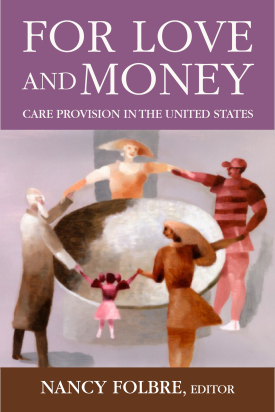
For Love and Money
About This Book
“Nancy Folbre and her colleagues have crafted an integrated, far-ranging, and incisive analysis of the contours, meaning, and possible solutions to the mounting care work crisis. A group of stellar contributors offers a treasure trove of information and ideas about how to define, measure, and value care work in all its myriad and often hidden forms. It is an understatement to say that For Love and Money is essential for anyone who cares about care work. Even more, any serious effort to address the care vacuum facing market societies should begin with this book.”
—Kathleen Gerson, New York University
“For Love and Money is a rich and innovative examination of the broad care landscape, including both paid and unpaid care, in the United States. The authors look at care work in depth and in breadth—from child care to care of people with disabilities and frail older adults. They draw a picture of care work as an activity in which all participate and all benefit. This inclusive perspective should inform public policy in the future.”
—Carol Levine, United Hospital Fund
“Based on a successful interdisciplinary effort, For Love and Money synthesizes and then moves well beyond—both theoretically and empirically—earlier analyses of care work. Rejecting the conventional frame that separates love and money, the authors insist on and convey the connections and similarities between paid and unpaid care. Making giant steps towards delineating a new paradigm, the book intelligently considers issues of definition, measurement, motive, amount, form, and value of care work as well as clearly lays out the inadequacies of current policies that address it. The authors show the ways care work is shaped by gender inequality and make a convincing case that gender equality depends on improved care provision. Wide-ranging yet careful, For Love and Money should become a key resource for scholars, activists, and policymakers concerned with helping Americans of all ages get the care we need.”
—Naomi Gerstel, University of Massachusetts Amherst
As women moved into the formal labor force in large numbers over the last forty years, care work – traditionally provided primarily by women – has increasingly shifted from the family arena to the market. Child care, elder care, care for the disabled, and home care now account for a growing segment of low-wage work in the United States, and demand for such work will only increase as the baby boom generation ages. But the expanding market provision of care has created new economic anxieties and raised pointed questions: Why do women continue to do most care work, both paid and unpaid? Why does care work remain low paid when the quality of care is so highly valued? How effective and equitable are public policies toward dependents in the United States? In For Love and Money, an interdisciplinary team of experts explores the theoretical dilemmas of care provision and provides an unprecedented empirical overview of the looming problems for the care sector in the United States.
Drawing on diverse disciplines and areas of expertise, For Love and Money develops an innovative framework to analyze existing care policies and suggest potential directions for care policy and future research. Contributors Paula England, Nancy Folbre, and Carrie Leana explore the range of motivations for caregiving, such as familial responsibility or limited job prospects, and why both love and money can be efficient motivators. They also examine why women tend to specialize in the provision of care, citing factors like job discrimination, social pressure, or the personal motivation to provide care reported by many women. Suzanne Bianchi, Nancy Folbre, and Douglas Wolf estimate how much unpaid care is being provided in the United States and show that low-income families rely more on unpaid family members for their child and for elder care than do affluent families. With low wages and little savings, these families often find it difficult to provide care and earn enough money to stay afloat. Candace Howes, Carrie Leana and Kristin Smith investigate the dynamics within the paid care sector and find problematic wages and working conditions, including high turnover, inadequate training and a “pay penalty” for workers who enter care jobs. These conditions have consequences: poor job quality in child care and adult care also leads to poor care quality. In their chapters, Janet Gornick, Candace Howes and Laura Braslow provide a systematic inventory of public policies that directly shape the provision of care for children or for adults who need personal assistance, such as family leave, child care tax credits and Medicaid-funded long-term care. They conclude that income and variations in states’ policies are the greatest factors determining how well, and for whom, the current system works. Despite the demand for care work, very little public policy attention has been devoted to it. Only three states, for example, have enacted paid family leave programs.
Paid or unpaid, care costs those who provide it. At the heart of For Love and Money is the understanding that the quality of care work in the United States matters not only for those who receive care but also for society at large, which benefits from the nurturance and maintenance of human capabilities. As care work gravitates from the family to the formal economy, this volume clarifies the pressing need for America to fundamentally rethink its care policies and increase public investment in this increasingly crucial sector.
NANCY FOLBRE is professor of economics at the University of Massachusetts, Amherst.