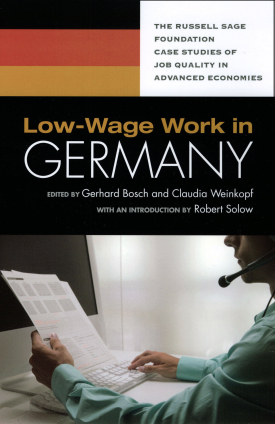
Low-Wage Work in Germany
About This Book
"Low-Wage Work in Germany is a valuable addition to knowledge on recent changes in German labor markets. It not only documents the extent and growth of low-wage work, but also offers well researched explanations for these developments in terms of changes in industrial systems and corporate governance, the fragmentation of work, and the weakening of collective agreements. This analysis is of interest in all industrialized countries. It also offers an important scientific contribution to the current debate in Germany on minimum wage policy."
-GERRY RODGERS, International Institute for Labour Studies, Geneva
"The German social model was praised for many decades because of its low level of social exclusion. Now low-wage work nearly reaches the high level of the United States. The brilliant analysis of Gerhard Bosch, Claudia Weinkopf, and their coauthors helps us understand the dramatic changes of the German social model after the unification. What happens in the strongest European economy is decisive for the European Social model. Therefore, Low-Wage Work in Germany is a must-read for policymakers, analysts, and researchers interested in Europe and the future of the welfare state."
-REINER HOFFMANN, European Trade Union Confederation
"This book challenges our understanding of the German social market economy by expertly documenting the incidence and implications of low-wage work in Germany. Combining labor market analysis with industry case studies, the authors provide a detailed and comprehensive treatment of low-wage work across key occupations. The surprising finding that the share of low-wage work in Germany has reached a level nearly as high as the United States and the United Kingdom makes Low-Wage Work in Germany essential reading for those interested in the German economy."
-PETER BERG, Michigan State University
In recent years, the German government has intentionally expanded the low-wage work sector in an effort to reduce exceptionally high levels of unemployment. As a result, the share of the German workforce employed in low-paying jobs now rivals that of the United States. Low Wage Work in Germany examines both the federal policies and changing economic conditions that have driven this increase in low-wage work. The new “mini-job” reflects the federal government’s attempt to make certain low-paying jobs attractive to both employers and employees. Employers pay a low flat rate for benefits, and employees, who work a limited number of hours per week, are exempt from social security and tax contributions. Other factors, including slow economic growth, a declining collective bargaining system, and the influx of foreign workers, also contribute to the growing incidence of low-wage work. Yet while both Germany and the United States have large shares of low-wage workers, German workers receive health insurance, four weeks of paid vacation, and generous old age support—benefits most low-wage workers in the United States can only dream of. The German experience offers an important opportunity to explore difficult trade-offs between unemployment and low-wage work.
GERHARD BOSCH is professor of sociology at the University of Duisburg-Essen.
CLAUDIA WEINKOPF is deputy director of the Institute for Work, Skills, and Training at the University of Duisburg-Essen.
CONTRIBUTORS: Lars Czommer, Karen Jaehrling, Thorsten Kalina, Robert Solow, Achim Vanselow, Dorothea Voss-Dahm.
A Volume in the RSF Case Studies of Job Quality in Advanced Economies