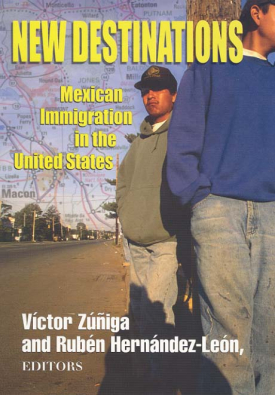
New Destinations
About This Book
"New Destinations describes, situates, and analyzes the new Mexican settlement in Pennsylvania, lowa, Kentucky, Georgia, Delaware, Louisiana, Nebraska, North Carolina, and New York City. The editors' informed and scholarly chapters also provide an overview of Mexican dispersion to non-traditional localities. Rich with local detail, the contributors' chapters address the social impact of Mexican settle ment, new intergroup relations in impacted places, community formation among Mexicans, and the local economic incorporation of the Mexican immigrants. In the coming decade, as Mexican resettlement continues, their dispersion will move to the top of the research agenda in American ethnic and immigration studies. New Destinations is only the beginning of the scholarship, but this volume will mold and inform the debate and discussion that will surely follow. For these reasons, everyone seriously interested in immigration and ethnic studies should read this timely, persuasive, and readable book soon."
-Ivan Light, University of California, Los Angeles
"New Destinations is the definitive volume that will help map out, conceptually and spatially, the new geography of Mexican immigration in the United States. The story's narrative has gone from a regional to a national one, and the research in this book reveals many lessons about the new social and economic dynamics currently unfolding in the many new points of destination. This is a must read for anyone who aspires to understand the contemporary challenges and promises of Mexican immigration, as well as the changing face of America, from the heartland to the big apple."
-Pierrette Hondagneu-Sotelo, University of Southern California
"The hundred year history of Mexican migration to the United States has involved many twists and turns, but perhaps none quite so unexpected as the development of new migrant destinations, in virtually every part of the United States, and most notably, in communities where immigrants-whether from Mexico or elsewhere- had never been a presence before. Víctor Zúñiga and Rubén Hernández-León have pro duced a carefully-focused collection of interdisciplinary essays, one that provides the essential background for understanding this newest phase of Mexican migration."
-Roger Waldinger, University of California, Los Angeles
Mexican immigration to the United States—the oldest and largest immigration movement to this country—is in the midst of a fundamental transformation. For decades, Mexican immigration was primarily a border phenomenon, confined to Southwestern states. But legal changes in the mid-1980s paved the way for Mexican migrants to settle in parts of America that had no previous exposure to people of Mexican heritage. In New Destinations, editors Víctor Zúñiga and Rubén Hernández-León bring together an inter-disciplinary team of scholars to examine demographic, social, cultural, and political changes in areas where the incorporation of Mexican migrants has deeply changed the preexisting ethnic landscape.
New Destinations looks at several of the communities where Mexican migrants are beginning to settle, and documents how the latest arrivals are reshaping—and being reshaped by—these new areas of settlement. Contributors Jorge Durand, Douglas Massey, and Chiara Capoferro use census data to diagram the historical evolution of Mexican immigration to the United States, noting the demographic, economic, and legal factors that led recent immigrants to move to areas where few of their predecessors had settled. Looking at two towns in Southern Louisiana, contributors Katharine Donato, Melissa Stainback, and Carl Bankston III reach a surprising conclusion: that documented immigrant workers did a poorer job of integrating into the local culture than their undocumented peers. They attribute this counterintuitive finding to documentation policies, which helped intensify employer control over migrants and undercut the formation of a stable migrant community among documented workers. Brian Rich and Marta Miranda detail an ambivalent mixture of paternalism and xenophobia by local residents toward migrants in Lexington, Kentucky. The new arrivals were welcomed for their strong work ethic so long as they stayed in “invisible” spheres such as fieldwork, but were resented once they began to take part in more public activities like schools or town meetings. New Destinations also provides some hopeful examples of progress in community relations. Several chapters, including Mark Grey and Anne Woodrick’s examination of a small Iowa town, point to the importance of dialogue and mediation in establishing amicable relations between ethnic groups in newly multi-cultural settings.
New Destinations is the first scholarly assessment of Mexican migrants’ experience in the Midwest, Northeast, and deep South—the latest settlement points for America’s largest immigrant group. Enriched by perspectives from demographers, anthropologists, sociologists, folklorists, and political scientists, this volume is an essential starting point for scholarship on the new Mexican migration.
VÍCTOR ZÚÑIGA is dean of the School of Education and Humanities at the Universidad de Monterrey.
RUBÉN HERNÁNDEZ-LEÓN is assistant professor of sociology at the University of California at Los Angeles.
CONTRIBUTORS: Ana Maria Aragones, Carl L. Bankston III, Chiara Capoferro, Miguel A. Carranza, Jasney Cogua, Katharine M. Donato, Timothy J. Dunn, Jorge Durand, Lourdes Gouveia, Mark A. Grey, David C. Griffith, Douglas S. Massey, Marta Miranda, Brian L. Rich, George Shivers, Debra Lattanzi Shutika, Robert Courtney Smith, Melissa Stainback, Anne C. Woodrick.