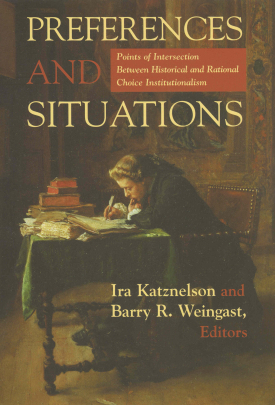
Preferences and Situations
About This Book
"Preferences and Situations seeks to stimulate and promote mutual engagement between historical and rational choice institutionalisms. This is a great idea, and it is masterfully executed in a volume that features contributions by some of the leading lights from both traditions."
-KATHLEEN THELEN, Payson S. Wild Professor of Political Science, Northwestern University, and chair, Council for European Studies
"Preferences and Situations addresses those sectors of political science concerned with both theory building and the empirical applications of theoretical approaches. The editors provide a heroic synthesis of both the rational and historical institutionalist persuasions, pointing out where they triangulate on institutions and preferences and presenting a wide range of exemplars of the best work from both camps. Both sets of contributions are accessible to adherents of the other camp and avoid the paradigm warfare that often passes for debate in the social sciences. Preferences and Situations will go far to advance the integration of contemporary approaches in political science and beyond."
-SIDNEY TARROW, Maxwell M. Upson Professor of Government, Cornell University
"In Preferences and Situations Ira Katznelson and Barry R. Weingast assemble a top group of schol ars to address a central question in the social sciences: how does social context influence prefer ences? The provocative intuition that drives this volume is that fruitful answers can be produced by fostering an engagement between two approaches that are often considered at odds with one another-historical and rational choice institutionalism. The results are quite impressive. By iden tifying an array of ways in which context can affect preferences, the contributors to this volume provide a useful framework for future research that highlights the complementary strengths of the two approaches. Preferences and Situations constitutes a significant advance in our understanding of this complex question."
-JACK KNIGHT, Sidney W. Souers Professor of Government in Arts and Sciences, Washington University
A scholarly gulf has tended to divide historians, political scientists, and social movement theorists on how people develop and act on their preferences. Rational choice scholars assumed that people—regardless of the time and place in which they live—try to achieve certain goals, like maximizing their personal wealth or power. In contrast, comparative historical scholars have emphasized historical context in explaining people’s behavior. Recently, a common emphasis on how institutions—such as unions or governments—influence people’s preferences in particular situations has emerged, promising to narrow the divide between the two intellectual camps. In Preferences and Situations, editors Ira Katnelson and Barry Weingast seek to expand that common ground by bringing together an esteemed group of contributors to address the ways in which institutions, in their wider historical setting, induce people to behave in certain ways and steer the course of history.
The contributors examine a diverse group of topics to assess the role that institutions play in shaping people’s preferences and decision-making. For example, Margaret Levi studies two labor unions to determine how organizational preferences are established. She discusses how the individual preferences of leaders crystallize and become cemented into an institutional culture through formal rules and informal communication. To explore how preferences alter with time, David Brady, John Ferejohn, and Jeremy Pope examine why civil rights legislation that failed to garner sufficient support in previous decades came to pass Congress in 1964. Ira Katznelson reaches back to the 13th century to discuss how the institutional development of Parliament after the signing of the Magna Carta led King Edward I to reframe the view of the British crown toward Jews and expel them in 1290.
The essays in this book focus on preference formation and change, revealing a great deal of overlap between two schools of thought that were previously considered mutually exclusive. Though the scholarly debate over the merits of historical versus rational choice institutionalism will surely rage on, Preferences and Situations reveals how each field can be enriched by the other.
IRA KATZNELSON is Ruggles Professor of Political Science and History at Columbia University.
BARRY R. WEINGAST is a senior fellow at the Hoover Institution and the Ward C. Krebs Family Professor in the Department of Political Science at Stanford University.
CONTRIBUTORS: Richard Bensel, David W. Brady, Charles M. Cameron, Jon Elster, John A. Ferejohn, Peter A. Hall, James Johnson, Margaret Levi, James Mahoney, Jeremy C. Pope.