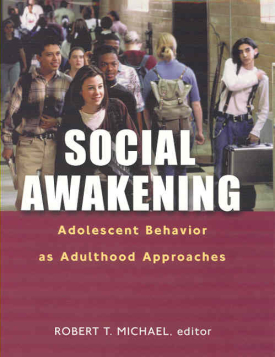
Social Awakening
About This Book
"Michael and his colleagues make significant contributions to the field of youth development and to our understanding of the background for the complex transition from youth to adulthood. The authors take a rich data source and bring sophisticated statistical techniques to bear on it. The refinement of family structure measures and the multiplicity of youth outcomes examined add tremendously to a field where many studies treat family simplistically and speak only to a single issue. The volume will serve as the necessary starting point for further analyses of the 1997 National Longitudinal Survey of Youth as the cohort ages. It will also contribute to current policy discussions on how families and society help -- and sometimes hinder -- the transition to adulthood."
-MATTHEW W. STAGNER, The Urban Institute
"This fascinating volume examines the determinants of such adolescent behaviors as. discretionary time use, sexual activity, expectations regarding future fertility outcomes, dating, use of alcohol and marijuana, and criminal activity from the perspectives of economics, sociology, and other social sciences. It contains a rich set of extremely valuable analyses and insights for practitioners of these disciplines, policy makers, and the population at large. Robert T. Michael is to be congratulated for assembling this collection of papers based on the 1997 National Longitudinal Survey of Youth and for his penetrating introduction to the key issues addressed."
-MICHAEL GROSSMAN, City University of New York
While headlines about violent crimes committed by adolescents often capture the public's attention, many more young people excel in the classroom, on the athletic field, and in the community. Why do some youngsters strive to achieve while others court disaster? Using new data from the National Longitudinal Survey of Youth (NLSY), a survey of more than nine thousand young people between the ages of twelve and sixteen, Social Awakening explores the choices adolescents make about their lives and their futures. The book focuses on the key role the family plays as teenagers navigate the difficult transition from childhood to adulthood.
Social Awakening analyzes a wide range of adolescent behavior and issues that affect teenagers' lives—from their dating and sexual behavior, drug and alcohol use, and physical and mental well-being, to their career goals and expectations for the future. The findings strengthen our understanding of how an array of family characteristics—single parenthood, income, educational level, race, and geographical location—influences teens' lives. One contributor explores why children from single-parent families are more likely to perform poorly in school and to indulge in risky behavior, such as drug abuse or promiscuous sexual activity. Another chapter examines why children of parents with a college degree are less likely to engage in early sexual activity. And another looks at different levels of criminal behavior among urban and rural youths.
One of the advantages of an in-depth interview such as the NLSY is the wide array of behavior and experiences by the same youths that can be mutually investigated. The analysis in Social Awakening helps confirm or refute what we think we know—to explore what we could not explore with older or less complex surveys. The NLSY, which forms the foundation of Social Awakening, will be updated annually over the coming decades to enable experts to learn how those who were adolescents at the dawn of the twenty-first century handled the move to adulthood. Social Awakening provides a compelling first look at these young peoples' lives.
ROBERT T. MICHAEL is Elkiam Hastings Moore Distinguished Service Professor and dean of the Irving B. Harris Graduate School of Public Policy Studies, University of Chicago.
CONTRIBUTORS: Yasuo Abe, Laura M. Argys, Courtney Bickert, John Cawley, Pinka Chatterji, Jeff Dominitz, Baruch Fischoff, Diane Gibson, Charles F. Manski, Mignon R. Moore, H. Elizabeth Peters, Charles R. Pierret, Robin L. Tepper, James R. Walker, L. Susan Williams.