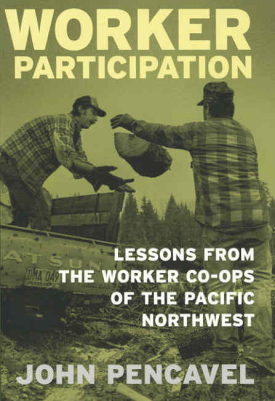
Worker Participation
About This Book
"The story is set in the thick forests of the Pacific Northwest, but the lessons about worker participation in decision-making and ownership are universal. Pencavel's rigorous, relevant, and engaging analysis will enrich tremendously our understanding of employee involvement at the workplace. This little book, rich in theory, history, and data, is not to be missed."
-Avner Ben-Ner, University of Minnesota
"Worker Participation is the most comprehensive and careful theoretical and empirical treatment to date of the issues relating to employee ownership of companies. Readers interested in polemics will have to look elsewhere. Although Pencavel clearly tells readers his own biases, he very carefully separates them from his dispassionate analyses of worker participation in corporate ownership and governance. Written in a style that is easily accessible to a general audience, the book builds on over a decade's research by Pencavel and his collaborators. Worker Participation is a book that I would be very proud to have been able to call my own."
-Ronald G. Ehrenberg, Cornell University
"Worker Participation is a fascinating mixture of economic and historical analysis of how cooperatives work in a near-ideal situation for worker participation. Biologists often search for the ideal "model"-fruitflies, yeast, ants-to understand general processes, but economists rarely do. Pencavel's analysis shows the power of such a procedure. He gives convincing support for the general model of worker-owned enterprises as income maximizers for members in the Northwest plywood sector, both in the statistics and case analysis."
-Richard B. Freeman, Harvard University
Once they accept a job, most Americans have little control over their work environments. In Worker Participation, John Pencavel examines some of those rare workplaces where employees both own and manage the companies they work for: the plywood cooperatives and forest worker cooperatives of the Pacific Northwest. Rather than relying on abstract theories, Pencavel reviews the actual experiences of these two groups of worker co-ops. He focuses on how worker-owned companies perform when compared to more traditional firms and whether companies operate more efficiently when workers determine how they are run. He also looks at the long-term viability of these enterprises and why they are so unusual.
Most businesses are constantly caught in the battle over whether to use the firm's profits to pay labor or to increase capital. Worker cooperatives provide an appealing case study because the interests of labor and capital are aligned. If individuals have a role in setting goals, they should have an added incentive to help meet those goals, and productivity should benefit. On the other hand, observers have long argued that, since any single employee in a co-op reaps only a small benefit from working hard, workers may shirk work, and productivity can flag. Furthermore, co-ops often have difficulty raising capital, since they are constrained by how much money the workers have, and banks are often reluctant to lend them money.
Using some fifteen years of data on forty mills in Washington State, Pencavel examines how worker co-ops really function. He assesses the practical problems of running a workplace where every employee is a boss. He looks at worker productivity, on-the-job injuries and financial risks facing owner-workers. He considers whether co-ops are inherently unstable and if they are plagued by infighting among the many worker-owners.
Although many of the co-ops he studied have closed or been replaced by conventional businesses, Pencavel judges them to have been a success. Despite the risks inherent in such operations, allowing workers to make the decisions that profoundly affect them produces many benefits, including workplace efficiency and increased job security. However, Pencavel concludes, if more Americans are to enjoy such a working arrangement, labor laws will have to be changed, participation encouraged, and a more vigorous public debate about worker participation must take place. This book provides an excellent place to start the discussion.
JOHN PENCAVEL is Levin Professor of Economics, Stanford University.