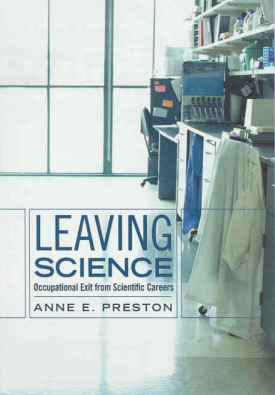
Leaving Science
About This Book
"We need you, Madame Curie. Please don't leave. This is a compelling study of why women leave science. It links qualitative and quantitative evidence in a way that is social science at its best. It explains why women exit science more than men and suggests ways to remedy this problem. Leaving Science should be read by everyone concerned with maintaining a healthy U.S. science work force, from the science advisor to the president to members of for the American Association for the Advancement of Science."
-RICHARD B. FREEMAN, Herbert Ascherman Chair in Economics, Harvard University
"Leaving Science provides an exceedingly thorough examination of factors leading individuals to exit science. It is a must read for anyone concerned with the United States' capacity to continue to innovate, especially given recent events that discourage the entrance of foreign- born and foreign-trained into U.S. science. Anne Preston's focus on retention reminds the reader that the pipeline in is only half of the story. A vibrant scientific workforce depends on retaining those already trained, as well as recruiting new talent to science. Preston's analysis of factors leading to exit is well crafted. The combination of recounting interview data with a careful analysis of survey data provides a rich framework for exploring why individuals leave science and how exit factors vary by gender."
-PAULA STEPHAN, professor of economics, Andrew Young School of Policy Studies, Georgia State University
"Leaving Science is fascinating. It is rich social science, augmenting statistical analysis with interviews and individual work histories and applying these insights to policy. I hope that it will be widely read by academic administrators and research managers, as well as by experts on the scientific and engineering workforce. The picture it presents of why men and women leave science is highly nuanced, but there are lessons to be learned by everyone involved in managing and living scientific careers."
-CHARLOTTE KUH, deputy executive director, Policy and Global Affairs Division, The National Academies
The past thirty years have witnessed a dramatic decline in the number of U.S. students pursuing advanced degrees in science and an equally dramatic increase in the number of professionals leaving scientific careers. Leaving Science provides the first significant examination of this worrisome new trend. Economist Anne E. Preston examines a wide range of important questions: Why do professionals who have invested extensive time and money on a rigorous scientific education leave the field? Where do these scientists go and what do they do? What policies might aid in retaining and improving the quality of life for science personnel?
Based on data from a large national survey of nearly 1,700 people who received university degrees in the natural sciences or engineering between 1965 and 1990 and a subsequent in-depth follow-up survey, Leaving Science provides a comprehensive portrait of the career trajectories of men and women who have earned science degrees. Alarmingly, by the end of the follow-up survey, only 51 percent of the original respondents were still working in science. During this time, federal funding for scientific research decreased dramatically relative to private funding. Consequently, the direction of scientific research has increasingly been dictated by market forces, and many scientists have left academic research for income and opportunity in business and industry. Preston identifies the main reasons for people leaving scientific careers as dissatisfaction with compensation and career advancement, difficulties balancing family and career responsibilities, and changing professional interests. Highlighting the difference between male and female exit patterns, Preston shows that most men left because they found scientific salaries low relative to perceived alternatives in other fields, while most women left scientific careers in response to feelings of alienation due to lack of career guidance, difficulty relating to their work, and insufficient time for their family obligations.
Leaving Science contains a unique blend of rigorous statistical analysis with voices of individual scientists, ensuring a rich and detailed understanding of an issue with profound consequences for the nation's future. A better understanding of why professionals leave science can help lead to changes in scientific education and occupations and make the scientific workplace more attractive and hospitable to career men and women.
ANNE E. PRESTON is associate professor of economics at Haverford College, Pennsylvania.