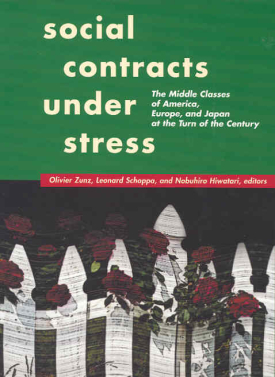
Social Contracts Under Stress
About This Book
"Bringing together a team of internationally known social scientists and historians, Social Contracts Under Stress exam ines the expansion of the middle classes in the United States, Western Europe, and Japan, as well as the problems that the universalist promise of the post-1945 'democratization of wealth' ran into in later decades. A truly outstanding anthology that convinces by virtue of its intellectual rigor and cohesion-and its timeliness-as the industrialized nations face the age-old social contract question, but this time on a global scale."
-Volker R. Berghahn, Columbia University
"It is rare that a single volume covers so important a theme across so wide a swath of nations at so high a level of analysis. This book explores the postwar social contract as it comes under increasing strain at the turn of our own century. The growth of the middle class-above all the turning of former proletarians into members of the bourgeoisie-was the social and political basis of postwar stability and democracy. This process, though similar across the industrialized world, took different inflections in various nations: from the the European focus on redistribution and social welfare, through the North American liberalist concern with consumer society, to the Japanese solution whereby exporting industries earned the wherewithal that allowed inefficient modes of production to continue, cushioning the hard social choices that would have been necessary in its absence. In our own day, however, this social contract has been challenged: by issues of race and gender and, above all, by globalization and the hard social choices it requires. It is such problems, at the core of contemporary political dilemmas, that these essays address with vision, rigor, and coherence."
-Peter Baldwin, University of California, Los Angeles
The years following World War II saw a huge expansion of the middle classes in the world's industrialized nations, with a significant part of the working class becoming absorbed into the middle class. Although never explicitly formalized, it was as though a new social contract called for government, business, and labor to work together to ensure greater political freedom and more broadly shared economic prosperity. For the most part, they succeeded. In Social Contracts Under Stress, eighteen experts from seven countries examine this historic transformation and look ahead to assess how the middle class might fare in the face of slowing economic growth and increasing globalization.
The first section of the book focuses on the differing experiences of Germany, Britain, France, the United States, and Japan as they became middle-class societies. The British working classes, for example, were slowest to consider themselves middle class, while in Japan by the 1960s, most workers had abandoned working-class identity. The French remain more fragmented among various middle classes and resist one homogenous entity. Part II presents compelling evidence that the rise of a huge middle class was far from inclusive or free of social friction. Some contributors discuss how the social contract reinforced long-standing prejudices toward minorities and women. In the United States, Ira Katznelson writes, Southern politicians used measures that should have promoted equality, such as the GI bill, to exclude blacks from full access to opportunity. In her review of gender and family models, Chiara Saraceno finds that Mediterranean countries have mobilized the power of the state to maintain a division of labor between men and women. The final section examines what effect globalization might have on the middle class. Leonard Schoppa's careful analysis of the relevant data shows how globalization has pushed "less skilled workers down and more skilled workers up out of a middle class that had for a few decades been home to both." Although Europe has resisted the rise of inequality more effectively than the United States or Japan, several contributors wonder how long that resistance can last.
Social Contracts Under Stress argues convincingly that keeping the middle class open and inclusive in the face of current economic pressures will require a collective will extending across countries. This book provides an invaluable guide for assessing the issues that must be considered in such an effort.
OLIVIER ZUNZ is Commonwealth Professor of History, University of Virginia.
LEONARD SCHOPPA is associate professor in the Woodrow Wilson Department of Government and Foreign Affairs, University of Virginia.
NOBUHIRO HIWATARI is professor of political science at the University of Tokyo.