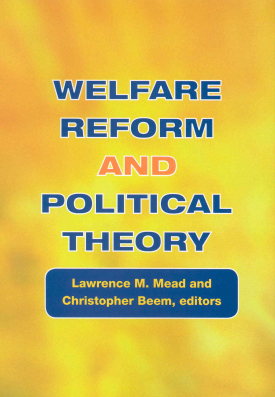
Welfare Reform and Political Theory
About This Book
"The welfare reform law of 1996 required mothers to work in exchange for their welfare benefits. At least a million mothers, previously dependent on welfare, went to work. But the story does not end there. By requiring work of some citizens, the new law revived timeless questions about whether poor citizens are entitled to welfare, whether government has the right to require work, and whether government should make invidious distinctions directed at those who don't work or don't live in accord with widely-held values such as marriage before parenthood. Welfare Reform and Political Theory is by far the most complete treatment of these and related value issues, with all points of view well-sometimes brilliantly-represented."
-RON HASKINS, senior fellow, Brookings Institution
"Christopher Beem, Lawrence M. Mead, and their contributors prove that it is possible for people on both sides of the debate about welfare reform to talk civilly to one another. Each of these essays presents a powerful and multifaceted argument, illuminating an array of connected issues about need, citizenship, virtue, responsibility, and exploitation. Each of them engages in detail with arguments on the other side. Welfare Reform and Political Theory is a fine collection, and it should be required reading for anyone who wants to deepen their thought about these issues."
-JEREMY WALDRON, University Professor and director, Center for Law and Philosophy, Columbia Law School
During the 1990s, both the United States and Britain shifted from entitlement to work-based systems for supporting their poor citizens. Much research has examined the implications of welfare reform for the economic well-being of the poor, but the new legislation also affects our view of democracy—and how it ought to function. By eliminating entitlement and setting behavioral conditions on aid, welfare reform challenges our understanding of citizenship, political equality, and the role of the state. In Welfare Reform and Political Theory, editors Lawrence Mead and Christopher Beem have assembled an accomplished list of political theorists, social policy experts, and legal scholars to address how welfare reform has affected core concepts of political theory and our understanding of democracy itself.
Welfare Reform and Political Theory is unified by a common set of questions. The contributors come from across the political spectrum, each bringing different perspectives to bear. Carole Pateman argues that welfare reform has compromised the very tenets of democracy by tying the idea of citizenship to participation in the marketplace. But William Galston writes that American citizenship has in some respects always been conditioned on good behavior; work requirements continue that tradition by promoting individual responsibility and self-reliance—values essential to a well-functioning democracy. Desmond King suggests that work requirements draw invidious distinctions among citizens and therefore destroy political equality. Amy Wax, on the other hand, contends that ending entitlement does not harm notions of equality, but promotes them, by ensuring that no one is rewarded for idleness. Christopher Beem argues that entitlement welfare served a social function—acknowledging the social value of care—that has been lost in the movement towards conditional benefits. Stuart White writes that work requirements can be accepted only subject to certain conditions, while Lawrence Mead argues that concerns about justice must be addressed only after recipients are working. Alan Deacon is well to the left of Joel Schartz, but both say government may actively promote virtue through social policy—a stance some other contributors reject.
The move to work-centered welfare in the 1990s represented not just a change in government policy, but a philosophical change in the way people perceived government, its functions, and its relationship with citizens. Welfare Reform and Political Theory offers a long overdue theoretical reexamination of democracy and citizenship in a workfare society.
LAWRENCE M. MEAD is professor of politics at New York University.
CHRISTOPHER BEEM is a program officer at The Johnson Foundation.
CONTRIBUTORS: Alan Deacon, William A. Galston, Desmond King, Carole Pateman, Joel Schwartz, Amy L. Wax, Stuart White.