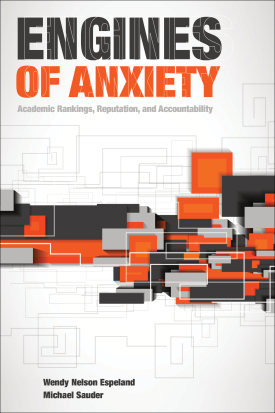
Cover image of the book Engines of Anxiety
Books

Engines of Anxiety

Academic Rankings, Reputation, and Accountability
Authors
Wendy Nelson Espeland
Michael Sauder
Paperback
$35.00
Add to Cart
Publication Date
6 in. × 9 in. 294 pages
ISBN
978-0-87154-427-8
Also Available From

About This Book

Winner of the Midwest Sociological Society's 2018 Distinguished Book Award 

Honorable Mention for the 2017 Distinguished Book Award from the Sociology of Law Section of the American Sociological Association

Honorable Mention for the 2017 Max Weber Award for Distinguished Scholarship from the Organizations, Occupations, and Work Section of the American Sociological Association

Engines of Anxiety is essential reading for anyone involved in legal education or considering a career in law. In this meticulously researched book, Wendy Espeland and Michael Sauder show how media rankings have profound and harmful effects  on  how  administrators  admit  students,  deans  allocate  resources, and employers select applicants. The book’s powerful take-away is that, if law school was once  an  equalizer,  offering  a  gateway  to  career  opportunities  and  social  advancement  for  people  of  modest means, today it serves to entrench the wealth inequality and status hierarchy that permeate American society.”

—Tanina Rostain, Professor of Law, Georgetown University Law Center

“This splendid book unmasks the power of ostensibly objective rankings, showing how metrics create social hierarchies. Even though our collective enthusiasm for rankings seems closely tethered to America’s populist yearnings, scholars and consumers alike will be staggered at Wendy Espeland and Michael Sauder’s superb analysis of how profoundly transformative these metrics have become.”

—Walter W. Powell, Professor of Education and (by courtesy) Sociology, Organizational Behavior,Management Science and Engineering, Communication, and Public Policy, Stanford University

Engines of Anxiety is one of these rare books that will profoundly reshape how we think of contemporary higher education and organizational life more generally. Wendy Espeland and Michael Sauder provide a magisterial demonstration of how the quantification of performance is revolutionizing our world on so many dimensions. Their book is a ‘must-read’ for anyone concerned with some of the most important questions we face in our hyper-competitive world, namely: what is success, how can we achieve it, and how can we insure that multiple forms of excellence continue to flourish side by side.”

Michèle Lamont, Robert I. Goldman Professor of European Studies, Professor of Sociology and African and African-American Studies, Harvard University

Students and the public routinely consult various published college rankings to assess the quality of colleges and universities and easily compare different schools. However, many institutions have responded to the rankings in ways that benefit neither the schools nor their students. In Engines of Anxiety, sociologists Wendy Espeland and Michael Sauder delve deep into the mechanisms of law school rankings, which have become a top priority within legal education. Based on a wealth of observational data and over 200 in-depth interviews with law students, university deans, and other administrators, they show how the scramble for high rankings has affected the missions and practices of many law schools.

Engines of Anxiety tracks how rankings, such as those published annually by the U.S. News & World Report, permeate every aspect of legal education, beginning with the admissions process. The authors find that prospective law students not only rely heavily on such rankings to evaluate school quality, but also internalize rankings as expressions of their own abilities and flaws. For example, they often view rejections from “first-tier” schools as a sign of personal failure. The rankings also affect the decisions of admissions officers, who try to balance admitting diverse classes with preserving the school’s ranking, which is dependent on factors such as the median LSAT score of the entering class. Espeland and Sauder find that law schools face pressure to admit applicants with high test scores over lower-scoring candidates who possess other favorable credentials.

Engines of Anxiety also reveals how rankings have influenced law schools’ career service departments. Because graduates’ job placements play a major role in the rankings, many institutions have shifted their career-services resources toward tracking placements, and away from counseling and network-building. In turn, law firms regularly use school rankings to recruit and screen job candidates, perpetuating a cycle in which highly ranked schools enjoy increasing prestige. As a result, the rankings create and reinforce a rigid hierarchy that penalizes lower-tier schools that do not conform to the restrictive standards used in the rankings. The authors show that as law schools compete to improve their rankings, their programs become more homogenized and less accessible to non-traditional students.

The ranking system is considered a valuable resource for learning about more than 200 law schools. Yet, Engines of Anxiety shows that the drive to increase a school’s rankings has negative consequences for students, educators, and administrators and has implications for all educational programs that are quantified in similar ways.

Wendy Nelson Espeland is professor of sociology at Northwestern University.

Michael Sauder is associate professor of sociology at the University of Iowa.

RSF Journal
View Book Series
Sign Up For Our Mailing List
Apply For Funding
Cover image of the book Race, Class, and Affirmative Action
Books

Race, Class, and Affirmative Action

Author
Sigal Alon
Paperback
$37.50
Add to Cart
Publication Date
6 in. × 9 in. 348 pages
ISBN
978-0-87154-001-0
Also Available From

About This Book

“If you thought class-based affirmative action is the answer, think again. This provocative book, based on a rigorous study of current and historical trends in the United States and internationally, raises serious questions and challenges for both race- and class-based affirmative action policies. Bringing a timely and compelling perspective to the debate, Sigal Alon convincingly demonstrates what the most equitable admission solutions are for today.”

–Barbara Schneider, John A. Hannah University Distinguished Professor, Michigan State University

Race, Class, and Affirmative Action is an important book, which adopts an unusual and valuable international perspective, focusing on Israel and the United States. It is remarkably balanced and free of the abundance of cant too often found in American discussions of affirmative action. Equally noteworthy is Sigal Alon’s emphasis on evidence-based findings and her frank recognition that there is no ‘silver bullet.’ Trade-offs are unavoidable—between achieving significant representation of racial minorities in the most elite universities and achieving a broader diversity at affordable cost. Neither class-based affirmative action (in any number of guises) nor a well-crafted race-sensitive policy is, in and of itself, a cure-all. Alon is to be commended for her practical, realis - tic, and hard-headed approach to a topic that needs precisely those qualities.”

–William G. Bowen, president emeritus, The Andrew W. Mellon Foundation

“In her new book, Race, Class, and Affirmative Action, Sigal Alon offers a powerful comparative analysis which opens new approaches to assess the structural determinants of disadvantage, yielding new strategies for productive policy development. Her insights open our thinking for forward movement in the United States, but also for other countries such as Brazil, India, and South Africa which are struggling with similar challenges.”

–Ann Marcus, professor and director, The Steinhardt Institute for Higher Education Policy, New York University

No issue in American higher education is more contentious than that of race-based affirmative action. In light of the ongoing debate around the topic and recent Supreme Court rulings, affirmative action policy may be facing further changes. As an alternative to race-based affirmative action, some analysts suggest affirmative action policies based on class. In Race, Class, and Affirmative Action, sociologist Sigal Alon studies the race-based affirmative action policies in the United States and the class-based affirmative action policies in Israel. Alon evaluates how these different policies foster campus diversity and socioeconomic mobility by comparing the Israeli policy with a simulated model of race-based affirmative action and the U.S. policy with a simulated model of class-based affirmative action.

Alon finds that affirmative action at elite institutions in both countries is a key vehicle of mobility for disenfranchised students, whether they are racial and ethnic minorities or socioeconomically disadvantaged. Affirmative action improves their academic success and graduation rates and leads to better labor market outcomes. The beneficiaries of affirmative action in both countries thrive at elite colleges and in selective fields of study. As Alon demonstrates, they would not be better off attending less selective colleges instead.

Alon finds that Israel’s class-based affirmative action programs have provided much-needed entry slots at the elite universities to students from the geographic periphery, from high-poverty high schools, and from poor families. However, this approach has not generated as much ethnic diversity as a race-based policy would. By contrast, affirmative action policies in the United States have fostered racial and ethnic diversity at a level that cannot be matched with class-based policies. Yet, class-based policies would do a better job at boosting the socioeconomic diversity at these bastions of privilege. The findings from both countries suggest that neither race-based nor class-based models by themselves can generate broad diversity. According to Alon, the best route for promoting both racial and socioeconomic diversity is to embed the consideration of race within class-based affirmative action. Such a hybrid model would maximize the mobility benefits for both socioeconomically disadvantaged and minority students.

Race, Class, and Affirmative Action moves past political talking points to offer an innovative, evidence-based perspective on the merits and feasibility of different designs of affirmative action.

SIGAL ALON is an associate professor in the Department of Sociology and Anthropology at Tel-Aviv University.

RSF Journal
View Book Series
Sign Up For Our Mailing List
Apply For Funding
Cover image of the book Parents Without Papers
Books

Parents Without Papers

The Progress and Pitfalls of Mexican American Integration
Authors
Frank D. Bean
Susan K. Brown
James D. Bachmeier
Paperback
$37.50
Add to Cart
Publication Date
6 in. × 9 in. 304 pages
ISBN
978-0-87154-042-3
Also Available From

About This Book

Winner of the 2016 Otis Dudley Duncan Award for Outstanding Scholarship in Social Demography

Honorable Mention, 2016 Thomas and Znaniecki Award from the International Migration Section of the American Sociological Association

Parents Without Papers exposes the effects of legal status on immigrants’ life chances, which persist over generations. Through carefully collected data, meticulous analysis, and theoretical acuity, the authors offer a sobering account of the injurious consequences of an undocumented status on long-term patterns of immigrant integration, making a unique and significant contribution to immigration scholarship. Their findings also have much to offer for policy, making a compelling case for the legalization of undocumented immigrants to ensure a better future for the immigrants themselves and for the country as a whole.”

—CECILIA MENJÍVAR, Cowden Distinguished Professor, Arizona State University

Parents Without Papers is a major contribution to our understanding of immigrant incorporation and Mexican American mobility. Conceptually, theoretically, and empirically it shows the multifaceted impact that ‘illegal’ status has on Mexican American communities including immigrants and the native born second and third generations. The volume will become essential to scholars and policy makers seriously concerned about immigrant policy. “

—RODOLFO O. DE LA GARZA, Eaton Professor of Administrative Law and Municipal Science, Columbia University

For several decades, Mexican immigrants in the United States have outnumbered those from any other country. Though the economy increasingly needs their labor, many remain unauthorized. In Parents Without Papers, immigration scholars Frank D. Bean, Susan K. Brown, and James D. Bachmeier document the extent to which the outsider status of these newcomers inflicts multiple hardships on their children and grandchildren. Parents Without Papers provides both a general conceptualization of immigrant integration and an in-depth examination of the Mexican American case. The authors draw upon unique retrospective data to shed light on three generations of integration. They show in particular that the “membership exclusion” experienced by unauthorized Mexican immigrants—that is, their fear of deportation, lack of civil rights, and poor access to good jobs—hinders the education of their children, even those who are U.S.-born. Moreover, they find that children are hampered not by the unauthorized entry of parents itself but rather by the long-term inability of parents, especially mothers, to acquire green cards. When unauthorized parents attain legal status, the disadvantages of the second generation begin to disappear. These second-generation men and women achieve schooling on par with those whose parents come legally. By the third generation, socioeconomic levels for women equal or surpass those of native white women. But men reach parity only through greater labor-force participation and longer working hours, results consistent with the idea that their integration is delayed by working-class imperatives to support their families rather than attend college. An innovative analysis of the transmission of advantage and disadvantage among Mexican Americans, Parents Without Papers presents a powerful case for immigration policy reforms that provide not only realistic levels of legal less-skilled migration but also attainable pathways to legalization. Such measures, combined with affordable access to college, are more important than ever for the integration of vulnerable Mexican immigrants and their descendants.

FRANK D. BEAN is Distinguished Professor of Sociology and Director of the Center for Research on International Migration at the University of California, Irvine.

SUSAN K. BROWN is associate professor of sociology at the University of California, Irvine.

JAMES D. BACHMEIER is assistant professor of sociology at Temple University.

RSF Journal
View Book Series
Sign Up For Our Mailing List
Apply For Funding

An increasing number of workers report that they have a hard time balancing work and personal and family life, and that this affects job satisfaction and productivity. Many factors help explain why the pressures of employment have been intensifying in recent decades. First, women from all socioeconomic classes have entered the labor force, reducing their time for work at home. This is especially the case for low-wage workers, and for single heads of household.

Cover image of the book Disasters
Books

Disasters

And the American Red Cross in Disaster Relief
Author
J. Byron Deacon
Ebook
Publication Date
229 pages

About This Book

A collection of principles and methods for the application of disaster relief, this book explains the essential problems present in a variety of calamities, as well as the procedures determined best to deal with them effectively, based on the experience of the American Red Cross.

J. BYRON DEACON was general secretary of the Philadelphia Society for Organizing Charity and division director of Civilian Relief for Pennsylvania.

RSF Journal
View Book Series
Sign Up For Our Mailing List
Apply For Funding
Cover image of the book Lawyers' Ethics
Books

Lawyers' Ethics

A Survey of the New York City Bar
Author
Jerome E. Carlin
Ebook
Publication Date
267 pages

About This Book

In this 1966 book, Jerome E. Carlin, who was both a lawyer and a sociologist, marshals persuasive evidence that many lawyers do not consistently adhere to the standards of ordinary honesty, still less to the special professional rules in the canons of legal ethics. It calls for new and tough questions about the way the practice of law is organized.

JEROME E. CARLIN was professor at the Bureau of Applied Social Research, Columbia University, and the Center for the Study of Law and Society, University of California, Berkeley.

RSF Journal
View Book Series
Sign Up For Our Mailing List
Apply For Funding
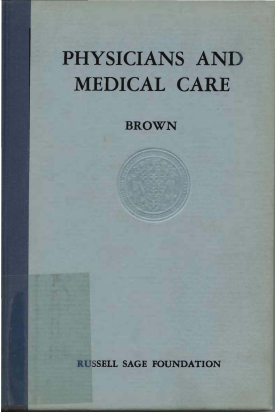
Cover image of the book Physicians and Medical Care
Books

Physicians and Medical Care

Author
Esther Lucile Brown
Ebook
Publication Date
203 pages

About This Book

Published in 1937 as part of a series of studies dealing with the status of emerging and established professions in the United States.

ESTHER LUCILE BROWN was director of the Department of Studies in the Professions at the Russell Sage Foundation.

RSF Journal
View Book Series
Sign Up For Our Mailing List
Apply For Funding
Cover image of the book Lawyers, Law Schools, and the Public Service
Books

Lawyers, Law Schools, and the Public Service

Author
Esther Lucile Brown
Ebook
Publication Date
259 pages

About This Book

Published in 1948, this book is concerned with how the law school may be more effective in educating the many law-trained students who will eventually go on to work as legislators, judges, and policy-making members in government, or who, as lawyers outside the government, will nevertheless exert large influence over it. One of the most important questions is whether government lawyers are inadvertent policy-makers, and if so, how they make policy.

ESTHER LUCILE BROWN was director of the Department of Studies in the Professions at the Russell Sage Foundation.

RSF Journal
View Book Series
Sign Up For Our Mailing List
Apply For Funding
Cover image of the book Collegiate Education for Nursing
Books

Collegiate Education for Nursing

Author
Margaret Bridgman
Ebook
Publication Date
206 pages

About This Book

In 1949, the Russell Sage Foundation instituted a counseling service for colleges and universities that wished to improve their existing schools of nursing or introduce new nursing curricula, headed by Dr. Margaret Bridgman. After visits to more than eighty colleges around the country, the National League of Nursing Education invited her to continue the work under the new National League for Nursing in 1952. This report presents her findings.

MARGARET BRIDGMAN was academic dean of Skidmore College.

RSF Journal
View Book Series
Sign Up For Our Mailing List
Apply For Funding
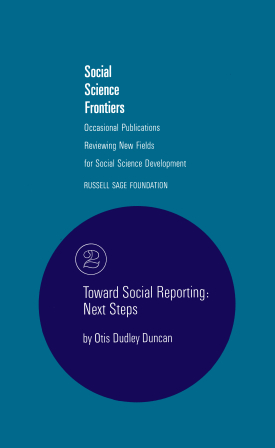
Cover image of the book Toward Social Reporting
Books

Toward Social Reporting

Next Steps
Author
Otis Dudley Duncan
Paperback
$21.95
Add to Cart
Publication Date
6 in. × 9.5 in. 50 pages
ISBN
978-0-87154-487-2

About This Book

A volume of Social Science Frontiers, a series of publications reviewing new fields for social development, aimed at foundation executives, administrators of research grant programs, directors of research organizations, and others concerned with making contemporary social science more useful for the function of social reporting.

OTIS DUDLEY DUNCAN was professor of sociology at the University of Wisconsin.

Download
RSF Journal
View Book Series
Sign Up For Our Mailing List
Apply For Funding