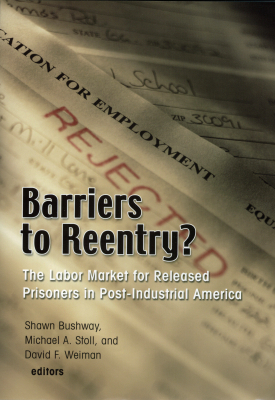
Cover image of the book Barriers to Reentry?
Books

Barriers to Reentry?

The Labor Market for Released Prisoners in Post-Industrial America
Editors
Shawn D. Bushway
Michael A. Stoll
David Weiman
Hardcover
$47.50
Add to Cart
Publication Date
6.63 in. × 9.25 in. 388 pages
ISBN
978-0-87154-087-4
Also Available From

About This Book

"In the last few years, there has emerged an animated national conversation about problems faced by-and posed by-people who have been to prison. Regardless of one's politics, we can all agree that we share an interest in discovering and enacting policies that will help the formerly incarcerated `make it.' But good policies require good data, and to date there has been a dearth of information to help us think realistically and critically about the circumstances facing people who leave prison. This important book fills a gap in our knowledge about the labor market prospects people returning from prison face, and it provides an invaluable foundation for the much-needed policy work in that area. The contributors are some of the most skilled social scientists working in the area, and the methods and data they use to shed light on this policy problem are uniquely suited to help advance our knowledge. Anyone who is interested in reentry will find Barriers to Reentry? a treasure trove of findings to spur their creative thinking."
-Todd R. Clear, Distinguished Professor of Criminal Justice, John Jay College of Criminal Justice, The City University of New York

"Hundreds of thousands of ex-offenders are released from prison every year. Most fare poorly. Employers hire them as a last resort, their employment and wage experience is poor, rehabilitation programs do too little, too late. Three quarters recividate. The compelling statistic analysis in Barriers to Reentry? shows that the United States should seek alternatives to the mass incarceration of nonviolent offenders."
-Richard B. Freeman, Herbert Ascherman Chair in Economics, Harvard University

"The chapters in this volume cut below the surface of the obvious correlation between incarceration and poor labor market outcomes to identify potential policy options and the groups in the population who will be most likely to benefit. As a whole, the book offers a thorough analysis of institutions driving labor markets for those with prison experience and criminal records. The evidence assembled is not generally optimistic about the prospects for improving labor market outcomes for those recently released from prison. For anyone working to improve the economic status of former inmates, Barriers to Reentry? is an invaluable analysis of the realities they must confront."
-Anne Piehl, associate professor of economics, Rutgers University

With the introduction of more aggressive policing, prosecution, and sentencing since the late 1970s, the number of Americans in prison has increased dramatically. While many have credited these “get tough” policies with lowering violent crime rates, we are only just beginning to understand the broader costs of mass incarceration. In Barriers to Reentry? experts on labor markets and the criminal justice system investigate how imprisonment affects ex-offenders’ employment prospects, and how the challenge of finding work after prison affects the likelihood that they will break the law again and return to prison.

The authors examine the intersection of imprisonment and employment from many vantage points, including employer surveys, interviews with former prisoners, and state data on prison employment programs and post-incarceration employment rates. Ex-prisoners face many obstacles to re-entering the job market—from employers’ fears of negligent hiring lawsuits to the lost opportunities for acquiring work experience while incarcerated. In a study of former prisoners, Becky Pettit and Christopher Lyons find that employment among this group was actually higher immediately after their release than before they were incarcerated, but that over time their employment rate dropped to their pre-imprisonment levels. Exploring the demand side of the equation, Harry Holzer, Steven Raphael, and Michael Stoll report on their survey of employers in Los Angeles about the hiring of former criminals, in which they find strong evidence of pervasive hiring discrimination against ex-prisoners. Devah Pager finds similar evidence of employer discrimination in an experiment in which Milwaukee employers were presented with applications for otherwise comparable jobseekers, some of whom had criminal records and some of whom did not. Such findings are particularly troubling in light of research by Steven Raphael and David Weiman which shows that ex-criminals are more likely to violate parole if they are unemployed. In a concluding chapter, Bruce Western warns that prison is becoming the norm for too many inner-city minority males; by preventing access to the labor market, mass incarceration is exacerbating inequality. Western argues that, ultimately, the most successful policies are those that keep young men out of prison in the first place.

Promoting social justice and reducing recidivism both demand greater efforts to reintegrate former prisoners into the workforce. Barriers to Reentry? cogently underscores one of the major social costs of incarceration, and builds a compelling case for rethinking the way our country rehabilitates criminals.

SHAWN BUSHWAY is professor of criminal justice at the University at Albany.

MICHAEL A. STOLL is professor of public policy at the University of California, Los Angeles.

DAVID F. WEIMAN is professor of economics at Barnard College, Columbia University.

CONTRIBUTORS: Shauna Briggs, Shawn Bushway, Harry J. Holzer, Vera Kachnowski, Jeffrey R. Kling, Christopher J. Lyons, Devah Pager, Becky Pettit, Steven Raphael, William J. Sabol, Michael A. Stoll, Faye Taxman, Meridith Thanner, John H. Tyler, Mischelle Van Brakle, Christy A. Visher, David F. Weiman, and Bruce Western

RSF Journal
View Book Series
Sign Up For Our Mailing List
Apply For Funding
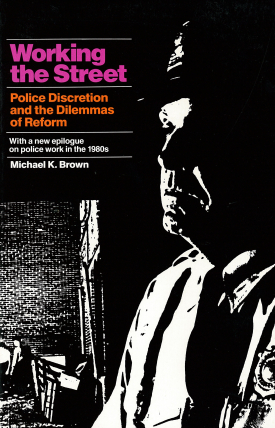
Cover image of the book Working the Street
Books

Working the Street

Police Discretion and the Dilemmas of Reform
Author
Michael K. Brown
Paperback
$28.95
Add to Cart
Publication Date
6 in. × 9 in. 392 pages
ISBN
978-0-87154-191-8
Also Available From

About This Book

Now available in paperback, this provocative study examines the street-level decisions made by police, caught between a sometimes hostile community and a maze of departmental regulations. Probing the dynamics of three sample police departments, Brown reveals the factors that shape how officers wield their powers of discretion. Chief among these factors, he contends, is the highly bureaucratic organization of the modern police department.

A new epilogue, prepared for this edition, focuses on the structure and operation of urban police forces in the 1980s.

"Add this book to the short list of important analyses of the police at work....Places the difficult job of policing firmly within its political, organizational, and professional constraints...Worth reading and thinking about." —Crime & Delinquency

"An excellent contribution...Adds significantly to our understanding of contemporary police." —Sociology

"A critical analysis of policing as a social and political phenomenon....A major contribution." —Choice

MICHAEL K. BROWN is emeritus professor of politics, University of California, Santa Cruz


RSF Journal
View Book Series
Sign Up For Our Mailing List
Apply For Funding
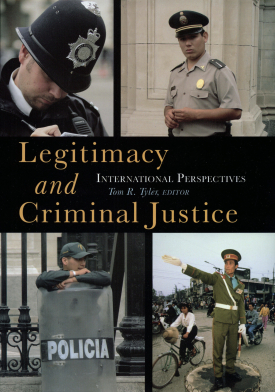
Cover image of the book Legitimacy and Criminal Justice
Books

Legitimacy and Criminal Justice

International Perspectives
Editors
Anthony Braga
Jeffrey Fagan
Tracey Meares
Robert Sampson
Tom R. Tyler
Chris Winship
Hardcover
Add to Cart
Publication Date
6 in. × 9 in. 408 pages
ISBN
978-0-87154-876-4
Also Available From

About This Book

"Over the last fifteen years or so research on legitimacy and procedural justice has made a decisive contribution to our understandings of policing, of the dynamics of compliance and, more generally, of people's encounters with authorities. In Legitimacy and Criminal Justice, Tom Tyler and a distinguished group of coeditors and contributors extend this discussion beyond its American stronghold and into the streets, legislatures, and political controversies of numerous other countries. This book issues the clearest possible clarion call for a new and genuinely comparative, international inquiry into the conditions of legitimacy and their relation to social order and social change around the world." 
-RICHARD SPARKS, University of Edinburgh

"I learned a lot from Legitimacy and Criminal Justice. The essays in it extend the application of Tom Tyler's path-breaking work on legitimacy and law enforcement procedures to legal systems in Europe, South Africa, and Latin America. They provide rich, detailed accounts of the ways in which members of the public interact with the police, the courts, and other institutions. And on that empirical basis, the authors are able to offer some very helpful reflections on the different ways in which legitimacy can be enhanced (as well as the various ways in which it can be undermined). This is a fine contribution to the socio-legal literature on legitimacy and I suspect, too, that it will become an indispensable resource for serious students of law enforcement."
-JEREMY WALDRON, New York University Law School

The police and the courts depend on the cooperation of communities to keep order. But large numbers of urban poor distrust law enforcement officials. Legitimacy and Criminal Justice explores the reasons that legal authorities are or are not seen as legitimate and trustworthy by many citizens.

Legitimacy and Criminal Justice is the first study of the perceived legitimacy of legal institutions outside the U.S. The authors investigate relations between courts, the police, and communities in the U.K., Western Europe, South Africa, Slovenia, South America, and Mexico, demonstrating the importance of social context in shaping those relations. Gorazd Meško and Goran Klemenčič examine Slovenia’s adoption of Western-style “community policing” during its transition to democracy. In the context of Slovenia’s recent Communist past—when “community policing” entailed omnipresent social and political control—citizens regarded these efforts with great suspicion, and offered little cooperation to the police. When states fail to control crime, informal methods of law can gain legitimacy. Jennifer Johnson discusses an extra-legal policing system carried out by farmers in Guerrero, Mexico—complete with sentencing guidelines and initiatives to reintegrate offenders into the community. Feeling that federal authorities were not prosecuting the crimes that plagued their province, the citizens of Guerrero strongly supported this extra-legal arrangement, and engaged in massive protests when the central government tried to suppress it. Several of the authors examine how the perceived legitimacy of the police and courts varies across social groups. Graziella Da Silva, Ignacio Cano, and Hugo Frühling show that attitudes toward the police vary greatly across social classes in harshly unequal societies like Brazil and Chile. And many of the authors find that ethnic minorities often display greater distrust toward the police, and perceive themselves to be targets of police discrimination. Indeed, Hans-Jöerg Albrecht finds evidence of bias in arrests of the foreign born in Germany, which has fueled discontent among Berlin’s Turkish youth. Sophie Body-Gendrot points out that mutual hostility between police and minority communities can lead to large-scale violence, as the Parisian banlieu riots underscored.

The case studies presented in this important new book show that fostering cooperation between law enforcement and communities requires the former to pay careful attention to the needs and attitudes of the latter. Forging a new field of comparative research, Legitimacy and Criminal Justice brings to light many of the reasons the law’s representatives succeed—or fail—in winning citizens’ hearts and minds.

ANTHONY BRAGA is a senior research associate at the Kennedy School of Government, Harvard University, and at the Berkeley Center for Criminal Justice at the University of California, Berkeley.

JEFFREY FAGAN is professor of law and public health at Columbia University, and director of the Center for Crime, Community and Law at Columbia Law School.

TRACEY MEARES is professor of law at Yale Law School.

ROBERT SAMPSON is Henry Ford II Professor of the Social Sciences at Harvard University.

TOM R. TYLER is University Professor of Psychology at New York University.

CHRIS WINSHIP is Diker-Tishman Professor of Sociology at Harvard University and also a member of the faculty of the Kennedy School of Government.

CONTRIBUTORS: Hans-Jorg Albrecht, Catrien Bijleveld, Sophie Body-Gendrot, Anthony Braga, John Braithwaite, Ignacio Cano, Jean Camaroff, John Camaroff, Jeffrey Fagan, Hugo Fruhling, Heike Goudriaan, Mike Hough, Jennifer L. Johnson, Goran Klemencic, Marijke Malsch, Tracey Meares, Gorazd Mesko, Graziella Moraes, Sebastian Roche, Robert Sampson, David J. Smith, Michael Tonry, Chris Winship.

A Volume in the Russell Sage Foundation Series on Trust

RSF Journal
View Book Series
Sign Up For Our Mailing List
Apply For Funding
Cover image of the book Dialectics of Legal Repression
Books

Dialectics of Legal Repression

Black Rebels Before the American Criminal Courts
Author
Isaac D. Balbus
Hardcover
Add to Cart
Publication Date
6 in. × 9 in. 288 pages
ISBN
978-0-87154-081-2
Also Available From

About This Book

Winner of the 1973 C. Wright Mills Award from the Society for the Study of Social Problems

Less than 2 percent of some 4000 adults prosecuted for participating in the bloodiest ghetto revolt of this generation served any time in jail as a result of their conviction and sentencing. Why? Why, in contrast, did the majority of those arrested following a brief and minor confrontation with police in a different city receive far harsher treatment than ordinarily meted out for comparable offenses in "normal" times? What do these incidents tell us about the nature of legal repression in the American state?

No coherent theory of political repression in the liberal state exists today. Neither the liberal view of repression as "anomaly" nor the radical view of repression as "fascist core" appears to come to grips with the distinctive characteristics of legal repression in the liberal state.

This book attempts to arrive at a more adequate understanding of these "distinctive characteristics" by means of a detailed analysis of the legal response to the most serious violent challenge to the existing political order since the Great Depression—the black ghetto revolts between 1964 and 1968.

Using police and court records, and extensive interviews with judges, defense attorneys, prosecutors, and detention officials, Professor Balbus provides a complete reconstruction of the response of the criminal courts of Los Angeles, Detroit, and Chicago to the "civil disorders" that occurred in these cities. What emerges is a disturbing picture of the relationship between court systems and participants and the local political environments in which they operate.

ISAAC D. BALBUS has been assistant professor of politics at Princeton University, and will join the faculty of York College of the City University of New York as associate professor of political science in the fall of 1973. He received his B.A. in Government from Colby College and his M.A. and Ph.D. in Political Science from the University of Chicago. He is the author of a number of articles on Marxism, Elitist Theory, and Pluralism.

RSF Journal
View Book Series
Sign Up For Our Mailing List
Apply For Funding