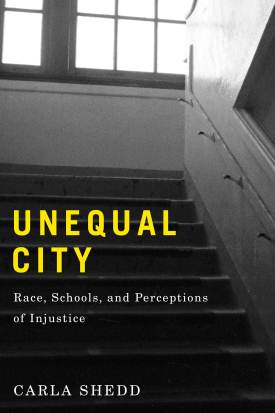
Cover image of the book Unequal City
Books

Unequal City

Race, Schools, and Perceptions of Injustice
Author
Carla Shedd
Paperback
$35.00
Add to Cart
Publication Date
6 in. × 9 in. 244 pages
ISBN
978-0-87154-796-5
Also Available From

About This Book

Winner of the 2016 C. Wright Mills Award from the Society for the Study of Social Problems

Winner of the 2016 Distinguished Contribution to Scholarship Book Award Presented by the American Sociological Association's Section on Race, Gender, and Class 

Honorable Mention, 2017 Outstanding Book Award from the Inequality, Poverty, and Mobility Section of the American Sociological Association

“Unequal City is a revelatory study that shows and tells how inner city young people struggle to acquire a decent education. It powerfully describes the everyday challenges these students face—illuminating how they navigate school and their local communities and the way they confront what too often holds them back. This book should be required reading for anyone who wants to understand the relationship between inequality and urban education.”

—Elijah Anderson, William K. Lanman, Jr. Professor of Sociology, Yale University

“Carla Shedd has written an important book about how race and place shape the experiences of young people in Chicago. Unequal City stands out for many reasons, but most importantly for its empirical richness. Shedd has amassed amazing data and uses both quantitative and qualitative methods to amplify the voices of young people. If you want to understand what young people think about such topics as the police, schools, and in-equality, you should read this book. It is a timely and insightful book.”

–Cathy Cohen, David and Mary Winton Green Professor of Political Science, University of Chicago

Chicago has long struggled with racial residential segregation, high rates of poverty, and deepening class stratification, and it can be a challenging place for adolescents to grow up. Unequal City examines the ways in which Chicago’s most vulnerable residents navigate their neighborhoods, life opportunities, and encounters with the law. In this pioneering analysis of the intersection of race, place, and opportunity, sociologist and criminal justice expert Carla Shedd illuminates how schools either reinforce or ameliorate the social inequalities that shape the worlds of these adolescents.

Shedd draws from an array of data and in-depth interviews with Chicago youth to offer new insight into this understudied group. Focusing on four public high schools with differing student bodies, Shedd reveals how the predominantly low-income African American students at one school encounter obstacles their more affluent, white counterparts on the other side of the city do not face. Teens often travel long distances to attend school which, due to Chicago’s segregated and highly unequal neighborhoods, can involve crossing class, race, and gang lines. As Shedd explains, the disadvantaged teens who traverse these boundaries daily develop a keen “perception of injustice,” or the recognition that their economic and educational opportunities are restricted by their place in the social hierarchy.

Adolescents’ worldviews are also influenced by encounters with law enforcement while traveling to school and during school hours. Shedd tracks the rise of metal detectors, surveillance cameras, and pat-downs at certain Chicago schools. Along with police procedures like stop-and-frisk, these prison-like practices lead to distrust of authority and feelings of powerlessness among the adolescents who experience mistreatment either firsthand or vicariously. Shedd finds that the racial composition of the student body profoundly shapes students’ perceptions of injustice. The more diverse a school is, the more likely its students of color will recognize whether they are subject to discriminatory treatment. By contrast, African American and Hispanic youth whose schools and neighborhoods are both highly segregated and highly policed are less likely to understand their individual and group disadvantage due to their lack of exposure to youth of differing backgrounds.

CARLA SHEDD is assistant professor of sociology and African American studies at Columbia University.


RSF Journal
View Book Series
Sign Up For Our Mailing List
Apply For Funding

The movement to hold schools "accountable," and debates about alternative schooling options, governance arrangements, and other educational reform efforts are all based on the assumption that school quality strongly influences its students’ educational outcomes. There is also a strong theoretical basis and some empirical support for expecting that a student’s neighborhood will influence his or her academic achievement.

Cover image of the book Lawyers and the Promotion of Justice
Books

Lawyers and the Promotion of Justice

Author
Esther Lucile Brown
Ebook
Publication Date
302 pages

About This Book

Lawyers and the Promotion of Justice, published in 1938, is part of a series dealing with the status of certain established or emerging professions in the United States. It focuses on the evolution of professional education and problems incident to it in regards to the field of law.

ESTHER LUCILE BROWN was director of the Department of Studies in the Professions at the Russell Sage Foundation.

RSF Journal
View Book Series
Sign Up For Our Mailing List
Apply For Funding
Cover image of the book Two Worlds of Childhood
Books

Two Worlds of Childhood

USA and USSR
Author
Urie Bronfenbrenner
Ebook
Publication Date
190 pages

About This Book

Two Worlds of Childhood is a cross-cultural study of child rearing and education in the U.S. and the Soviet Union, published in 1970. Bronfenbrenner conducted research in the Soviet Union to study child rearing in the family and collective settings.

URIE BRONFENBRENNER was professor of Psychology and of Child Development and Family Studies at Cornell University, and one of the founders of the Head Start Program.

RSF Journal
View Book Series
Sign Up For Our Mailing List
Apply For Funding
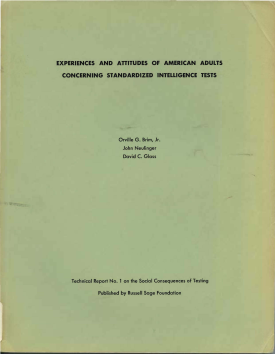
Cover image of the book Experiences and Attitudes of American Adults Concerning Standardized Intelligence Tests
Books

Experiences and Attitudes of American Adults Concerning Standardized Intelligence Tests

Technical Report No. 1 on the Social Consequences of Testing
Authors
Orville G. Brim, Jr.
John Neulinger
David C. Glass
Ebook
Publication Date
212 pages

About This Book

In 1962 the Russell Sage Foundation initiated a series of studies on the social consequences of standardized intelligence, aptitude, and achievement testing. This book presents the initial results from the series, focusing on the social impact of tests of intellectual abilities, based on questionnaire responses from adults across the United States.

ORVILLE G. BRIM was president of the Russell Sage Foundation.

JOHN NEULINGER was assistant professor of psychology at City College of the City University of New York.

DAVID C. GLASS was professor of psychology at New York University.

RSF Journal
View Book Series
Sign Up For Our Mailing List
Apply For Funding
Cover image of the book Collegiate Education for Nursing
Books

Collegiate Education for Nursing

Author
Margaret Bridgman
Ebook
Publication Date
206 pages

About This Book

In 1949, the Russell Sage Foundation instituted a counseling service for colleges and universities that wished to improve their existing schools of nursing or introduce new nursing curricula, headed by Dr. Margaret Bridgman. After visits to more than eighty colleges around the country, the National League of Nursing Education invited her to continue the work under the new National League for Nursing in 1952. This report presents her findings.

MARGARET BRIDGMAN was academic dean of Skidmore College.

RSF Journal
View Book Series
Sign Up For Our Mailing List
Apply For Funding
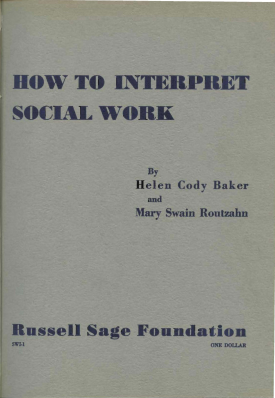
Cover image of the book How to Interpret Social Work
Books

How to Interpret Social Work

A Study Course
Authors
Helen Cody Baker
Mary Swain Routzahn
Ebook
Publication Date
90 pages

About This Book

Published in 1937 to serve as a course plan, How to Interpret Social Work focuses on how to talk about social work in a range of public spheres, from informal and familiar approaches to more formalized and skilled techniques needed in addressing the general public.

HELEN CODY BAKER was publicity director at the Council of Social Agencies of Chicago.

MARY SWAIN ROUTZAHN was director at the Department of Social Work Interpretation of the Russell Sage Foundation.

RSF Journal
View Book Series
Sign Up For Our Mailing List
Apply For Funding